How to Write SEO Content That Ranks
Crafting SEO content that ranks requires understanding search intent, thorough keyword research, and optimizing content for both users and search engines. Here’s the process in a nutshell:
- Keyword Research: Identify primary and long-tail keywords using tools like Ahrefs or SEMrush. Focus on terms with a balance of relevance, search volume, and low competition.
- Search Intent: Match your content to what users want - be it informational, navigational, commercial, or transactional queries.
- Content Structure: Use clear headings, short paragraphs, and bullet points for readability. Include related keywords naturally.
- On-Page SEO: Optimize title tags, meta descriptions, and headers. Use concise, keyword-rich URLs and descriptive image alt text.
- User Experience: Improve readability, ensure mobile-friendliness, and update content regularly to maintain relevance.
Key takeaway: SEO content isn’t just about keywords - it’s about delivering value and meeting user expectations. Start with solid research, create user-friendly content, and keep refining your approach to stay competitive.
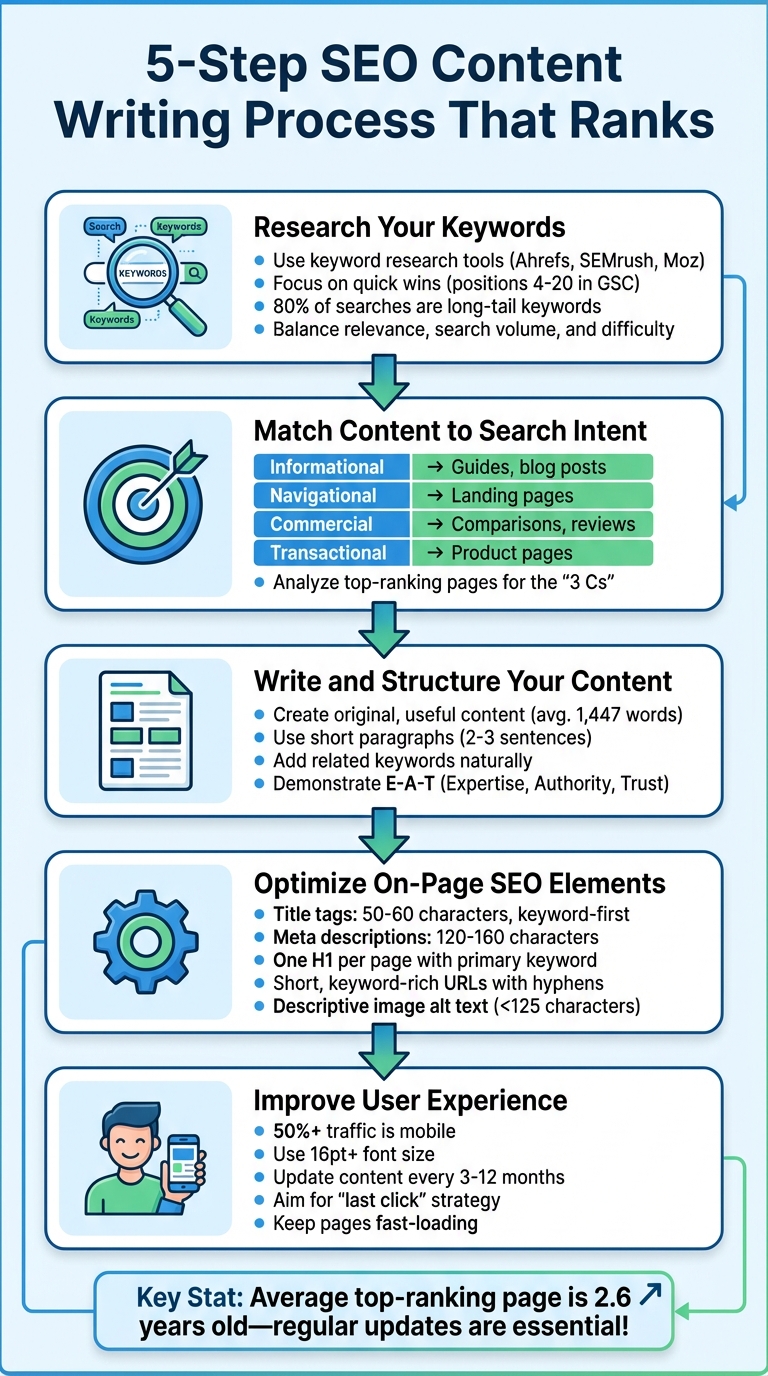
5-Step SEO Content Writing Process That Ranks
Content Writing for SEO: How to Create Content that Ranks in Google
sbb-itb-4f1eab7
Step 1: Research Your Keywords
Building a strong SEO content strategy starts with thorough keyword research. Without it, you're essentially guessing at what your audience wants. Greg Gifford, VP of Search at Search Lab, puts it perfectly:
"The biggest mistake I see people making with keyword research is simply not doing it... We're not simply matching keyword to keyword any more. We have to understand how potential customers are searching."
The process begins with seed keywords - basic terms directly linked to your business or topic. From there, you expand into broader keyword themes that reflect how users search online.
Use Keyword Research Tools
Keyword research tools are your best friend here. They provide insights into search volume, keyword difficulty, and organic click-through rates. Google Keyword Planner is a free option that can show historical trends, but its data often comes in broad ranges. For more precise information, tools like Ahrefs, SEMrush, and Moz are excellent choices. For example, Ahrefs alone tracks over 33 billion keywords, updating its data monthly.
Start by looking for "quick wins" in Google Search Console. Focus on keywords where your site already ranks in positions 4–20 and gets high impressions. Additionally, real-time tools like Google Autocomplete and the "People Also Ask" feature can help uncover long-tail phrases that users are actively searching for.
Another effective approach is competitor gap analysis. Tools like Ahrefs' Content Gap report can highlight keywords your competitors rank for but your site doesn’t. This method allows you to zero in on proven opportunities without wasting time on trial and error.
Choose Primary and Long-Tail Keywords
Here’s a key insight: about 20% of searches are broad, while 80% are long-tail queries. Long-tail keywords account for the majority of search traffic and are often easier to rank for because they face less competition and reflect more specific user intent. In fact, long-tail keywords make up nearly 80% of all search traffic.
To maximize your reach, target a broad primary keyword and group related long-tail variations into a cohesive keyword theme. Think of it as casting a wide net rather than aiming for a single target - you’ll capture more traffic this way.
When narrowing down your keywords, evaluate three factors: relevance to your business, search volume (how often the term is searched), and difficulty (how hard it is to rank for). The ideal keyword strikes a balance between high demand and low competition. If your site is new, focus on keywords with difficulty scores in the 20s or 30s to establish authority before moving on to more competitive terms.
Finally, don’t skip the step of analyzing search results for your target keywords. Search them on Google to see what types of content are performing well. This will give you a clear idea of what users expect and what you’ll need to create to compete effectively.
Next, we’ll dive into how to align your content with the search intent behind these keywords.
Step 2: Match Your Content to Search Intent
Once you've nailed down your keyword research, the next step is figuring out why users are searching for those terms. In other words, you need to understand the purpose behind their queries. Si Quan Ong from Ahrefs sums it up perfectly:
"To rank, align your content with search intent."
Google's entire mission revolves around delivering results that best match what users are looking for. If your content doesn’t align with their intent, it simply won’t rank. Nick Eubanks, Founder of NickEubanks.com, puts it bluntly:
"Without this consideration... an SEO could spend hoards of time, energy, and dollars investing in ranking for terms that will not deliver traffic."
To move forward, start by categorizing user queries into one of four main search intent types.
4 Types of Search Intent
Understanding these four intent types will help you craft content that meets user needs:
- Informational intent: The user is seeking knowledge or answers. For example, queries like "how to brew espresso" or "what is inbound marketing" fall into this category. These searches call for educational resources like guides, blog posts, or videos.
- Navigational intent: Here, the user is looking for a specific website or page. Examples include "Moz login" or "Ahrefs keywords explorer." For these queries, users expect to land on pages like homepages or specific landing pages.
- Commercial intent: This is when users are researching products or services but aren’t ready to buy yet. Searches like "best CRM software" or "top coffee beans" suggest they’re looking for comparisons, reviews, or listicles to help make a decision.
- Transactional intent: The user is ready to take action - usually to make a purchase. Keywords like "buy motorcycle jacket" or "espresso machine sale" indicate they’re looking for product pages or e-commerce listings.
Here’s a quick breakdown:
| Intent Type | User Goal | Example Keywords | Best Content Format |
|---|---|---|---|
| Informational | Learn or discover | "how to brew espresso", "northern lights" | Guides, blog posts, videos |
| Navigational | Find a specific site | "Moz login", "Ahrefs keywords explorer" | Landing pages, homepages |
| Commercial | Compare and research | "best CRM software", "top coffee beans" | Listicles, comparison tables, reviews |
| Transactional | Purchase or act | "buy motorcycle jacket", "espresso machine sale" | Product pages, e-commerce listings |
Once you understand the intent behind your target keywords, you can fine-tune your content strategy to meet those specific goals.
Create Content That Matches User Goals
Now that you’ve identified the intent behind your keywords, it’s time to align your content with what users actually want. Start by Googling your target keyword and analyzing the top-ranking pages. These pages have been tested and approved by millions of users, so they’re a great benchmark for what works.
Pay attention to the "3 Cs" of search intent:
- Content Type: Is the top content a blog post, a product page, or something else?
- Content Format: Are the top results how-to guides, listicles, or reviews?
- Content Angle: Does the content target beginners, experts, or a specific niche?
For example, if the top results for "how to make money" are listicles, then creating a list-based article will likely perform better than a long-form guide on a single topic.
Take advantage of SERP features like "People Also Ask" and "Related searches." These provide valuable clues about subtopics and questions that users expect to see addressed.
Your ultimate goal is to be the "last click" for users. This means covering all the key subtopics, answering common questions, and delivering a better experience than competing pages. In-depth content, supported by unique insights like interviews or original data, can give you a significant edge in meeting user expectations.
Step 3: Write and Structure Your Content
Now that you've done your keyword research and understand search intent, it's time to create content that delivers. The goal? Balance search engine optimization with engaging, reader-focused writing. As Joshua Hardwick, Head of Content at Ahrefs, explains:
"SEO content is content designed to rank in search engines. It's all about giving searchers what they want, bringing new information to the discussion, and maximizing engagement."
Your content needs to do more than just rank - it should genuinely connect with readers. Next, let’s dive into writing and structuring your content to achieve that.
Write Original and Useful Content
To stand out in a crowded digital space, offer something fresh. This could mean sharing original data, conducting personal experiments, interviewing experts, or presenting a perspective that’s not already dominating the top search results.
Take Angi (formerly Angie’s List) as an example. In 2024, they maintained strong organic rankings by embedding proprietary data into their blog posts, drawing over 4 million organic visitors each month. Similarly, Folyo created a standout resource, "How Much Does a Website Cost", by surveying designers and crafting a unique price distribution chart. This approach added value that generic content simply couldn’t match.
While the average top-ranking page contains about 1,447 words, the focus shouldn’t be on word count - it should be on completeness. Cover the main query thoroughly, along with any related questions, so readers don’t feel the need to look elsewhere.
When writing, aim to demonstrate E-A-T - Expertise, Authoritativeness, and Trustworthiness. This is especially important for topics where credibility is essential. Share your firsthand experiences, cite reliable sources, and back up your claims with strong data. As Cyrus Shepard, an SEO consultant at Moz, puts it:
"Content without value is spam."
Format for Easy Reading
Even the most valuable content can fail if it’s hard to read. To keep readers engaged, organize your content into clear, logical sections with headings (H2 and H3). These not only help readers navigate but also signal the content’s structure to search engines.
Here are some tips for improving readability:
- Keep paragraphs short - 2 to 3 sentences max.
- Use bullet points and visuals to emphasize key points.
- Add a table of contents for longer articles to guide readers.
- Place the most critical information "above the fold" so users quickly find what they need.
| Element | SEO Benefit | Reader Benefit |
|---|---|---|
| Subheadings (H2-H3) | Helps search engines understand topic structure | Makes scanning and navigation easier |
| Short Paragraphs | Reduces bounce rates | Makes content less overwhelming |
| Internal Links | Spreads link equity across your site | Guides readers to related helpful resources |
| Alt Text | Improves image search rankings | Provides context for visually impaired users |
By structuring your content for readability, you also create opportunities to naturally add related keywords, expanding your content’s relevance.
Add Related Keywords
Instead of overusing your primary keyword, build a broader "keyword theme" using secondary keywords, synonyms, and long-tail variations. Analyze top-ranking pages to spot keyword gaps, and use tools like Google’s "People Also Ask" section to discover additional questions you can address.
The trick is to weave these keywords into your content naturally. Avoid overloading your text with repetitive terms - modern search engines use advanced language processing to understand context. Covering a topic thoroughly and addressing related ideas will do more for your rankings than obsessing over keyword density.
Step 4: Optimize On-Page SEO Elements
Once you've created high-quality content, the next step is to fine-tune its on-page SEO elements. These elements help search engines understand your content and determine its relevance for specific searches.
Write Title Tags and Meta Descriptions
The title tag is the clickable headline that appears in search results and is one of the most important on-page SEO elements [26,27]. Since search engines usually display the first 50–60 characters (around 600 pixels) [8,25,28], include your primary keyword early in the title to boost visibility.
Meta descriptions may not directly influence your rankings, but they can significantly impact your click-through rate (CTR) [25,28]. Think of them as a mini ad for your page. As Rand Fishkin, Co-founder of Moz, puts it:
"The primary goal of a meta description should be to earn the searcher's click. Think of them like ad copy, and work to make searchers care about your page."
For mobile, keep meta descriptions under 120 characters, and for desktop, aim for 160. Google highlights matching keywords in bold, which can make your result stand out [25,21]. To make your content more appealing, consider adding terms like "guide", "checklist", or the current year to show relevance. Every page should have a unique title and description [8,25]; using duplicates can confuse search engines and limit your ranking potential. Including your brand name at the end of the title (e.g., "Keyword | Brand Name") can also help establish trust.
Use Header Tags Correctly
Header tags (H1 through H6) create a clear structure for your content, making it easier for both readers and search engines to navigate [8,29]. Each page should have one H1 tag that includes your primary keyword and reflects the user's search intent [8,29,25]. Use H2 tags to organize major sections and H3 tags to break those sections into smaller, more specific topics.
Avoid skipping heading levels, like jumping from an H2 to an H4, as this can confuse both users and search engines [29,30]. Instead, use descriptive subheadings that align with actual search queries. For instance, "How to Set Up SEO Tracking" is more helpful than a vague heading like "Step 1". Clear H2 and H3 tags also help Google's passage-based ranking system identify and highlight relevant parts of your content. Whitney W., a Content Specialist, explains:
"H2 headers help [search engines] understand the main ideas of each section and how they relate to the overall page topic."
Lastly, vary your keyword usage in headers. Repeating the same keyword in every subheading can come across as spammy.
Now, let’s focus on optimizing URLs and image alt text to further improve your page's performance.
Optimize URLs and Image Alt Text
Your URL slug should be short, descriptive, and include relevant keywords. Use hyphens to separate words, and remove unnecessary stop words like "and" or "the" to keep it concise. For example, use /seo-content-guide/ instead of a longer URL like /how-to-write-seo-content-that-ranks-in-2026/. Avoid including dates in URLs to keep them timeless. While URL keywords are a minor ranking factor, they still provide clarity to users about your page's content.
Image alt text serves two key purposes: it helps visually impaired users understand images through screen readers and provides additional context to search engines. Keep alt text under 125 characters and avoid generic phrases like "image of". Use descriptive filenames for images, such as red-running-shoes.jpg instead of IMG_001.jpg, to give search engines even more context. Additionally, choose the right file format - WebP for photos, PNG for graphics, and SVG for logos - and compress images to maintain fast page load times without compromising quality.
Step 5: Improve User Experience
Once you've optimized your on-page elements and structured your content effectively, the next step is to refine the user experience. Google pays close attention to how users interact with your content to determine its relevance. If visitors leave your page quickly, it can signal poor relevance and hurt your rankings. Improving readability and engagement naturally aligns with the SEO strategies outlined earlier.
Enhance Readability
Make your content easy to read and navigate. Break up large blocks of text into shorter paragraphs, and use bullet points and subheadings to improve structure. Since over 50% of web traffic comes from mobile devices, using a font size of at least 16 points is essential. Google even recommends this to avoid forcing users to pinch and zoom.
Keep your tone conversational, your language simple, and your sentences short. As Morgan Housel wisely said:
Big words mask little thoughts.
Tools like Hemingway and Grammarly can help simplify your writing and catch errors. Adding visual elements - such as images, charts, or videos - can also make your content more engaging and easier to understand. These tweaks not only improve the user experience but also increase on-page engagement, supporting your broader SEO goals. Aim to create content so thorough and engaging that users don’t feel the need to return to the search results - an approach often called the "Last Click" strategy.
Update Your Content Regularly
Outdated content can lead to a drop in rankings. To avoid this, review your top-performing pages every 3 to 12 months. Update time-sensitive details like statistics, screenshots, and references to keep your content relevant. For instance, including the current year in titles for evolving topics - like "Best SEO Tools for 2026" - signals freshness to both users and search engines.
When revising content, look for gaps that competitors have addressed or restructure sections into lists and tables to increase your chances of capturing featured snippets. Adding a few sentences of updated context around internal links can also breathe new life into older pages. Regular updates ensure your content stays relevant, meets user expectations, and maintains its visibility in search results.
Conclusion
Crafting SEO content that truly ranks isn’t about gaming the system - it’s about understanding your audience’s needs and delivering content that meets those needs better than anyone else. Start with solid keyword research to uncover topics your audience cares about, and then align your content format with their search intent. For example, a user searching for a quick answer has very different expectations than someone diving deep into research for a significant purchase.
What sets exceptional content apart is the effort behind it. As Ryan Law, Director of Content Marketing at Ahrefs, puts it:
Great writing should feel hard. If you can crank out an article by opening a few browser tabs, so can everyone else. But interview someone, read a book, find an esoteric research paper, or collect some data… and investing extra effort gives you an edge.
Make sure the basics are covered - place your primary keywords thoughtfully, use clear and descriptive header tags, and optimize title tags and meta descriptions. But here’s the kicker: none of this matters if users leave your page right away. Keep your content easy to scan, use simple language, and ensure your site loads quickly, especially on mobile devices.
SEO isn’t a one-and-done deal. To stay competitive, you’ll need to revisit and update your high-ranking pages regularly. Research shows that the average top-ranking page is 2.6 years old, so maintaining relevance is a continuous process. By applying these strategies, you can create content that not only ranks well but also stands the test of time.
FAQs
How can I pick the best keywords for SEO content?
Creating content that ranks well and connects with your audience starts with choosing the right keywords. Here's how to pinpoint the ones that work best:
- Brainstorm relevant ideas: Begin by listing topics, phrases, or questions your audience is likely searching for. Keep your focus on what aligns closely with your niche or business.
- Leverage keyword tools: Use tools like Google Keyword Planner to refine your list. These tools can show you related terms, search volumes (e.g., 12,500 searches), and even long-tail variations that might be easier to rank for.
- Evaluate competition and intent: Look for keywords with manageable competition, and make sure they align with your content's purpose. Whether you're targeting informational searches or transactional ones, the intent behind the keyword is key.
The goal is to find keywords that strike the right balance between search volume, user intent, and competition. This strategy ensures your content not only ranks but also resonates with your audience.
What is search intent, and why does it matter for SEO?
Search intent is all about understanding why someone types a specific query into a search engine. Are they trying to learn something? Find a particular website? Or are they ready to buy a product or service? Pinpointing this intent is a game-changer for SEO.
When your content aligns perfectly with what users are looking for, it creates a better experience for them. This can lead to longer time spent on your site and fewer people leaving right away (also known as a lower bounce rate). Search engines notice this and often reward such alignment by boosting your page in the rankings.
By crafting content that matches search intent, you're not just helping users - you’re also making your site more visible. It’s a win-win: your audience gets the answers they need, and your content gets the attention it deserves.
How can I make sure my SEO content stays relevant over time?
To ensure your SEO content stays relevant and useful over time, focus on creating evergreen content that directly addresses your audience's core needs. Write in a style that stands the test of time - steering clear of slang or fleeting references that might age poorly. Use reliable data from trusted sources and make it a habit to review your articles every 3–6 months. During these audits, update any broken links, replace outdated information, and explore new keyword opportunities.
Keep an eye on keyword performance with SEO tools, and tweak your headings or content as search intent shifts. Update visuals when needed, ensuring they adhere to U.S. measurement standards like inches for consistency. For continued visibility, consider using DashK12 to share updates, repurpose your content, and introduce it to fresh audiences. By following these steps, your content can remain relevant and continue to attract traffic over time.