Ultimate Guide to Entrepreneurship Projects for K12
Entrepreneurship projects in K12 education empower students to solve problems, develop leadership skills, and gain practical knowledge through hands-on activities. These projects focus on real-world challenges, encouraging students to create businesses, collaborate, and learn skills like financial literacy, communication, and problem-solving. Examples include starting small businesses, addressing local issues, or creating innovative products.
Key Takeaways:
- Skill Development: Students learn financial management, teamwork, and public speaking.
- Age-Appropriate Ideas: From lemonade stands in elementary school to advanced business models in high school.
- Steps to Success: Identify problems, build business concepts, and create prototypes.
- Challenges: Time, resources, and motivation can be managed with structured plans and tools like DashK12.
Entrepreneurship projects not only teach practical skills but also prepare students for future careers by fostering creativity, teamwork, and resilience.
08/15/23 - Lessons to Bring Entrepreneurship into your Classroom - YEI Educator Power Hour
Benefits of Entrepreneurship Projects for K12 Students
When students dive into entrepreneurship projects, they're not just learning - they're creating, problem-solving, and stepping into leadership roles. These projects take classroom lessons and connect them to real-world challenges, making learning more engaging and purposeful. By choosing their own project focus, students realize their ideas have genuine value and can make a difference in their communities.
Practical Skill Development
Entrepreneurship projects help students build skills they’ll use for a lifetime. Managing budgets, understanding taxes, and exploring funding options sharpen their financial literacy. Digital tools like AI platforms, Canva, and podcast editing software teach them how to bring their ideas to life in today’s tech-driven world. Market research and business model creation turn abstract concepts into hands-on learning experiences.
Communication and leadership also take center stage. Activities like "Shark Tank"-style pitches help students practice persuasive writing, public speaking, and even negotiation. As Dr. Jenny Pieratt, Founder of CraftED Curriculum, puts it:
"Teaching entrepreneurship educates students how to think outside of the box and helps broaden their view of the world."
These experiences naturally lead to creative problem-solving and innovative thinking.
Encouraging Innovation and Creativity
Entrepreneurship projects teach students to see challenges as opportunities. By encouraging reflection with questions like, "What would you do differently?" educators help spark new ideas. Techniques like SCAMPER, brainwriting, and reverse brainstorming help students overcome creative blocks, while prototyping and mock-ups allow them to refine their concepts and bring their ideas to life.
Building Confidence and Teamwork
Group projects require students to collaborate, make decisions together, and provide constructive feedback. This goes beyond simple teamwork, fostering a deeper sense of collaboration and engagement. Jennifer Stillittano, a teacher at Central Coast New Tech, highlights how entrepreneurship:
"foster(s) a strong sense of agency and collaboration"
in students, helping them stay motivated and invested in their learning.
By taking on roles such as designers, marketers, or sales managers, students develop leadership skills and learn to take responsibility. As Edutopia explains:
"Learning to persist, collaborate, problem-solve, and accept that not everything goes perfectly the first, 10th, or 10,000th time will serve them well in the jobs of the future."
These lessons in resilience and teamwork prepare students for challenges far beyond the classroom.
Steps to Create Effective Entrepreneurship Projects
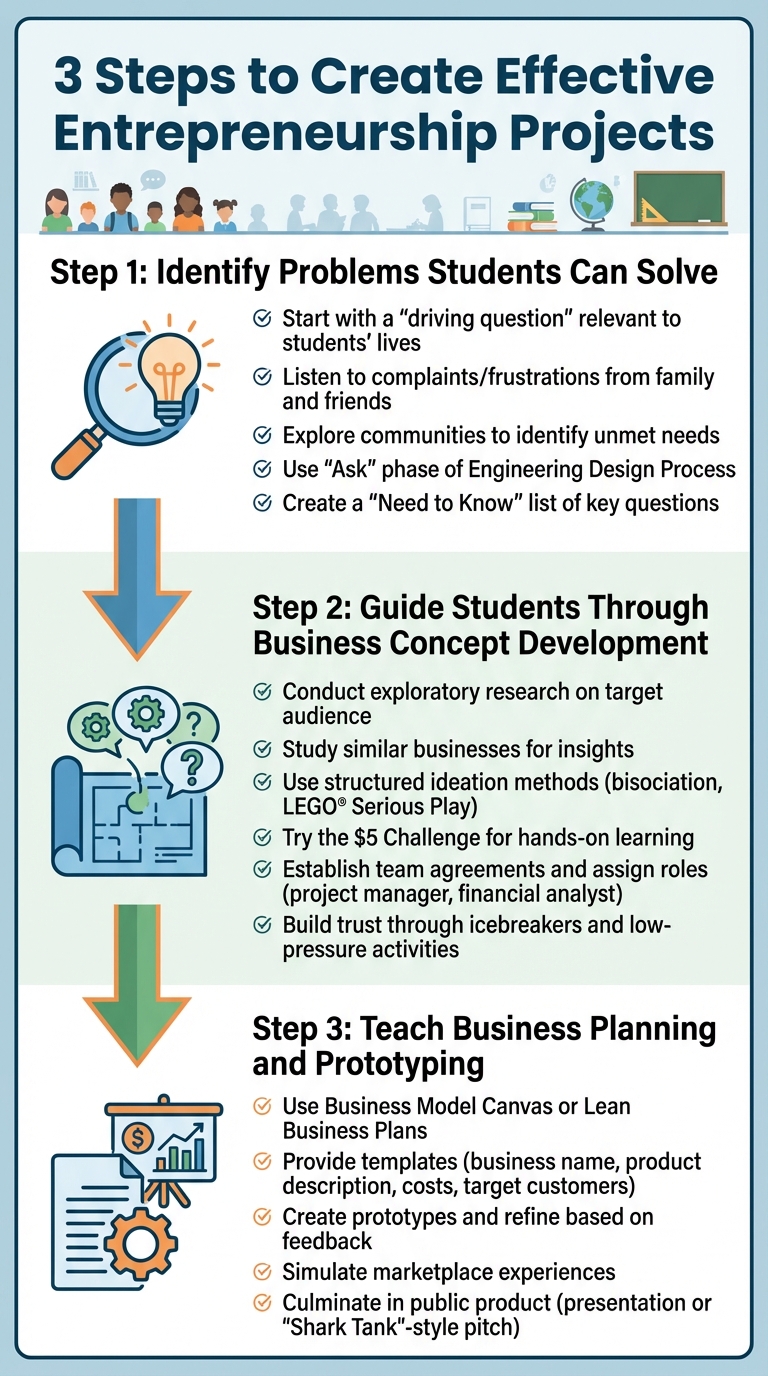
3-Step Process for Creating K12 Entrepreneurship Projects
Designing entrepreneurship projects that tackle real-world problems offers students a chance to engage in meaningful, hands-on learning. By following a structured process, students can mirror how businesses develop while taking ownership of their ideas. This approach transforms classroom activities into opportunities to create something impactful. Start by identifying a relevant problem and then guide students as they develop and refine their business concepts.
Step 1: Identify Problems Students Can Solve
The first step is helping students uncover everyday problems tied to their lives or communities. Begin with a "driving question" that resonates with them personally. Encourage students to listen to complaints or frustrations from family and friends - these often reveal opportunities for creative solutions.
Another strategy is to have students explore their communities to identify unmet needs. This not only grounds their learning in real-world contexts but also fosters a sense of connection to their surroundings.
Introduce them to the "Ask" phase of the Engineering Design Process, where they create a "Need to Know" list. This list includes key questions they need to answer to advance their business ideas . By focusing their inquiries, students can stay organized and avoid feeling overwhelmed.
Step 2: Guide Students Through Business Concept Development
Once a problem is identified, the next step is to help students develop viable business ideas. Start with exploratory research where they define their target audience, understand their needs, and test any assumptions they have. Encourage them to study similar businesses to identify what works and where improvements could be made.
To spark creativity, use structured ideation methods. For example, bisociation, which involves blending unrelated ideas, can lead to innovative concepts. Interactive activities like LEGO® Serious Play can also encourage collaboration and fresh thinking. For a hands-on challenge, try the $5 Challenge, where students are given a small amount of seed money and a limited timeframe to create as much value or profit as possible.
Before diving into complex tasks, establish team agreements. Assign roles such as project manager or financial analyst, and set clear guidelines for conflict resolution. Early in the semester, use icebreakers and low-pressure activities to build trust and confidence among team members. For example, in August 2019, teacher Jennifer Stillittano supported student Matthew Richardson in leveraging his graphic design skills to launch a successful candle-making business. This project emphasized collaboration and student-driven creativity.
Step 3: Teach Business Planning and Prototyping
With a solid concept in place, move on to detailed planning and prototyping. Introduce tools like the Business Model Canvas or Lean Business Plans to help students visualize how their business will operate . Provide templates that include sections for the business name, product description, cost breakdowns, and target customers. These tools make complex ideas easier to grasp and execute.
Encourage students to create prototypes and refine them based on feedback from peers and teachers . Simulate a marketplace experience where students trade their products or services and reflect on the outcomes.
Finally, the project should culminate in a public product, such as a presentation or a "Shark Tank"-style pitch to a panel of evaluators . This not only hones their persuasive communication skills but also helps them see the value of their work beyond the classroom.
Age-Appropriate Project Ideas for K12 Students
Entrepreneurship projects can be a fantastic way to engage students, but they need to match the developmental stages of the learners. Younger students thrive with simple, hands-on activities that introduce basic concepts, while older students can dive into more complex projects that mimic real-world business challenges. The idea is to start small and gradually increase the complexity of the projects as students grow and their skills develop. Below are some age-specific project ideas tailored to different grade levels.
Elementary School: Simple Product and Service Ideas
For elementary students, projects should focus on introducing basic business concepts in a fun and interactive way. Early elementary students (Pre-K to 2nd Grade) can explore money awareness, the difference between "wants" and "needs", and basic leadership traits. For example, a 1st-grade class could run a lemonade stand or create "Future Career" business cards to learn about different professions. Another engaging activity is the CEL Currency project, where students design their own coins for a classroom economy.
Upper elementary students (3rd to 5th Grade) are ready to handle slightly more advanced ideas, like understanding profit margins and conducting basic market research. A great activity for this age group is the Winter Beverage Tasting project. Students create warm drink recipes, calculate the cost per serving, and host a family taste-testing event to decide which recipe is the most profitable. They can practice setting prices by keeping costs low (e.g., under $2.00) to achieve a specific profit margin for a $5.00 product. Many programs for this age group culminate in events like a "Marketplace" or "Pop-up store", where students sell their creations to peers or the community.
As one 5th grader from freshINCedu put it:
"Being an entrepreneur to me means that I can do whatever I set my mind to".
These early experiences help build a foundation for more challenging projects in middle school.
Middle School: Social Entrepreneurship and Community Impact
Middle school is a great time to encourage students to transition from being consumers to creators. Projects at this level should focus on identifying local needs and addressing them through entrepreneurial solutions. For instance, at SCH Academy, middle school students in a social entrepreneurship course funded 107 micro-loans across 39 countries using a "raise and reinvest" model. They created and sold products to support social causes through platforms like KIVA.
Another idea is to guide students in launching podcasts about social issues, helping them build advocacy and communication skills while promoting their mission. Classroom "market days" can also be organized, where students act as both producers and consumers, with proceeds going to a community project or charity. These activities teach students that entrepreneurship isn't just about making money - it’s about creativity, collaboration, and solving real-world problems.
These experiences prepare students for more advanced business ventures in high school.
High School: Advanced Business Development
By high school, students are ready to take on projects that resemble professional business ventures. Using structured frameworks like the Business Model Canvas can help students plan strategically and focus on delivering value. A popular activity for this age group is the $5 Seed Money Challenge, where students start with minimal resources and must plan and execute a business idea. This project emphasizes resourcefulness and quick thinking.
For example, Joe Keeley developed "College Nannies and Tutors" as part of a class project, which later became a successful business. Another inspiring example comes from students Shakeena Julio and Allieberry Pitter, who created a wooden scooter capable of charging a cell phone through movement. This project started in an after-school Maker program at PS 107 in the Bronx, where they collaborated with engineers from Autodesk and Olin College. Their work earned them $3,000 in funding on a "Shark Tank" segment of the Rachael Ray show, and they even pursued a patent for their invention. Reflecting on the experience, Shakeena said:
"The project taught me a lot about engineering and a lot about patience because it took forever to get where we are".
Hosting "Shark Tank"-style pitch events is another excellent way to help high school students develop public speaking and critical thinking skills.
sbb-itb-4f1eab7
Overcoming Challenges in K12 Entrepreneurship Projects
Every project comes with its fair share of hurdles. For K12 entrepreneurship projects, these challenges often revolve around time constraints, limited resources, and balancing academic standards like Common Core or NGSS. On top of that, students may face issues with teamwork or struggle to stay motivated during lengthy projects. However, with thoughtful strategies, these obstacles can be tackled effectively.
Time and Resource Constraints
Finding time to incorporate entrepreneurship projects without sidelining the core curriculum is a common concern for educators. A practical way to address this is by weaving entrepreneurial concepts into existing subjects. For example, students could practice persuasive writing through marketing pitches, use math skills for profit calculations, or research local businesses as part of social studies. Patty Vreeland, an educator at Newsome Park Elementary School, underscores the importance of preparation:
"We have to know the curriculum. We've got to know the standards inside and out. Even though it looks like the kids are doing all the hard work, there's a lot of planning that goes on behind it".
Budget constraints can also be addressed by focusing on low-cost project models and leveraging free digital tools. Platforms like Canva can help with branding, while tools like ChatGPT can assist with brainstorming and refining ideas. To keep things manageable, divide projects into smaller, clearly defined tasks. This not only makes the workload feel less overwhelming but also helps students stay organized and on track.
Student Engagement and Motivation
Sparking and sustaining student engagement over the course of a multi-week project requires more than just an interesting topic. Giving students the ability to make choices - such as selecting their project focus, deciding how to approach tasks, or determining the final product - can significantly boost their sense of ownership and investment. Adding a public element, like a school marketplace or a community pitch event, can also make the work feel more meaningful and encourage accountability.
Assigning specific roles within teams, such as Project Manager, Financial Analyst, or Scribe, ensures that every student has a clear responsibility. This approach prevents uneven workloads and helps all team members contribute meaningfully. As Michael D. Toth and David A. Sousa explain in The Power of Student Teams:
"The brain that does the work is the brain that learns".
When students see their individual efforts directly tied to the team's success, their motivation naturally increases.
Assessment and Feedback
Traditional grading methods often fall short when it comes to evaluating skills like collaboration, problem-solving, and resilience. To address this, consider using dual rubrics: one to assess team dynamics and participation, and another to evaluate the quality of the final product. Involving students in creating these rubrics can clarify expectations and make the grading process more transparent.
Another effective strategy is to build in critique and revision cycles. Encourage students to give and receive peer feedback before their final presentation. When things don’t go as planned - like a pitch that misses the mark or a product that doesn’t sell - use these moments as learning opportunities. Questions like “What would you do differently?” and “What did you learn?” can turn setbacks into valuable lessons.
Research backs the effectiveness of these approaches. In a randomized controlled trial involving 3,645 students across five urban districts, those participating in project-based learning outperformed their peers in traditional classrooms by 8 percentage points. This success spanned various socioeconomic backgrounds, highlighting the broad applicability of these methods.
Leveraging Tools and Resources like DashK12
To make the most out of entrepreneurship projects, having the right tools and training is a game-changer. Success in these projects depends on a combination of support, hands-on tools, and effective training. Platforms like DashK12 help bridge the gap between theory and practice, offering resources designed specifically for project-based learning.
DashK12's Online Courses and Mentorship Programs
DashK12 offers a CTE Teacher Training Course priced at $497, which helps industry professionals transition into skilled CTE educators. The course ensures that project management aligns with industry standards, making it a valuable resource for those in career and technical education (CTE) fields. Additionally, their LMS Professional Learning program connects educators to best practices, with a focus on boosting student engagement and preparing them for future careers.
Rhonda Parker, M.Ed, an educator and business owner, shared her thoughts on the program:
"This LMS program is a thoughtfully designed professional learning experience that supports CTE teachers at every stage of their journey... Teachers gain strategies that enhance student engagement, align instruction with industry standards, and strengthen career readiness outcomes".
DashK12 goes a step further by offering dedicated mentorship to support teachers. This kind of guidance plays a crucial role in improving job satisfaction and retaining educators. It's especially important now, as 62% of Gen Zers have already started or plan to start their own businesses, driving up the demand for high-quality entrepreneurship education.
Workshops and Teacher Support Resources
In addition to its online programs, DashK12 provides in-person workshops for schools and districts. These sessions tackle real-world challenges like managing time, allocating resources, and developing assessment strategies - key areas that often pose difficulties for teachers implementing entrepreneurship projects. These workshops aim to reduce teacher turnover while equipping educators with practical solutions.
DashK12 also offers a range of digital marketing tools that students can incorporate directly into their projects. These include a Social Media Post Planner, Engagement Rate Calculator, and Social Media Caption Generator. These tools aren't just for practice - they mirror the resources used by actual entrepreneurs, giving students a taste of real-world applications.
To further support educators, DashK12 provides access to an academic support team available Monday through Friday, from 8:00 AM to 8:00 PM ET. This real-time assistance is particularly helpful for troubleshooting unexpected project challenges or getting quick advice on grading and managing student teams.
Conclusion
Entrepreneurship projects help students build skills that reach far beyond the classroom. The aim isn’t to turn every student into a business owner but to nurture qualities like resilience, critical thinking, teamwork, and financial know-how - traits that are valuable in any career path they pursue. These experiences lay the groundwork for students to take an active role in shaping their futures.
To make this work, entrepreneurship needs to blend seamlessly into your existing curriculum, whether it’s Math, English Language Arts, or Social Studies. Start by crafting a thought-provoking question that ties into your students’ local community. Offer real-world tools like Canva or professional planning templates, and then step back, giving students the space to take charge. Your role shifts - you become more of a guide and coach than a traditional instructor.
With over 190,000 educators across all 50 states already trained in Project-Based Learning and more than 5,800 schools adopting these frameworks, you’re stepping into a well-established movement. There are plenty of resources to help you get started, including DashK12’s online courses and mentorship programs. And remember, the students in your classroom today are heading into a workforce where 62% of Gen Z is already planning to launch their own businesses.
FAQs
How can schools incorporate entrepreneurship projects into their curriculum?
Schools can bring entrepreneurship into the classroom by weaving it into project-based learning (PBL) that ties directly to core subjects like math, social studies, or language arts. For instance, students might work on crafting business plans, conducting market research, or designing marketing materials. These hands-on projects not only meet academic standards but also help students develop practical skills they can use beyond the classroom.
Teachers can take it a step further by guiding students in starting small ventures, such as running a school store or organizing a fundraising initiative. These experiences teach valuable lessons in financial literacy, teamwork, and communication. By posing essential questions to spark curiosity, students can explore business concepts, create branding strategies, and deliver compelling pitches. These activities encourage creativity and critical thinking, making learning more dynamic and directly applicable to everyday life.
How can educators manage limited resources when implementing entrepreneurship projects in K-12 classrooms?
K-12 educators often face budget constraints when introducing entrepreneurship projects, but there are creative ways to work around these challenges. One approach is tapping into free or low-cost resources. Many organizations offer free activity guides, lesson plans, and digital tools tailored to teaching entrepreneurial skills. These resources allow teachers to design engaging projects without straining their budgets.
Another smart move is making the most of what’s already available. Schools often have materials that can be repurposed for entrepreneurship activities. Additionally, partnering with local businesses or community organizations can open doors to extra resources, mentorship programs, or even sponsorships. These collaborations not only provide practical support but also connect students with real-world opportunities.
Educators can also focus on creativity-driven, project-based learning. Activities like business simulations or pitch games encourage critical thinking and innovation while requiring minimal materials. By combining free tools, community partnerships, and resourceful project design, teachers can bring entrepreneurship to life without breaking the bank.
How do entrepreneurship projects prepare students for future careers?
Entrepreneurship projects help students develop essential skills that can shape their future careers. Through these activities, students enhance their ability to think critically, solve problems, collaborate effectively, and approach challenges with creativity. At the same time, they gain a solid foundation in financial literacy and learn key business concepts that are relevant in the real world.
By diving into tasks such as market research, creating business plans, and managing finances, students get hands-on experience that reflects real-world scenarios. These projects also promote qualities like resilience, adaptability, and a forward-thinking approach, equipping students with a mindset that’s valuable in any career. Whether they pursue entrepreneurial paths or other professions, the skills they build through these experiences serve as a strong foundation for success.