Ultimate Guide To Brand Storytelling
Brand storytelling is about more than selling products - it’s about creating emotional connections. By sharing your brand’s mission, values, and experiences, you can turn customers into loyal advocates. Research shows stories are 22x more memorable than facts, and 92% of consumers prefer ads that feel like stories.
Here’s the bottom line: a strong narrative helps your brand stand out, builds trust, and drives engagement. Key elements include defining your purpose, knowing your audience, and crafting a relatable message where the customer is the hero. Examples like Dove’s “Real Beauty” campaign and Apple’s 1984 ad prove how storytelling can boost loyalty and sales.
Want to start? Follow these steps:
- Define your goals and audience.
- Choose the right story type (e.g., origin, mission, or customer success).
- Use proven structures like the Hero’s Journey.
- Add visuals and real testimonials for impact.
Storytelling isn’t just a marketing tool - it’s how you build lasting relationships with your audience.
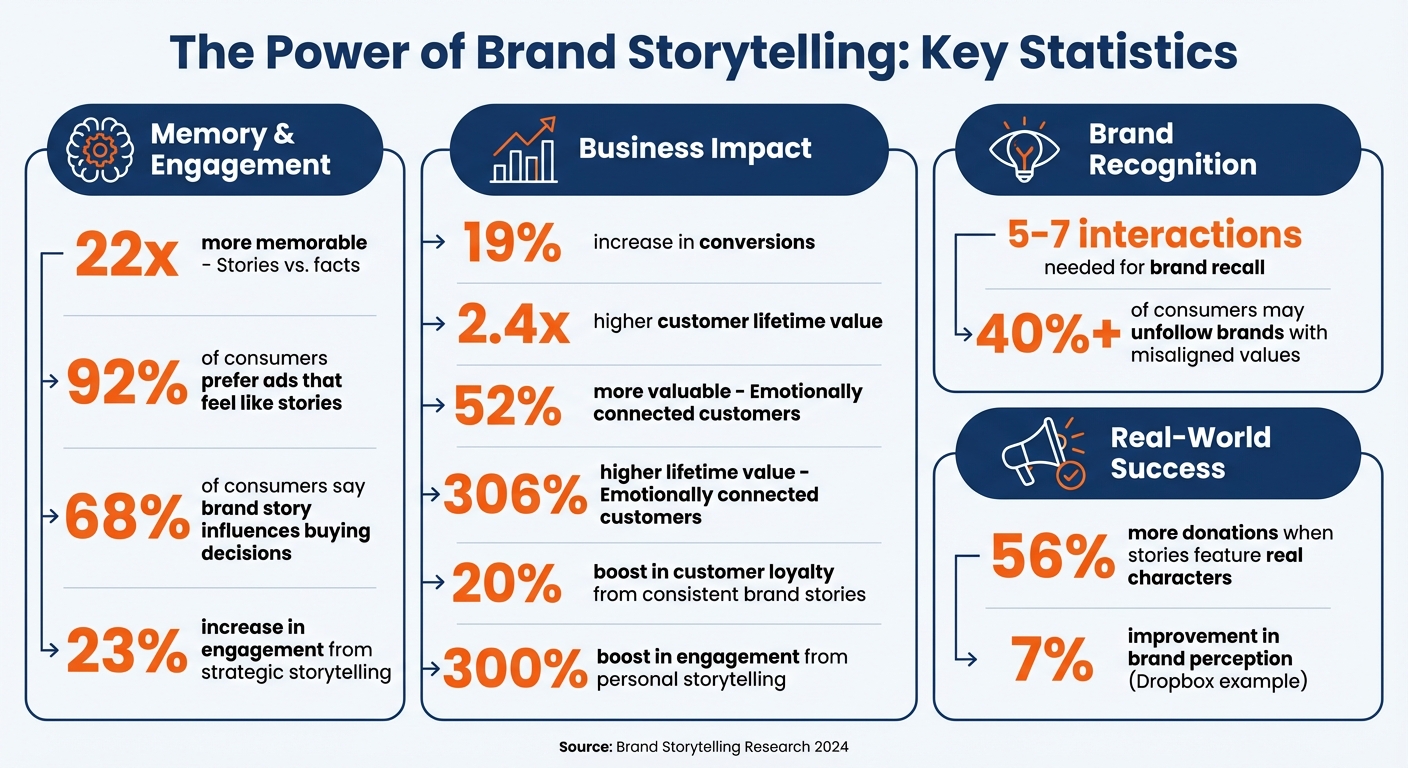
Brand Storytelling Statistics and Impact Metrics
Master The Art Of Brand Storytelling in 32 Minutes For 2026
Core Elements of a Great Brand Story
A compelling brand story relies on a few key ingredients that work together to leave a lasting impression and forge emotional connections. These elements determine whether your narrative strikes a chord with your audience. Let’s break them down.
Purpose and Mission
At the heart of every great brand story is a clear purpose and mission. This isn’t about your products - it's about the deeper "why" behind your brand. A well-defined mission serves as a guiding light for your content and helps you connect on a meaningful level with your audience.
Take TOMS, for instance. Their mission - "With every product you purchase, TOMS will help a person in need" - is simple yet powerful. It doesn’t just explain what they do; it shows how they’re making a difference. This kind of mission acts as the resolution in your brand’s story, showing customers how you’re solving real-world challenges and creating positive change.
Brand Voice and Personality
Your brand voice is what makes your business feel human. It’s how you communicate your personality and values at every touchpoint. Many successful brands use archetypes like the Hero, the Rebel, or the Caregiver to shape their identity. When your voice is consistent and relatable across all platforms, it builds trust and makes your brand instantly recognizable.
Emotional Connection and Relatability
What makes a brand unforgettable? Emotional connections. Stories that resonate on a personal level stick in people’s minds. In fact, 68% of consumers say that a brand’s story influences their buying decisions.
To create this kind of connection, position your customer as the hero of the story and your brand as their guide. When people see themselves reflected in your narrative and recognize shared values, they feel like they’re part of something bigger. Acknowledge challenges and show how they’re overcome - this emotional journey creates a sense of triumph that turns customers into loyal advocates.
How to Craft Your Brand Story: Step-by-Step
Creating a brand story isn't just about weaving a narrative; it's a process that transforms ideas into a structured, actionable strategy. Here's how to do it step-by-step.
Step 1: Define Your Storytelling Goals
Before you dive into storytelling, be clear about what you want to achieve. Your brand story isn't just for show - it's a tool that should support your business objectives, whether that's boosting engagement, building trust, or driving conversions. For example, brands using storytelling strategically report a 23% jump in engagement, a 19% increase in conversions, and a 2.4x higher customer lifetime value. Emotionally connected customers can even be 52% more valuable.
Think about what you’re aiming for: Do you want to stand out in a crowded market where consumers are bombarded with messages daily? Or perhaps you want to create internal alignment so your employees understand your brand's purpose. Whether it's about humanizing your brand for Gen Z or fostering emotional connections, your goals should directly tie to measurable outcomes. Once your objectives are clear, define your audience to ensure your story resonates.
Step 2: Know Your Audience
To tell a story that sticks, you need to understand who you're speaking to. Your customer should be the hero of the story, with your brand acting as the guide. Start by distinguishing between your target market (the broad group you serve) and your target audience (a more specific segment with shared traits). Dive into demographics like age, location, and income, but also explore psychographics - values, interests, and motivations. Consider their lifestyle, buying habits, and even niche affiliations (like "Swifties" or "Trekkies").
"Telling a brand's story begins with finding its truth." – Peter Levin, Creative Director, Finn Partners
Use Voice of Customer (VoC) data - think reviews, social media comments, and surveys - to uncover recurring themes in customer feedback. Develop detailed buyer personas and map out their journey to identify the types of stories that will resonate at each stage. Keep in mind, over 40% of consumers may unfollow a brand if its values don't align with theirs. Knowing your audience is the foundation of impactful storytelling.
Step 3: Choose Your Story Type
Not all stories are created equal. The right type of story depends on your goals, audience, and where your brand stands in its journey. Here are some options:
- Origin stories: Share how your brand started, highlighting personal experiences or pivotal moments. These often portray your brand as an underdog challenging the status quo.
- Mission-driven narratives: Focus on the deeper purpose behind your brand, showing how you're making an impact beyond just selling products.
- Customer success stories: Showcase before-and-after transformations to highlight the value your brand delivers.
- Problem/solution stories: Address specific pain points and demonstrate how your brand provides the solution.
Pick the story type that aligns with your goals and speaks to your audience's current needs while staying true to your brand's core message.
Step 4: Build Your Narrative Structure
A powerful story needs a strong structure to guide your audience emotionally. Many successful brand stories use Freytag's Pyramid, which includes an introduction, a central challenge, and a resolution provided by your brand. Start by defining your brand's purpose, vision, mission, and values - this is your "brand heart".
Craft your narrative to create a "mirror experience" where your audience sees themselves in the story and feels motivated to act. Include a brief emotional moment (6–8 seconds) during your call-to-action to leave a lasting impression.
"Messages delivered as stories can be up to 22x more memorable." – Jerome Bruner, Cognitive Psychologist
Here’s a quick comparison of story arcs:
| Story Arc Type | Focus | Best Use Case |
|---|---|---|
| Hero's Journey | Adventure and overcoming obstacles | Brand origin stories or long-term transformations |
| Problem/Solution | Solving a specific challenge | Product-focused marketing or explainer videos |
| Before/After | Highlighting change through your brand | Customer success stories and testimonials |
| Underdog Story | Challenging industry giants | Startups or rebellious brands |
Keep your story concise - 200 to 300 words is ideal. Focus on one problem at a time and, if it fits, use archetypes like Carl Jung's 12 brand archetypes (e.g., The Hero, The Outlaw, The Sage) to create a consistent and relatable brand personality. For instance, Dropbox’s storytelling, centered on the belief "We believe the world can work better", improved brand perception by 7% among potential employees. Your narrative should align with the audience's pain points and aspirations.
Step 5: Add Visuals, Testimonials, and Real Examples
A great story becomes unforgettable when it's brought to life with real-world proof. Abstract ideas won’t stick, but customer testimonials, specific examples, and visuals will. For instance, stories featuring real characters can inspire people to donate 56% more to charity compared to non-narrative appeals. Use authentic testimonials with actual names, results, and direct quotes whenever possible.
Incorporate visuals thoughtfully - research shows people are 22 times more likely to remember information when it’s part of a story rather than standalone facts. Whether it's photos, videos, or infographics, visuals can make your story more engaging and memorable.
sbb-itb-4f1eab7
Tools and Frameworks for Brand Storytelling
To tell your brand story effectively, having the right frameworks and tools in place is essential. They help structure your narrative and ensure consistent delivery across platforms.
Storytelling Frameworks: Hero's Journey and Beyond
The Hero's Journey is a classic framework that positions your customer as the hero overcoming obstacles, with your brand acting as the guide offering solutions and transformation. This approach resonates deeply because emotionally connected customers are shown to have a 306% higher lifetime value.
Another popular method is the 3-Act Structure, which breaks your story into three clear phases: Introduction, Challenge, and Solution. For example, on social media, you could implement a "3-Act Publishing Week", where you introduce the problem on Monday, dive into the challenges on Wednesday, and wrap up with a resolution and call-to-action on Friday.
The StoryBrand Soundbite Strategy is another effective tool, boiling your brand message down into five concise soundbites. Whitney English, CEO of Day Designer, shared how this framework transformed her business:
"After going through StoryBrand my revenue quadrupled".
Similarly, Casandra Laymon, President of Beacon Wealth Consultants, revealed:
"Before StoryBrand we received zero leads from our website. Within the first month of changing our website we received two 2 million dollar leads".
StoryBrand offers various training options, from an on-demand course priced at $499 to an intensive eight-week program with Donald Miller for $100,000.
You can also draw inspiration from Carl Jung's 12 Brand Archetypes, aligning your brand's story with your audience's core values and aspirations. Once your narrative is built, the next step is finding the right tools to share it consistently.
Using DashK12 for Social Media Distribution

After crafting your brand story, it’s crucial to share it where your audience is most active. DashK12 is a social media management platform tailored for entrepreneurs, helping them maintain a consistent narrative across multiple platforms.
DashK12 simplifies scheduling and managing content for different social channels, ensuring your story reaches the right audience at the right time. Each platform has its own storytelling style - Instagram is great for detailed carousels, TikTok thrives on quick 6–30 second videos, and LinkedIn works well for thought leadership content. DashK12 ensures your messaging stays cohesive while adapting to these platform-specific demands.
Beyond scheduling, DashK12 provides tools to track engagement and refine your storytelling based on real-time data. Research shows that incorporating personal storytelling into branded content can boost engagement by up to 300%. With DashK12 handling the technical aspects, you can focus on creating compelling narratives while the platform ensures consistent and impactful distribution across your channels. This approach keeps your brand story clear and resonant, no matter where it’s shared.
Advanced Techniques for Brand Storytelling
Once you've laid the groundwork for your brand's story, it's time to refine and elevate it. These advanced methods help your narrative stay relevant in a changing market and ensure your brand stands out.
Maintaining Consistency Across Channels
Every brand story needs a "throughline" - a central message that ties together all your communications, from marketing campaigns to internal emails.
"Telling a brand's story begins with finding its truth... Once we've mined that truth we then convert it into an outward-facing message that can be disseminated and interpreted in every channel to every audience." - Peter Levin, Creative Director, Finn Partners
Why does consistency matter? It takes an average of five to seven interactions with a brand for someone to remember it. Companies that maintain a consistent brand story enjoy a 20% boost in customer loyalty. The trick is adapting your message to suit different platforms - short, snappy videos for TikTok or in-depth articles for your blog - while keeping the core message the same.
To ensure alignment, standardize your messaging and share it across your organization. This way, every team, from HR to sales, tells the same story. Use templates to maintain a consistent structure and tone. With everyone on the same page, you can then focus on creating emotional connections and sharing success stories.
Using Emotional Resonance and Customer Success Stories
Stories have a unique power to connect with audiences emotionally. When people hear a compelling narrative, their brains release cortisol (which grabs attention) and oxytocin (which fosters empathy and connection). This "neural coupling" strengthens emotional ties to your brand.
The stats back this up: 92% of consumers prefer ads that feel like a story. To make the most of this, position your customer as the hero and your brand as the guide.
Take Lionsgate's 2013 campaign for The Hunger Games: Catching Fire, for example. They created a fictional fashion magazine, Capitol Couture, on Tumblr, inspiring fans to share their own designs. The result? Over 10 million Facebook likes, 850,000 Twitter followers, and a $158.1 million opening weekend, with global earnings reaching $864.9 million.
Customer success stories also work wonders when framed as "mini-movies" that highlight transformation. One SaaS company, facing a tight 30-day runway, helped a client boost email open rates from 0.3% to 34% and grow revenue by 400% in just three months. The company's shared struggle and dedication became their most effective conversion story.
"Core values and mission are most effectively communicated and remembered when they're attached to a story. When you think about the idea of integrity, there is no way people are going to latch on to the idea of integrity. But you tell them a story about someone who demonstrated integrity. They get that." - Jeff Bartsch, Marketing Expert and Entertainment Professional
Once you've crafted a narrative that resonates emotionally, use data to fine-tune and elevate your storytelling.
Using Metrics to Refine Your Story
Metrics reveal what’s working and where you can improve. Track both internal metrics (like how well your team uses brand guidelines) and external metrics (like how your audience responds to your story). Key indicators include brand awareness, Net Promoter Score (NPS), branded search volume, and share of voice compared to competitors.
But remember, numbers only tell part of the story.
"If you can get a pulse from your audience in the comments section, DMs or via AMA, that qualitative data can help inform creative and content strategies, your editorial calendar and even your larger marketing strategy." - Alex Suazo, VP Digital Marketing & Social, Finn Partners
Here’s a quick breakdown of what to track and where to find it:
| Metric Category | Key Indicators | Where to Find It |
|---|---|---|
| Internal Adoption | Guideline views, template usage, asset reuse | Brand management platforms |
| Market Perception | Brand awareness, preference, loyalty, NPS | Customer surveys |
| Digital Presence | Branded search volume, share of voice | Google Search Console, social listening tools |
| Audience Sentiment | Positive/negative mention ratio, comment themes | Social media monitoring tools |
Pay attention to search terms within your internal brand portals that yield "zero results." These gaps highlight missing resources your team needs. Also, track visits to key content - spikes in traffic often signal materials worth updating or promoting further. Review your brand performance quarterly to stay aligned with market changes while avoiding knee-jerk reactions to short-term trends.
"In brand management, data is your roadmap to consistency and impact." - Jordan Giesler, Creative Director, Kansas City Chiefs
Conclusion: Key Takeaways
Summary of Key Points
Brand storytelling is more than just highlighting features - it’s about creating emotional connections that turn customers into loyal advocates. Research shows that stories are much easier to remember, and 68% of consumers say a compelling brand story directly influences their buying decisions.
At the heart of storytelling lies your brand's purpose, mission, and values. Build your narrative around these core elements, positioning the customer as the hero and your brand as their trusted guide. Authenticity is crucial - most consumers prefer ads with a strong narrative. Make sure your story remains consistent across all touchpoints, whether it's your website, social media, or email campaigns.
To truly stand out, tap into advanced techniques like emotional storytelling, sharing customer success stories, and refining your approach with data. Brands that master storytelling often see a 20% increase in customer loyalty, proving that a well-crafted narrative can deliver meaningful business results. These insights underscore the importance of storytelling in creating deeper, long-lasting customer relationships.
Next Steps for Your Brand Story
Start by documenting your core narrative in a concise format (200–300 words). Clearly define your brand’s purpose, identify the challenges your customers face, and outline how your brand serves as their guide. Develop detailed buyer personas to better understand your audience and tailor your story to their needs and aspirations.
Pick a storytelling framework that fits your brand, such as the Hero’s Journey, and adapt it for different platforms. Tools like DashK12 (https://dashk12.com) can help you distribute your story consistently across social media, ensuring your message reaches your audience wherever they are most active.
Finally, track key metrics like brand awareness and engagement, while also gathering qualitative feedback. Your brand story should evolve as you learn more about what resonates with your audience. The brands that thrive are those that stay true to their core message while continuously adapting to meet their customers’ expectations and preferences. By refining and testing your approach, you’ll keep your story fresh and impactful.
FAQs
How do I choose the best story type for my brand?
To figure out the best type of story for your brand, start by identifying your brand’s mission, core values, and the problem you aim to solve. These elements act as a roadmap, helping you decide which emotions - like trust, excitement, or happiness - you want your stories to spark. Here are a few common types of brand stories to consider:
- Origin stories: Share how your brand came to life.
- Purpose-driven stories: Explain your brand’s deeper reason for existing, beyond just making money.
- Customer success stories: Highlight the achievements or transformations of your clients.
- Behind-the-scenes stories: Offer a glimpse into your daily operations or company culture.
- Future vision stories: Paint a picture of where your brand is headed.
Choose a story type that aligns with your mission and resonates with your audience. To make sure it’s the right fit, analyze how your past content has performed - check metrics like likes, shares, and comments to see what strikes a chord. Use these insights to fine-tune your storytelling approach, ensuring it stays true to your brand while keeping your audience engaged.
What makes a brand story engaging and memorable?
An engaging brand story taps into emotions and showcases the brand's purpose and values. Start with a compelling origin story that explains why the brand was created and what it stands for. Emphasize the core values and how they connect with your customers’ goals or challenges. Craft a structured narrative with a relatable protagonist - often your customer - facing a challenge that your brand helps them overcome.
To make your story stick, aim to stir emotions like joy, inspiration, or empathy. Pair this with consistent visuals and tone across all platforms to reinforce your message. For instance, DashK12 can share its mission of simplifying social media management for entrepreneurs. By presenting its customers as heroes who tackle marketing challenges using DashK12’s tools, the story becomes relatable and inspiring. Focusing on real problems and practical solutions builds trust and leaves a lasting impression.
What’s the best way to measure the success of my brand storytelling efforts?
To gauge how effective your brand storytelling is, keep an eye on metrics that reveal both audience reactions and the overall impact on your business. Look at conversion rates, engagement metrics (like likes, shares, and comments), and sentiment analysis to get a sense of how your story connects with your audience.
It's also important to measure the return on investment (ROI) of your storytelling efforts. Assess how well your story supports broader marketing goals, such as boosting sales, improving brand awareness, or building customer loyalty. By consistently reviewing these metrics, you can fine-tune your narrative to better align with what your audience values and expects.