Ultimate Guide to Backlink-Worthy Content Creation
Want more backlinks? Here’s the secret: Create content so useful, credible, and engaging that others can’t help but link to it. Backlinks remain one of the strongest signals for SEO and have grown even more important in 2026, influencing not just search rankings but also how AI tools like ChatGPT and Google’s AI Mode perceive trust.
Key strategies to earn backlinks:
- Original research: Unique data and insights are highly cited (e.g., studies like Ahrefs’ stat that 94% of blog posts get zero backlinks).
- In-depth guides: Long-form, detailed content (3,000+ words) attracts more links, especially when it’s actionable and easy to navigate.
- Interactive tools and visuals: Tools like calculators or infographics simplify complex ideas and provide ongoing value.
Why it matters: With over 2.3 million blog posts published daily, standing out requires creating content that solves problems, provides new perspectives, or delivers practical solutions. Think of it as becoming the go-to resource in your niche.
How to succeed: Research link-worthy topics, structure your content clearly, and promote it through outreach, social media, and partnerships. Monitor backlink performance using tools like Ahrefs or Semrush, and keep your content updated to maintain relevance.
This guide explains everything you need to know about crafting link-worthy content, from choosing the right format to promoting it effectively.
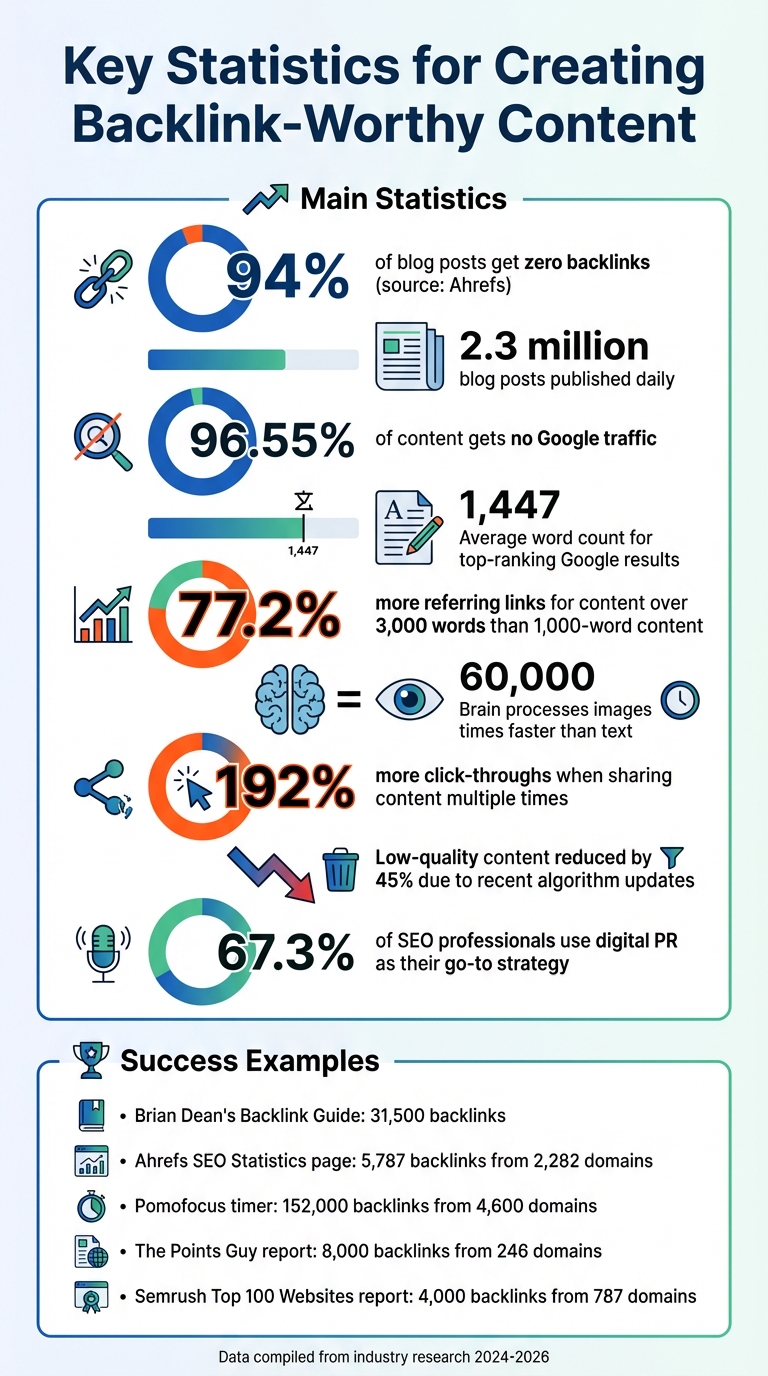
Key Statistics for Creating Backlink-Worthy Content in 2026
Backlinks for SEO: Complete Guide for 2026
sbb-itb-4f1eab7
What Makes Content Worth Linking To?
Did you know that 94% of blog posts don’t have a single backlink? That’s a staggering number, but it underscores a key point: to earn backlinks, your content needs to stand out. The secret? Offer original ideas, insightful analysis, and visually engaging formats. When your content is credible, thorough, and easy to reference, it becomes the go-to resource for writers and publishers. Let’s break down how to make that happen.
Original Ideas and Fresh Perspectives
Recycling old ideas won’t get you far. Writers and publishers are always looking for something new to cite - whether it’s groundbreaking data, a bold perspective, or a fresh spin on a well-trodden topic.
Take original research, for example. When Ahrefs revealed that 96.55% of content gets no Google traffic, it wasn’t just another blog post - it was a wake-up call. The study was cited by major players like Neil Patel, Search Engine Journal, and Backlinko because it offered unique, actionable insights that couldn’t be found elsewhere.
Similarly, contrarian viewpoints can attract attention. The health brand Zoe made waves with its article, "Why Calorie Counting Doesn’t Work", which challenged conventional weight-loss wisdom. By backing up their claims with expert data, they earned backlinks from respected medical journals and health influencers. As Search Engine Land explains:
"If you give [writers] a strong 'against the grain' argument, you're far more likely to be cited than if you play it safe with a middle-of-the-road summary that no one remembers."
Another effective strategy is newsjacking - reacting quickly to breaking news with expert insights. For instance, when Search Engine Land analyzed Google's "AI Max for Search" launch in May 2024, their timely piece earned 146 backlinks from high-profile sources like Forbes and SEO Round Table.
These approaches show that fresh ideas don’t just inform - they make your content indispensable.
Detailed and Practical Information
Content that scratches the surface won’t cut it. Writers link to resources that provide in-depth answers and solve real problems.
Long-form content tends to dominate in backlink performance. The average word count for top-ranking Google results is around 1,447 words, which is why creating "10x content" - content that’s better than anything else available - is so effective.
Practicality is just as important. Content that addresses specific pain points or pressing questions becomes a must-link resource. Take The Points Guy, for example. Their monthly report on the value of credit card points and miles has earned 8,000 backlinks from 246 domains because it consolidates complex, updated data into a single, easy-to-use reference.
Interactive tools can take this concept even further. Pomofocus, a simple Pomodoro Timer, has racked up 152,000 backlinks from 4,600 domains because it offers an elegant, functional solution to a common productivity challenge. Tools like this don’t just inform - they provide ongoing value every time they’re used.
Credibility also plays a huge role. Showcasing E-E-A-T (Experience, Expertise, Authoritativeness, Trustworthiness) builds the trust needed for backlinks. Use case studies, personal success stories, and original screenshots to demonstrate real-world experience. As Nate Matherson, Head of Growth at Numeral, puts it:
"When writing blog posts, I often source expert insights from leaders in the SEO industry for my weekly SEO podcast, Optimize."
Incorporating expert perspectives and firsthand experience makes your content not only trustworthy but also harder to replicate.
Visual Design and Easy Access
Even the most well-researched content can fall flat if it’s hard to navigate or visually unappealing. Editors and website owners often make linking decisions based on a quick visual scan - if your page looks cluttered or outdated, they’ll move on.
Visuals are a game-changer. The brain processes images 60,000 times faster than text, making infographics, charts, and diagrams incredibly effective for simplifying complex ideas. For example, when Semrush publishes its "Top 100: The Most-Visited Websites in the US" report with clear data visualizations, the content consistently earns nearly 4,000 backlinks from 787 domains. The combination of unique data and visual clarity makes it irresistible.
Interactive elements like quizzes and calculators also shine here. These tools don’t just earn backlinks once - they keep generating links as more people discover and use them over time.
To make your content link-worthy, focus on clean design, clear formatting, and visual aids. When your insights are easy to understand and share, you significantly increase the likelihood that others will reference your work.
| Content Characteristic | Why It Earns Backlinks | Example Format |
|---|---|---|
| Original Research | Provides new data for others to cite | Industry surveys, data reports |
| Interactive Tools | Offers ongoing utility and value | Calculators, timers, quizzes |
| Comprehensive Guides | Becomes the definitive resource | "Ultimate" guides, 10x content |
| Visual Simplification | Makes information easy to digest | Infographics, charts, diagrams |
| Controversial Takes | Sparks discussion and reactions | Opinion pieces, exposés |
Content Formats That Earn the Most Backlinks
When it comes to creating content that naturally attracts backlinks, some formats consistently outperform others. Content that provides utility, presents original data, or answers questions in-depth tends to stand out. Let’s dive into three content types that reliably generate the most backlinks and explore why they work so effectively.
Complete Guides and How-To Tutorials
Complete guides are like one-stop resources, covering a topic comprehensively and becoming the go-to reference for readers and other content creators. Research shows that content exceeding 3,000 words earns 77.2% more referring links than shorter pieces around 1,000 words. But length alone isn’t enough - guides need to be well-structured, easy to navigate, and packed with actionable insights.
A great example is Brian Dean’s Backlink Guide, which has earned an impressive 31,500 backlinks over the years. What makes it so effective? It delivers specific tactics, includes real email templates, and features annotated screenshots - avoiding vague advice in favor of practical, detailed solutions. Dean also popularized the "Skyscraper Technique", branding his unique strategy to make it more memorable and easier to cite.
To make your guides link-worthy:
- Use a sticky table of contents for easy navigation.
- Break the content into clear sections with descriptive subheadings.
- Regularly update the guide to keep it relevant.
As Search Engine Land aptly puts it:
"If you can help your audience as well as Brian Dean and Backlinko help the SEO industry, then you deserve a citation and a link." – Search Engine Land
Now, let’s look at how original research can position your site as a must-cite source.
Original Research and Data Reports
Publishing original research can transform your website into a trusted source for journalists, bloggers, and industry experts. According to SEO PowerSuite, data and research outperform all other content formats when it comes to earning backlinks. The secret? Unique data, thorough analysis, and clear presentation.
Take Brian Dean’s 2024 YouTube ranking factors study as an example. By analyzing 1.3 million videos, the study became a go-to resource for marketers and SEO professionals, earning thousands of backlinks. Why does this work? As Dean explains:
"Data helps bloggers and journalists back up their opinions with facts." – Brian Dean, Backlinko
Your research doesn’t need to be overly academic - it just needs to be original and relevant. For instance, Stanford University’s AI Index Report has attracted over 12,000 backlinks by compiling global data on AI research, funding, and trends. Its success lies in being a comprehensive source of information for analysts and educators alike.
To maximize the linkability of your research:
- Publish findings openly rather than gating them behind forms.
- Include clear, bite-sized stats that are easy to cite.
- Add embeddable charts and graphs for visual appeal.
- Provide a detailed methodology section to establish credibility.
While research builds authority, curated lists offer quick, shareable value.
Curated Resource Lists
Curated lists save readers time by gathering useful tools, data, or insights in one place. These lists are highly shareable and often attract backlinks through "ego bait" - when featured experts or companies share and link back to the content.
A standout example is Ahrefs’ SEO Statistics page, which has earned 5,787 backlinks and 2,282 referring domains since its launch in 2020. By consolidating key SEO data into an easy-to-reference format, it has become a trusted resource for many. However, keeping these lists up-to-date is crucial - stale resources lose their appeal. Refresh your list annually with the latest information and notify those featured to encourage them to share and link back.
| Format | Average Backlink Performance | Why It Works |
|---|---|---|
| Complete Guides (3,000+ words) | 77.2% more links than short content | Serves as a definitive, all-in-one reference |
| Original Research | Highest-performing format overall | Becomes a primary source for citations |
| Curated Resource Lists | 5,000+ backlinks possible | Provides instant utility and leverages ego bait |
Each of these formats brings something unique to the table, whether it’s depth, authority, or convenience. By focusing on these proven approaches, you can significantly increase the backlink potential of your content.
How to Create Content That Earns Backlinks
Crafting content that naturally attracts backlinks isn’t just about good writing - it’s about strategy. From picking the right topics to structuring your content and enhancing it with visuals, every step matters. Here’s how to create content that people want to link to.
Research and Topic Selection
Start by identifying topics that have a track record of earning backlinks. Tools like backlink analyzers and competitor research can help you pinpoint subjects that resonate. If a certain topic has worked well for others, you can create a more detailed and engaging version to achieve similar results.
Another way to find ideas is by exploring forums like Reddit and Quora, where recurring unanswered questions often highlight content gaps. For instance, the team at Backlinko noticed the success of "site audit" content on the Moz blog. They followed up with their own "The 18-Step SEO Audit Checklist", which quickly gained traction and ranked on Google’s first page.
Some formats naturally attract more links. Original research, infographics, and tools are prime examples. Back in 2018, Backlinko conducted a voice search industry study that provided unique statistics. The result? Over 1,500 backlinks. As Brian Dean puts it:
High-quality content is a start, it's not enough... you need to create content specifically engineered to get links.
When choosing your topic, consider your domain authority. If your site’s authority is on the lower side (under 20), focus on keywords with less competition. For higher authority sites, moderately competitive keywords are a better fit. You can also use Google’s "People Also Ask" section to identify specific, high-intent questions that are worth addressing.
Once you’ve locked in your topic, it’s time to structure your content to make it clear, engaging, and impactful.
Writing and Structuring Your Content
With your topic in hand, aim to cover it thoroughly. On average, top-ranking Google pages are around 1,447 words long. For example, Brian Dean’s "SEO Copywriting" guide, which spans 3,334 words, outshined competitors by offering in-depth, actionable insights.
Structure your content to make it easy to navigate. Use H2 and H3 headers to break up major concepts and consider adding a table of contents for longer pieces. Short paragraphs and simple language improve readability, while also signaling relevance to search engines.
Another tip? Name your unique techniques or methods. This makes your content more memorable and increases the likelihood of earning backlinks. As Brian Dean explains:
You're not just creating content. You're creating language. And language spreads.
To stand out, include elements that offer real value - like unique data, personal experiments, or exclusive expert insights. Joshua Hardwick from Ahrefs warns:
If you base the entirety of your content on top-ranking pages, you'll end up with copycat content... [which] fails to stand out from the crowd or offer anything unique.
Incorporating real-world examples, screenshots, and case studies can make your content more engaging and help it continue earning backlinks over time.
Once your text is structured, take it a step further by adding visuals and interactive features.
Adding Visuals and Interactive Features
Visuals can transform good content into something people want to share and link to. Infographics, data visualizations, and custom graphics make complex ideas easier to understand and more appealing. In fact, content presented as infographics or detailed "what" or "why" posts tends to attract more backlinks.
Tools like Canva and Skitch can help you create custom visuals that stand out. As Moz staff explains:
Strong images and visuals capture and retain readers' attention far better than text in most instances.
Interactive elements like quizzes, polls, or interactive maps can set your content apart from static pages. Embedding videos, podcasts, or SlideShare presentations can also elevate your post into a comprehensive resource. Just be sure to optimize all multimedia for fast loading times; slow pages can negatively impact both SEO and user experience.
Finally, don’t forget to add descriptive alt text to your images. This helps search engines index them and ensures accessibility for all users. Align your visuals with user intent - for example, step-by-step screenshots work better than decorative images for "how-to" content.
How to Promote Your Content for Backlinks
Creating amazing content is only half the battle. To truly make an impact, you need to get it in front of the right audience. That means reaching out to key players, leveraging social media, and building meaningful partnerships that benefit everyone involved.
Reaching Out to Industry Experts and Writers
The best outreach begins with standout content - think original research, data-driven reports, or expert insights that writers and journalists naturally want to reference. As Backlinko aptly puts it:
Link building isn't dead. Google continues to value links as signals, but today's wins come from PR-grade content that people want to cite.
When reaching out, focus on quality over quantity. Instead of blasting 500 generic emails, aim for 100–150 personalized pitches that stand out. Use the AIDA framework to craft your message: grab Attention with a personalized hook (like referencing a recent article they wrote), spark Interest by highlighting what makes your content special, create Desire by showing how it benefits their audience, and include a clear Action - such as asking them to cite a specific stat in their next piece.
Start strong by leading with your most compelling data. You can also try the "Moving Man Method": find outdated resources (like defunct services or rebranded companies) and reach out to sites still linking to them. For example, when SEOMoz rebranded to Moz, Backlinko contacted websites linking to the old SEOMoz.org URLs and suggested their own relevant resource, earning high-quality backlinks in the process.
Another effective tactic is link reclamation. Keep an eye out for unlinked mentions of your brand and kindly ask the author to add a link for better context. Tools like Featured.com, HARO, and MentionMatch can connect you with journalists looking for sources. If you don’t hear back after your initial pitch, follow up in 5–7 days with a short, polite reminder.
Once your pitches are ready, amplify your efforts on social media.
Using Social Media to Expand Reach
Social media is a powerful tool for sharing your content with journalists, bloggers, and industry leaders who can provide those valuable backlinks. The key is tailoring your approach to each platform. For instance, LinkedIn works well for professional posts and carousels, while Instagram and TikTok thrive on visual or short-form video content.
Repurpose your content to fit each platform. For example, turn a blog post into a LinkedIn carousel or distill its essence into a 280-character post for X (Twitter). Use social search queries like "site:linkedin.com + [topic] + data" to identify journalists who frequently cite industry research, then engage with their content before pitching your own.
Platforms like DashK12 can simplify this process by managing your social media promotion across multiple channels. With tools to schedule posts, map out distribution calendars, and optimize timing, you can ensure your content reaches the right audience when they’re most active.
One underrated tip: share the same piece of content multiple times. Research shows that doing so can drive 192% more click-throughs than a single post. Just tweak the messaging or highlight different insights each time for variety.
Beyond social media, forming strategic partnerships can further expand your content’s reach.
Creating Partnerships with Other Creators
Collaborations work best when both parties gain something valuable. Whether it’s co-creating guides, hosting contests, or developing interactive tools, partnerships provide a strong reason for everyone involved to promote the content. Begin by building real relationships on LinkedIn, niche forums, or through community engagement - this often leads to natural opportunities for backlinks.
One effective approach is offering detailed testimonials for products or services you genuinely use. Reach out to SaaS companies or vendors and offer a professional testimonial in exchange for a link on their "Customers" or "Success Stories" page. For example, when UnderFit teamed up with luxury suit brand Black Lapel to create a guest post about what to wear under a dress shirt, the collaboration featured UnderFit undershirts and resulted in over 150 sales in 12 months, while also boosting search visibility.
When proposing a partnership, make it as easy as possible for the other party. Provide "ready-to-go" content, like pre-written articles or pre-recorded videos, to minimize their workload. If they don’t have a podcast, suggest appearing as a guest or even helping them launch one. Engage with their blog or social media posts before pitching a partnership - this builds rapport and increases your chances of success.
Alex Horowitz, a digital PR expert at NP Digital, highlights what makes a backlink worthwhile:
A good backlink comes from a site with solid domain authority (DA 35+), consistent organic traffic of at least 1,000 visitors a month, and content that's trustworthy and relevant to the client.
Tracking and Improving Your Backlink Results
Once your content is live and promoted, it’s crucial to track its performance and use the insights to refine your strategy. The good news? Many tools to monitor and improve your backlinks are either free or budget-friendly.
Monitoring Your Backlink Growth
Start with Google Search Console and Google Analytics 4, both free tools offering a wealth of information about your site’s performance. Search Console helps you understand which pages are indexed, what search queries are driving traffic, and highlights technical issues. Meanwhile, Analytics 4 provides data on user behavior, such as session duration, scroll depth, and conversion rates from referral traffic.
For a deeper dive into backlink analysis, tools like Ahrefs and Semrush are industry favorites. Ahrefs boasts a massive database of 493 billion pages and 35 trillion historical backlink records, updated every 15 minutes. Semrush, on the other hand, tracks 43 trillion links from 390 million domains and scans 10 billion URLs daily. Both platforms offer unique metrics to evaluate link strength - Ahrefs uses Domain Rating (DR) and URL Rating (UR), while Semrush provides an Authority Score (AS).
Keep an eye on "new" and "lost" links. Losing a valuable backlink? Reaching out to the site owner to get it restored is often quicker than building a new one. Tools like Ahrefs’ "Best by Links" report can also help you analyze your competitors’ most linked-to pages. This insight reveals which types of content - like original research or interactive tools - are earning the most backlinks in your niche.
Once you’ve gathered your backlink data, the next step is to evaluate the quality of the traffic those links are driving.
Reviewing Traffic and User Behavior
Not all traffic is created equal. Use Google Analytics 4 to measure metrics like average engagement time, scroll depth, and conversion rates to determine whether your backlink-driven traffic is meaningful. Semrush’s Traffic Cost metric can even assign a dollar value to the organic traffic your backlinks generate, showing how much you’d need to spend on Google Ads to achieve similar results.
Google Search Console can also reveal if your metadata is doing its job. As Backlinko explains:
If impressions rise but clicks don't, your metadata might need a refresh.
This points to a potential issue with your title tags or meta descriptions - they might not be compelling enough to turn search impressions into clicks.
Regular audits are essential to ensure that pages earning backlinks are indexed and functional. Tools like Screaming Frog can identify broken links and other technical issues, while Looker Studio helps you create dashboards that consolidate data from multiple sources for easier analysis.
Armed with this information, you can fine-tune your content strategy to maximize results.
Adjusting Your Content Approach
Use the insights from your backlink and traffic analysis to refine your content strategy. Start by categorizing your backlinks - whether they come from product reviews, news articles, guest posts, or forum mentions. This helps you identify which formats are most effective in attracting links. Review the anchor text used in your backlinks; recurring topics or data points in the anchor text can indicate what’s driving the most links.
Look for "hidden winners" - pages with high engagement but low rankings. These are ideal candidates for a targeted link-building campaign. Refresh older posts that still attract backlinks by adding updated data or visuals to maintain their relevance and appeal. Compare your data month-over-month or year-over-year to account for trends and algorithm updates.
Context also matters. Non-clickable mentions in authoritative contexts can still boost your visibility with AI-driven search engines. Monitor brand mentions and aim to appear alongside respected industry leaders to build "contextual authority".
Finally, calculate your "Link Rate" - the number of links earned per outreach campaign or per month. This helps you measure the efficiency of your content efforts. Focus on securing high-quality links using metrics like "Best Links" or "Authority Score" rather than just chasing a high link count.
Conclusion
Earning backlinks through content isn't about gaming the system - it’s about providing real value. This means creating original data, offering fresh perspectives, and developing proprietary frameworks, all while adhering to E-E-A-T principles.
Recent updates to search algorithms have cut down low-quality content by 45%. Today, high-quality backlinks do more than just improve search rankings - they also enhance your visibility in AI-generated responses from tools like ChatGPT, Gemini, and Google's AI Overviews. As mentioned earlier, the context of a link often outweighs its mere presence.
To adapt to these changes, start by auditing your existing content. Update older posts with new data and insights. Use strategies like the Skyscraper Technique to create content that’s better than what’s already out there. Long-form, data-driven articles (over 3,000 words) are particularly effective, earning 77.2% more referring domain links.
But creating great content is only half the battle. Proactive outreach is just as important. Digital PR, a go-to strategy for 67.3% of SEO professionals, involves reaching out to journalists via platforms like Featured.com, pitching to link roundups, and consistently promoting your content on social media. This can increase click-through rates by as much as 192%.
Finally, don’t forget to monitor your performance and refresh your content regularly. The most successful brands in 2026 will be those that create helpful, engaging resources that earn citations, shares, and repeat visits. By applying E-E-A-T principles and these actionable strategies, your content can become a trusted, go-to resource for your audience.
FAQs
What types of content are best for earning backlinks?
When it comes to earning backlinks, the best content offers something special that others find worth referencing. Formats that tend to perform well include in-depth guides, fresh research or data studies, eye-catching infographics, and practical resources like listicles or "how-to" articles.
By concentrating on these types of content - thorough articles, exclusive findings, and highly shareable visuals - you can craft pieces that naturally draw links from other websites.
What are the best strategies to make my content stand out and attract backlinks?
To create content that grabs attention and earns backlinks, focus on addressing a specific, unmet need for your audience. Start by doing quick research - this could mean running surveys, diving into comment sections, or analyzing search intent. The goal? Spot the gaps in existing content. Then, fill those gaps by offering something fresh, like exclusive data, a compelling case study, or a practical framework that stands out.
Make your content irresistible to link to by presenting it in a format people love to reference. Think detailed guides, interactive tools, or eye-catching cheat sheets. Pair this with a headline that highlights the value of your piece, and structure it with scannable sections packed with real-world examples and actionable tips.
Promotion is key, too. Publish your content when your audience is most engaged - mid-morning on weekdays tends to work well. Amplify its reach through social media, and consider using tools like DashK12 to schedule posts, connect with niche communities, and repurpose your key points into shareable formats like short videos or infographics. Keep an eye on performance metrics to fine-tune your strategy and boost those backlinks over time.
What are the best ways to promote my content to earn backlinks?
If you're looking to attract backlinks, start by focusing on content that people want to share. Think ultimate guides, original research, case studies, or infographics - these types of content naturally draw attention from other websites that need reliable sources to reference.
Once you've created your content, it’s time to get strategic with outreach. One effective method is the Skyscraper Technique, where you take high-performing content, make it even better, and then reach out to sites already linking to the original version. When contacting these sites, don’t just send generic emails. Personalize your pitches to emphasize what makes your content stand out. You can also explore guest posting or collaborate with journalists, niche influencers, or respected blogs to get your content in front of the right audience.
Finally, don’t underestimate the power of social media. Platforms like Twitter, LinkedIn, and Instagram are great for spreading the word. Tools such as DashK12 can make this process easier by helping you schedule posts, monitor engagement, and run targeted campaigns. Pair your social efforts with email newsletters and active participation in relevant forums to boost visibility and open up more backlink opportunities.