Stress Management Strategies for Teacherpreneurs
Teacherpreneurs face the unique challenge of balancing teaching responsibilities with running a business. This dual role often leads to stress, burnout, and an overwhelming schedule. Key causes include poor time management, lack of boundaries, and constant multitasking. To combat these challenges, focus on:
- Physical Health: Incorporate short exercises like yoga or outdoor walks to reduce stress hormones and improve focus.
- Mindfulness: Use techniques like deep breathing, meditation, and journaling to reset mentally.
- Time Management: Prioritize tasks, plan breaks, and set clear boundaries between work and personal time.
- Support Networks: Connect with other teacherpreneurs or use tools like DASHK12 to streamline business tasks.
These strategies help protect your energy, improve productivity, and maintain balance in both roles. Start small by adding a 10-minute daily self-care habit or setting one evening aside each week for personal time.
How to Reduce Stress as a Teacher: Self-Care Strategies for 2025
sbb-itb-4f1eab7
Physical Health Methods for Reducing Stress
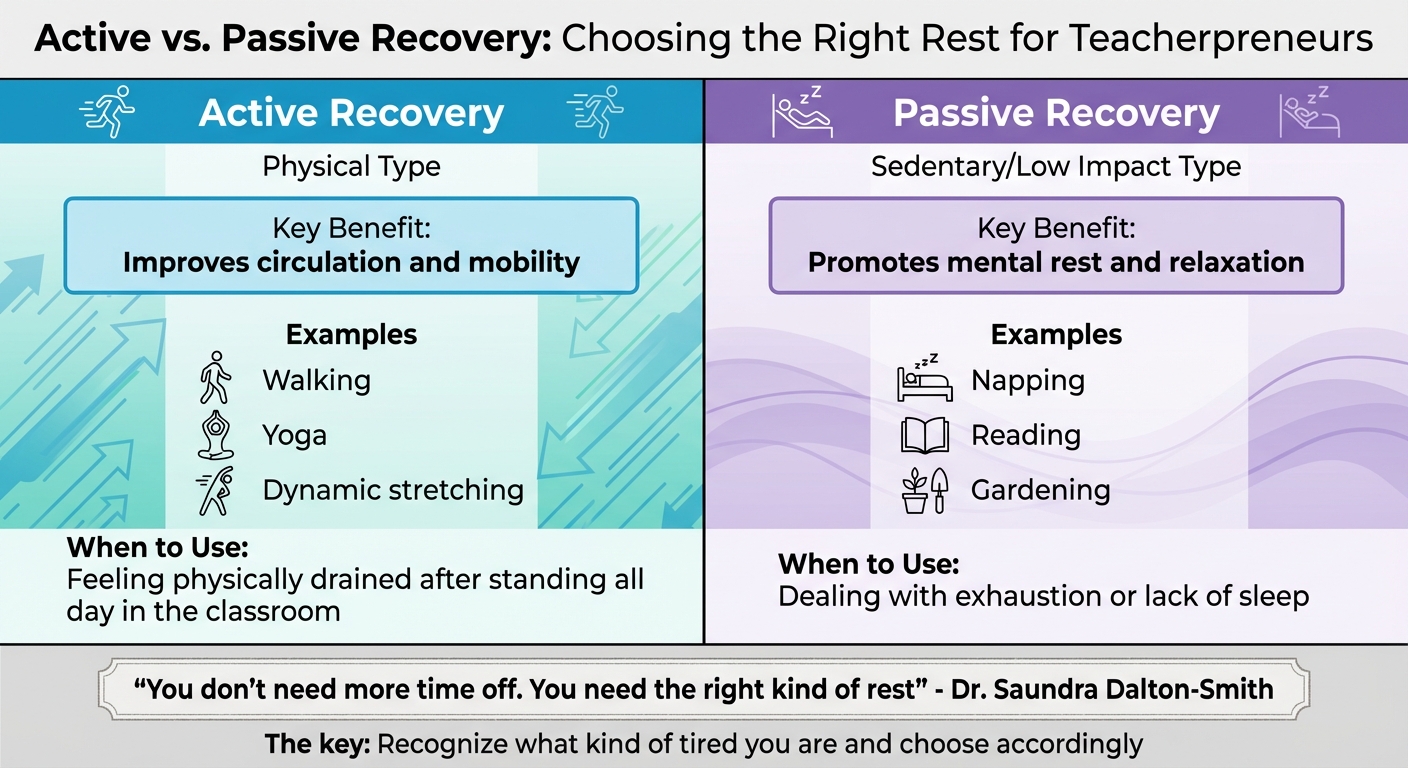
Active vs Passive Recovery Methods for Teacherpreneurs
Adding Exercise to Your Daily Routine
Physical activity is a quick and effective way to lower stress hormones and clear your mind. The best part? It doesn’t require long, grueling sessions. Short bursts of movement, often called micro-workouts, can fit seamlessly into a busy schedule. Think of a 5-minute lower body stretch or a quick 10-minute yoga flow - perfect for teacherpreneurs juggling endless tasks.
Yoga, in particular, stands out because it combines physical movement with mindful breathing and mental focus. As Kristin McGee, a Peloton Yoga Instructor, puts it:
The attention to breath is what makes yoga different from stretching. We focus on taking slow, deep, mindful breaths as we move in and out of or hold each yoga posture.
This makes yoga a two-in-one solution: it strengthens your body while calming your nervous system. For example, you could swap out one strength-training session per week for a yoga class or add a short 10-minute flow before bed to enhance sleep quality.
Other options include dynamic stretching, which involves controlled movements like walking lunges and serves as a great warm-up before cardio. On the other hand, passive stretching, where you hold a pose, is better for post-workout recovery. Even a daily 5-minute dynamic stretch before a run can help prevent injuries and boost performance.
Pair these activities with some outdoor time to amplify their benefits.
Using Outdoor Time and Breaks to Recharge
Spending just 10 minutes outside can work wonders for your energy and focus. Studies show that being in nature reduces cortisol (the stress hormone) and lowers blood pressure. Sunlight and fresh air naturally recharge your mental and physical capacity, making it easier to tackle tasks like grading papers or answering emails.
One idea is to schedule daily outdoor breaks. This could mean a quick solo walk after school or taking a phone call while strolling outside. A 2014 study from Stanford University revealed that walking meetings can spark creativity and encourage free-flowing ideas better than sitting at a desk. So, if you’re stuck on a challenging business decision or lesson plan, try stepping outside. A change of scenery often brings clarity.
Even mini-breaks during the school day can make a difference. Use the moments between classes to step outside for fresh air or practice deep breathing exercises. These small resets can prevent that overwhelming "always on" feeling, which often leads to burnout.
Now, let’s explore how to balance active and passive recovery for optimal rest.
Comparison: Active vs. Passive Recovery Methods
To maintain balance, it’s important to understand how different recovery styles fit into your routine. Not all rest is the same. Active recovery involves gentle movement to ease tension and improve circulation, while passive recovery focuses on complete stillness to allow your body to repair itself. As Dr. Saundra Dalton-Smith explains:
You don't need more time off. You need the right kind of rest.
| Method | Type | Benefit | Examples |
|---|---|---|---|
| Active Recovery | Physical | Improves circulation and mobility | Walking, yoga, dynamic stretching |
| Passive Recovery | Sedentary/Low Impact | Promotes mental rest and relaxation | Napping, reading, gardening |
If you’re feeling physically drained after a long day of standing in the classroom, active recovery - like a short walk or gentle yoga - might be just what you need. But if you’re dealing with sheer exhaustion or lack of sleep, passive recovery, such as an afternoon nap, will help you recharge. The key is recognizing what kind of tired you are and choosing the recovery method that matches your needs.
Mindfulness and Mental Reset Methods
Meditation and Deep Breathing Exercises
Just five minutes of focused breathing can help reset your mind and lower stress levels. The goal is to activate your parasympathetic nervous system, which slows your heart rate and reduces cortisol, ultimately sharpening your focus.
One simple technique to try is box breathing. Here's how it works: inhale for four counts, hold your breath for four counts, exhale for four counts, and hold again for four counts. Repeat this cycle six times (about two minutes) to calm your nervous system. This method is especially effective during transitions, like wrapping up a lesson or preparing to tackle your inbox.
You can also incorporate mindfulness into your daily routine. For example, while waiting for your computer to boot up, do a 90-second body scan. Pay attention to areas like your jaw, shoulders, or hands, and notice any tension. This small act of awareness can help you release stress. Elizabeth Miller, a teacher from Madison who completed mindfulness training, shared:
Breath awareness was just one part of the training, but it was something that I was able to consistently put into practice.
For a quick reminder to pause, keep a small object - like a stone - on your desk. Use it as a cue to take three deep breaths between tasks. These short "micro-meditations", lasting just 1-5 minutes, can make a noticeable difference in managing stress, whether you're in the classroom or running your business.
In addition to breathing exercises, putting your thoughts on paper can provide mental clarity.
Using Journaling for Mental Clarity
Journaling can help you process the challenges of balancing teaching and entrepreneurship. It’s more than just venting - it allows you to spot recurring thought patterns, like perfectionism or catastrophizing. Start with a thought log for one week, jotting down negative thoughts as they arise. Once you identify patterns, you can use the ABCDE Model to reframe them. This involves breaking down a situation into Adversity, Beliefs, Consequences, Disputation, and Energization, helping you shift to a more balanced mindset.
Another helpful practice is keeping a wins journal. Each day, write down small victories, whether it’s a breakthrough with a student, a new client reaching out, or simply managing a tough day. Tracking these successes helps you see progress in both your teaching and business roles.
Gratitude journaling is another powerful tool. List things you’re thankful for, like a supportive coworker or a successful lesson plan. Licensed Clinical Psychologist Ehab Youssef emphasizes:
Self-care is non-negotiable... don't underestimate the power of small steps.
Before heading into a stressful situation - like a parent-teacher conference or a business pitch - review past moments where you handled similar challenges successfully. This simple exercise can boost your confidence and prepare your mind to handle the dual demands of teaching and entrepreneurship.
Another quick way to reset is by checking in with your body.
Body Check-Ins and Staying Present
A quick body check-in - what some call "dropping in" - is a great way to reconnect with your physical and emotional state during natural breaks in your day.
Take three deep breaths after a meeting or before starting a new task. Pay attention to any tension in your body, like tight shoulders or a clenched jaw. Simply acknowledging these sensations can help you relax. Elizabeth Miller found this practice particularly valuable in her classroom:
Now I spend more time getting students to notice how they're feeling, physically and emotionally, before reacting to something. I think this act of self-monitoring was the biggest long-term benefit for both students and teachers.
This approach works just as well for teacherpreneurs. If you notice rising stress - like a racing heart during a tough conversation or tightness while grading - pause for a body check. This small act can anchor your mind, allowing you to respond thoughtfully instead of reacting impulsively. It’s a simple way to stay grounded while juggling the demands of teaching and running a business.
Time Management and Setting Boundaries
Organizing Tasks with Tools and Methods
Start by prioritizing tasks for both teaching and business responsibilities. This approach helps you avoid overcommitting and reduces the risk of burnout. When new tasks or responsibilities come your way, take a moment to request time to get oriented instead of diving in immediately. This small pause can help you avoid feeling constantly rushed.
Build buffer time into your schedule to account for unexpected delays. This creates a smoother workflow and helps you stay composed throughout the day. Additionally, apps like Headspace or Calm can help you stay focused and manage stress effectively. These tools can be game-changers when you're juggling lesson plans, grading, and running a business.
Planning Regular Breaks and Time Off
Once you've structured your tasks, make sure to include planned breaks. These breaks are essential for shifting your body out of stress mode and into rest mode. Skipping them can leave you in a constant state of alert, which often leads to exhaustion.
"I've worked with so many teachers who feel guilty about taking time for themselves because they think it's selfish. But when they start prioritizing self-care, they realize it's the opposite - it's what allows them to show up fully for their students."
- Ehab Youssef, Licensed Clinical Psychologist
Set aside at least one evening each week to be completely free from teaching and business tasks. This "school-free" time lets your mind and body recharge. During your workday, take five-minute breaks for quick resets - step outside, stretch, or try the box breathing technique.
Treat these mini-breaks like scheduled appointments. They're not just nice-to-haves; they're essential for staying productive and balanced. By planning breaks, you can clearly separate work time from personal time, which helps you stay focused and refreshed.
Separating Work and Personal Life
Stick to defined work hours and establish a "no-email after-hours" rule - for example, you might decide to stop checking emails after 6:00 p.m. Communicate this boundary clearly using direct "I" statements, like:
"I don't check emails after 6 p.m., but I'll respond first thing in the morning."
- Alex Skov
Think about boundaries in four key areas: material (protecting your physical resources), physical (preserving your space and time), mental (setting realistic expectations), and emotional (separating work issues from your self-worth). Addressing all these areas helps you better balance dual careers.
Say no to extra responsibilities that stretch you too thin. Instead, see yourself as a partner in education, collaborating with others rather than taking on everything alone.
"You can't just give yourself for free, and that's what was happening to me. I had to figure out what went wrong with me."
- Shayla Ewing, Principal
Building Support Networks and Using Available Resources
Connecting with Others for Support
Balancing the dual roles of teaching and entrepreneurship can sometimes feel isolating. In fact, research indicates that 27% of entrepreneurs experience loneliness, with an average loneliness score of 7.6 out of 10. This emotional strain can negatively impact decision-making, creativity, and risk assessment. Connecting with other teacherpreneurs can create a support system where you can share experiences and challenges that friends or family might not fully grasp. Platforms like Slack, Discord, and Reddit host communities of like-minded individuals who understand the unique struggles of teacherpreneurs.
Stepping out of your home office can also make a big difference. Whether you choose to work in a co-working space, schedule regular video calls (with cameras on), or participate in local markets and pop-up events, these activities can help combat isolation and keep your social skills sharp.
"It's impossible to run a business fully on your own, so taking the time to meet others in your community will, without a doubt, help you in the long run."
- Sophia Pierro, Owner, Present Day
While building connections is essential, tapping into specialized resources can give your efforts an extra edge.
Using DASHK12 Resources for Your Business

DASHK12 provides digital tools designed to make the shift from teaching to entrepreneurship smoother. Their Notion templates, like the CRM Dashboard and Progress Dashboard, are tailored to help you manage and track business growth without adding unnecessary stress to your schedule. These templates are budget-friendly, starting at $5, with e-books priced at $7 each. For those looking for more comprehensive support, bundles like the "Launch Your Brand" package are available for $67.
For tasks that demand more time and expertise, DASHK12 offers done-for-you services. These include web design for $50 per month, social media marketing for $150 per month, and blog writing services at $200 per month. Teacherpreneurs have successfully used these resources to generate steady income from the start and turn struggling businesses into profitable ventures.
"This LMS program is a thoughtfully designed professional learning experience that supports CTE teachers at every stage of their journey."
- Rhonda Parker, M.Ed, Educator/Business Owner
Additional tools like the "Teaching Skills to Business Skills Converter" and the "Passive Income Calculator for Teachers" are also available. These resources can help you determine your market value and set realistic financial goals, giving you a clear path as you grow your business.
Adding Stress Management to Your Daily Life
Designing Flexible Daily Schedules
Balancing teaching with entrepreneurship can feel like juggling two full-time jobs. To make it work, you need a routine that’s adaptable rather than rigid - one that bends with the demands of your week instead of snapping under pressure.
One way to lighten the mental load is by using time blocking and task batching. These strategies help you stay focused and efficient, especially when you're managing a packed 52-hour week with just 25 hours allocated to instruction. For instance, you could dedicate Tuesday and Thursday evenings to grading and reserve Monday mornings solely for lesson planning.
Make the most of your 45–60 minute prep periods by tackling high-focus tasks like creating lesson plans or responding to complex emails. This helps keep work from spilling into your personal life or eating up time you need for business development. For quick tasks - like replying to a parent email or grading a single assignment - apply the 2-minute rule: if it’ll take less than two minutes, handle it right away to avoid a pileup.
Physical cues can help your brain transition between roles. For example, changing outfits after teaching or moving to a separate workspace when switching from grading to business tasks can signal a shift in focus. Also, try holding off on using your phone for the first 30–60 minutes of your morning. This helps you ease into your day without immediately reacting to notifications.
"The world of an educator can feel like a 24/7 job. There is always something that needs to be done, and it is no secret that there is not enough time during the contracted teacher day to accomplish it all."
- Alivia Kramlick DeVere, Elementary School Teacher
Another tip? Treat personal time as sacred. Block it off in your calendar just like you would an important meeting. Create tech-free zones in your home - keep work devices out of spaces like the bedroom or dining table - to protect your boundaries. Keep in mind that forming a habit takes time; research shows it usually takes about 66 days for a new behavior to stick.
Once your flexible schedule is set, regularly check in with yourself to ensure it’s working and adjust as needed.
Monitoring Progress and Adjusting Your Approach
A flexible routine is a great start, but keeping it effective requires regular self-assessment. According to a 2022 Gallup Poll, K-12 workers in the U.S. experience the highest burnout rates of any industry.
Watch for warning signs that stress is creeping in - things like constant fatigue, irritability, trouble sleeping, or even physical symptoms like digestive issues. These can show up before you even realize you’re overwhelmed. To keep your spirits up during tough times, jot down one to three small wins each day. It’s a simple way to shift your focus toward the positive.
Set aside 15 minutes every Friday to reflect on your week. Ask yourself: What worked? What didn’t? What could I tweak for next week? You can also try using the ABCDE model (Adversity, Beliefs, Consequences, Disputation, Energization) to challenge negative thoughts that might be adding to your stress.
"If you do not make time for wellness, you make time for illness."
- Collen Carney, High School Teacher
Pay attention to your energy patterns throughout the day. When are you most productive? Use those peak hours for your hardest tasks, whether it’s designing curriculum or brainstorming for your business. If something you’re trying doesn’t seem to be helping after four to six weeks, don’t just push through - switch it up and test a new approach.
Sometimes, an outside perspective can be invaluable. Talk with a mentor, colleague, or therapist to get fresh insights into your stress management efforts. They might notice patterns or solutions that you’ve overlooked. After all, teaching is demanding - by the end of the 2021 school year, one in four teachers was considering leaving the profession. But with consistent monitoring and adjustments, you can create a sustainable balance that supports both your teaching career and entrepreneurial goals.
Conclusion: Finding Balance as a Teacherpreneur
Balancing the dual roles of teaching and entrepreneurship requires more than just hard work - it demands a thoughtful approach to well-being. This guide has highlighted how physical health, mindfulness, setting boundaries, and building support networks all play critical roles in maintaining that balance. These aren't just nice-to-haves; they're tools that help you thrive in both the classroom and your business.
Think of wellness as a key performance metric, just like lesson plans or revenue. Track your stress and energy levels with the same dedication. Simple strategies like the 2‑minute rule for quick tasks, batching similar activities, and automating repetitive work can make a big difference. As Ehab Youssef wisely points out, self-care isn't optional - it’s essential.
Start small. Try a 10‑minute micro-workout or set aside time for a Friday reflection session each week. Pay attention to what works and adjust as needed. Building resilience is a gradual process, but each small step brings you closer to sustainable balance.
Your students and business both deserve your best energy. By prioritizing wellness, you not only protect your health but also enhance your ability to succeed in both roles. Incorporating these strategies into your daily routine strengthens the link between self-care and professional success. For additional support, DashK12 (https://dashk12.com) offers courses and tools tailored to help educators build thriving businesses without sacrificing their well-being.
The goal isn't to work harder - it’s to work smarter, ensuring you have the energy to excel in both teaching and entrepreneurship.
FAQs
How do I know if I need active or passive recovery?
Deciding whether to go for active or passive recovery depends largely on how you're feeling - both physically and emotionally. Active recovery involves light activities like gentle exercise or mindfulness exercises, which can help you feel refreshed without overexerting yourself. On the other hand, passive recovery is all about rest, such as getting extra sleep or spending quiet time to recharge.
If you're emotionally drained or completely worn out, passive recovery might be the better choice. But if you're looking to re-energize or stay mentally engaged, active recovery could be more beneficial. The key is to listen to your body and mind to figure out what will help you recover most effectively.
What’s the fastest mindfulness reset I can do during a school day?
A quick 3-minute mindfulness practice can work wonders during a hectic school day. Take a moment to focus on your breathing or try a short awareness exercise between classes. These simple techniques can engage your parasympathetic nervous system, helping to ease stress and sharpen your focus.
How can DASHK12 help me reduce business-related stress?
DASHK12 offers tools and resources designed to ease the stress of running a business. By addressing challenges like time management, resource allocation, and staying motivated, they help bring structure to your daily operations. With their support, managing your business feels more streamlined, allowing you to focus on reaching your goals with greater confidence.