10 STAR Method Examples for Interviews
Behavioral interview questions like "Tell me about a time when..." are designed to uncover how you handle real-world challenges. The STAR method - Situation, Task, Action, Result - is a structured way to answer these questions effectively. It helps you stay focused, showcase your skills, and provide measurable outcomes that resonate with interviewers. Here's what you need to know:
- Situation: Set the stage with context and background.
- Task: Explain your role and the challenge you faced.
- Action: Highlight the steps you took (spend 60% of your answer here).
- Result: Share the outcome, ideally with quantifiable results.
This article provides 10 practical STAR method examples for common interview questions, such as solving problems, showing leadership, working in teams, and meeting tight deadlines. Each example demonstrates how to structure responses, focus on your contributions, and back up your achievements with data. By mastering this approach, you can confidently tackle even the toughest interview scenarios.
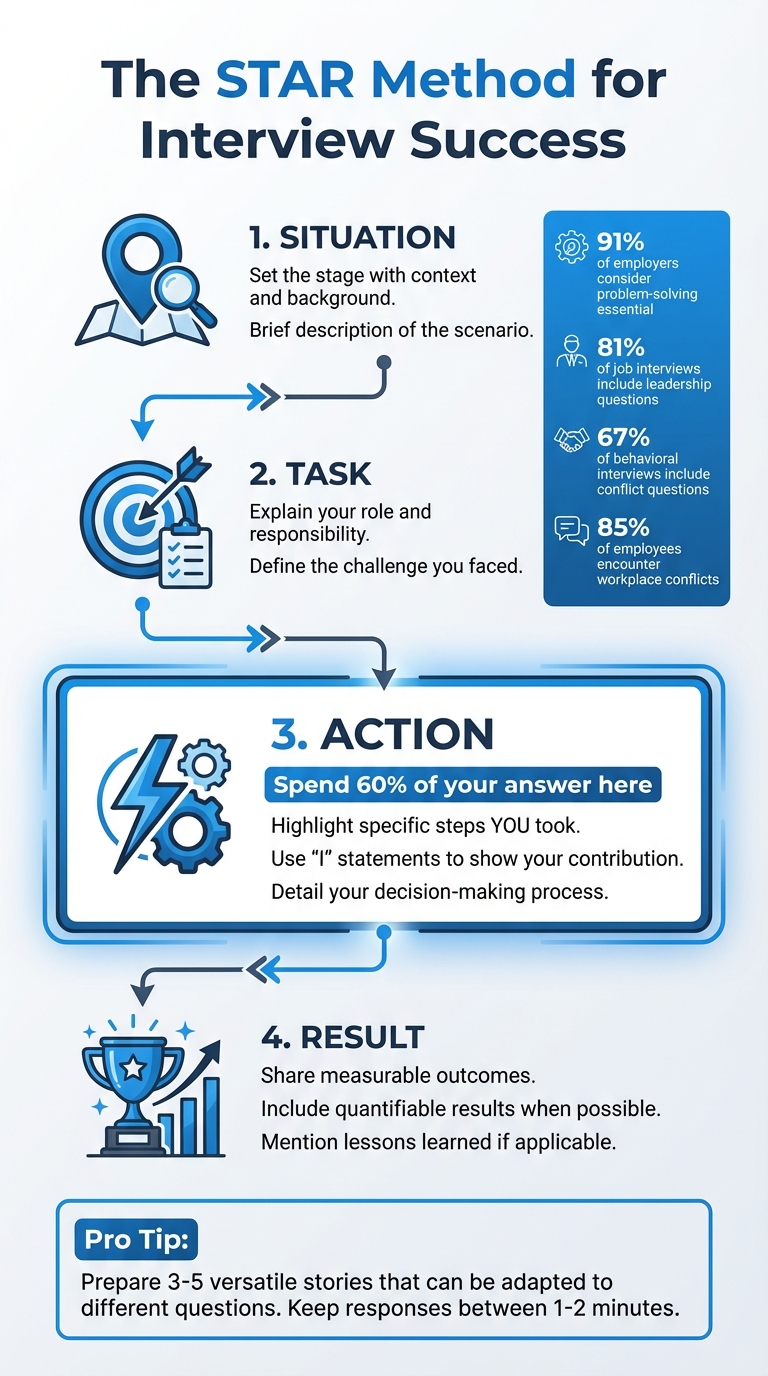
STAR Method Framework for Interview Responses
Answering Behavioral Interview Questions Using the STAR Method
1. Tell Me About a Time You Faced a Difficult Problem at Work
This question is designed to assess your problem-solving abilities, a skill that 91% of employers consider essential in new hires. The interviewer isn’t just interested in the challenge itself - they want to understand how you approached it and the results you delivered. To make your response impactful, focus on a meaningful problem that highlights your strengths. Avoid discussing minor or routine issues.
When crafting your answer, use the STAR method (Situation, Task, Action, Result). Start by briefly explaining the context and the problem you faced. Then, dive into the actions you specifically took to address it. Use "I" statements to emphasize your personal contribution, which helps demonstrate your unique impact.
"The truth is, your interviewer doesn't care about the problem you had at hand - they care about how you went about solving it, and the impact you had on the organization." - Tali Shlafer, Interview Coach
Whenever possible, back up your story with measurable outcomes. For example, you might say, "I reduced customer complaints by 30%" or "streamlined operations, saving the company $50,000 annually". Clear numbers make your achievements stand out and feel more tangible. If the situation involved setbacks, focus on what you learned and how you grew from the experience.
Choose a problem that aligns with the role you’re applying for, and keep your tone positive and professional, even when discussing challenging moments. By following these steps, you’ll present a story that resonates with your interviewer and leaves a lasting impression.
2. Describe a Time When You Showed Leadership
Did you know that 81% of job interviews include questions about leadership? And that’s not just for management roles - it applies across the board. Why? Because employers want to know if you can step up, inspire others, and make decisions under pressure, even without a formal title. It’s not about waiting for instructions; it’s about recognizing what needs to be done and taking action.
To effectively showcase your leadership, use the STAR method (Situation, Task, Action, Result). But here’s the trick: spend 60% of your response on the Action part. This is where you highlight your decision-making process and leadership style. Make sure to focus on your role. Use "I" statements to clarify your contributions. For instance:
- Instead of: "Our team improved customer service response times."
- Say: "I reorganized workflow and trained three team members, reducing customer service wait times by 30%."
"Leadership is about recognizing what needs to be done and taking initiative." – Revarta
Pick a recent example that demonstrates skills like strategic thinking, delegation, or conflict resolution. For example, leading a rebranding and digital marketing initiative could result in a 40% increase in social media engagement and a 25% boost in market share over three years. Or, revamping a company newsletter might drive a 25% increase in sign-ups in just three months. Even focusing on team motivation could lead to a 15% rise in productivity within a single quarter.
The key is to show how you didn’t just complete a task - you made an impact. Did you mentor a struggling colleague? Resolve a tense team conflict? Motivate an underperforming group? Use specific examples and measurable outcomes to make your story stand out. Numbers make it real, and results make it memorable.
3. Tell Me About a Time You Worked on a Team
Teamwork-related questions are designed to uncover how well you collaborate with others, manage challenges, and contribute to shared goals. Employers want to see how you navigate diverse personalities and maintain efficiency under pressure. The trick is to highlight your personal contributions without losing sight of the team’s overall success.
One common pitfall is overusing "we" statements, which can obscure your individual role. For example, instead of saying "Our team launched the product on time," try something more specific like: "I organized cross-departmental meetings to identify bottlenecks and delegated tasks to streamline the process, which helped us launch one week early."
"Using 'we' statements can make it difficult for an employer to have a clear understanding of what your skills are. Instead, focus your response on how you contributed to the outcomes of the team efforts." – MIT Career Advising & Professional Development
When structuring your answer, devote about 60% of your response to the Action you took. This is your opportunity to showcase the specific steps you implemented - whether it was organizing meetings, introducing collaborative tools, resolving conflicts, or adapting to different work styles. For instance, initiating one-on-one consultations to improve team morale could lead to measurable outcomes, like a 15% boost in quarterly productivity. Or, perhaps you helped complete a cross-functional project ahead of schedule by refining workflows and improving communication.
The goal is to strike a balance: emphasize your unique contributions while acknowledging the team dynamic. And if the results weren’t perfect, be transparent about what you learned and how you’d approach things differently next time.
4. Describe a Situation Where You Persuaded Someone
Persuasion questions test your ability to influence others, especially when you lack formal authority. Interviewers want to know if you can adjust your approach for different audiences, handle objections gracefully, and rely on logic over pressure. The key here is to show both empathy and a structured thought process.
Just like with problem-solving or leadership scenarios, persuasion hinges on taking clear, intentional steps. Start by outlining the initial objections you faced. Maybe the person was concerned about budget constraints, preferred sticking to a familiar process, or simply hadn’t seen the data supporting your idea. Then, explain how you addressed those concerns. For example, instead of saying, "I shared the benefits", you could say: "I scheduled a one-on-one meeting with the department head, presented a cost–benefit analysis showing we’d save $18,000 annually, and eased her concerns about implementation time by suggesting a phased rollout over three months."
"Persuasion can be the difference between securing a deal, inspiring a team, or simply conveying one's ideas effectively." – Ben Schwencke, Lead Consultant, Test Partnership
This is your chance to showcase your thought process. Detail how you gathered key data, listened to objections, and adapted your strategy. Did you use visual aids? Did you align your proposal with the team’s goals or priorities? Be specific about what you did and highlight the results. For instance, if your approach led to measurable outcomes like a 24% increase in project approval rates or $50,000 in savings, make sure to mention those metrics.
Finally, acknowledge any resistance you encountered at the start. Doing so helps emphasize the strategic effort you put into overcoming challenges and achieving success.
5. Tell Me About a Time You Handled a Stressful Situation
When interviewers ask about handling stress, they’re not just curious about how you felt - they want to know how you acted. Your response should focus on the steps you took to address the situation, not the emotional toll it might have had. This is where the STAR method can be a game-changer, as long as you balance your response correctly.
Here’s the key: dedicate about 60% of your answer to the actions you took. The situation and results are important, but they should take a backseat to the solution. For instance, instead of lingering on the pressure of juggling multiple deadlines, highlight how you tackled the challenge. Did you create a priority list? Set aside focused work time? Delegate less critical tasks? These are the details that showcase how you rise to the occasion.
It’s also critical to emphasize your individual contributions. Saying “we implemented a new system” makes it unclear what you did. A stronger response would be: “I worked with the IT team to implement a new ticketing system, which reduced response times by 24%.” Including measurable outcomes like this strengthens your credibility and demonstrates the impact of your actions.
Steer clear of negative phrasing. Statements like, “I was overwhelmed” or “I didn’t know where to start” can make you seem unprepared. Instead, reframe those moments to highlight leadership and problem-solving. For example: “I managed an unexpected staffing shortage by reallocating tasks and training two interns within three days.” This type of language shows you stayed calm, thought critically, and took charge - qualities that stand out to employers.
sbb-itb-4f1eab7
6. Give an Example of When You Took Initiative
When interviewers ask about taking initiative, they want to know if you can act independently, identify opportunities, and solve problems without waiting for explicit instructions. As Rumie explains, "Initiative means stepping up before anyone asks". This question helps assess your ability to spot gaps, take ownership, and deliver results without constant supervision.
The best examples of initiative focus on situations where you went beyond your assigned duties. Think about moments when you noticed a problem or opportunity and took action without being prompted. For instance, a retail employee might observe long holiday checkout lines and decide to set up a gift-wrapping station. This could reduce wait times by 24% while also boosting sales. Stories like these highlight your ability to recognize a need and take meaningful steps to address it.
When crafting your response, spend the majority - around 60% - of your time discussing the actions you took. Break it down: explain how you identified the issue, conducted research, persuaded others to support your idea, and implemented a solution. For example, a software developer might say, "I noticed our team spent three hours each week on manual testing. I researched automation tools, created a testing script, and reduced bug reports by 40%". This level of detail shows your problem-solving and organizational skills.
To make your answer even stronger, include measurable outcomes. Metrics like "increased sales by 15%" or "improved accuracy by 25%" demonstrate the real-world impact of your initiative. Even if the results weren’t perfect, sharing what you learned from the experience can show your ability to grow and adapt for future challenges.
7. Describe a Time You Met a Tight Deadline
When interviewers ask about meeting tight deadlines, they’re looking to understand how you handle pressure, manage your time, and ensure results. This question is an opportunity to highlight your ability to prioritize tasks, communicate effectively, and stay focused when every second counts.
Start by briefly setting the stage: What was the situation? What was the task? Then, dive into the actions you took to meet the deadline. Be specific about your approach. Did you create a detailed to-do list? Break the project into manageable steps? Delegate tasks or reorganize priorities? These details show your ability to think critically and adapt under pressure.
For example, instead of saying, "I worked hard to finish", explain how you identified the most urgent tasks, streamlined processes, or collaborated with team members to ensure efficiency. If challenges came up, describe how you addressed them quickly and adjusted your plan to stay on track.
Use "I" statements to emphasize your role in the process. Whenever possible, include measurable outcomes to make your success more tangible. For instance, you might say, "I delivered the project two days ahead of schedule", or "I secured $500,000 in additional revenue by meeting the deadline." These details make your story more impactful and credible.
Avoid framing your response negatively, such as admitting you felt overwhelmed or unprepared. Instead, focus on the proactive steps you took to succeed. Highlight your leadership, organization, and resilience.
This structured approach, aligned with the STAR method, not only demonstrates how you met a deadline but also showcases skills like problem-solving, multitasking, and staying composed under pressure. A well-prepared example can even be adapted for other questions about stress management or overcoming challenges. Practice your response to ensure it’s clear, concise, and confident. Aim for a two- to three-minute answer that flows naturally and avoids unnecessary filler.
8. Tell Me About a Time You Resolved a Conflict
Conflict questions appear in about 67% of behavioral interviews, making them a common way for employers to assess emotional intelligence, communication skills, problem-solving abilities, and professional maturity. With 85% of employees encountering workplace conflicts at some point, chances are you have a story to share. To prepare, focus on a situation that demonstrates your ability to handle disagreements professionally.
Choose an example involving a moderate-level conflict - like differences in project direction, work styles, or communication issues - rather than serious matters such as harassment or ethical violations. For instance, you could describe a scenario where a coworker preferred working independently while you advocated for pair programming. These types of conflicts show you can handle professional disagreements without raising concerns.
Organize your response using the STAR-R framework (Situation, Task, Action, Result, Reflection). Spend 40–60% of your time explaining the actions you took. Be specific about the steps you followed, such as initiating a private meeting, asking questions to understand the other person's perspective, and suggesting compromises. Use "I" statements to highlight your role, even if the situation involved a team effort.
"The best answers focus more on resolution than the conflict itself, demonstrating maturity and communication skills." - The Interview Guys
When discussing the results, include measurable outcomes. For example, you might say, "After we implemented the compromise, our project velocity improved by 30%", or "The resolution reduced communication errors by 50% over the next quarter." Avoid criticizing former colleagues or claiming you've never faced conflict - both can suggest a lack of self-awareness. Keep your tone neutral and professional, focusing on how the issue was resolved rather than any personal drama.
9. Give an Example of a Difficult Decision You Made
When interviewers ask about tough decisions, they're looking to understand how you think critically, handle ethical dilemmas, make firm choices, and juggle competing priorities under pressure. To stand out, pick an example that highlights your logical, step-by-step decision-making process. Scenarios like choosing between two equally qualified job candidates, managing budget cuts, or deciding between meeting a deadline versus ensuring quality (e.g., delaying a product launch to address a security issue) work well here.
The key to answering this question effectively lies in how you frame your response. Focus on the actions you took to arrive at your decision. This is your chance to show off your reasoning. Did you research thoroughly? Consult stakeholders? Compare options carefully? For instance, one leader might describe reallocating resources in a way that generated $850,000 in revenue, while another might share how individual consultations with team members led to a 15% boost in productivity.
Be sure to explain why the decision was challenging. Maybe it risked client trust, impacted team morale, or involved complex ethical trade-offs. Use "I" statements to take ownership of your role, even if the decision was made within a team setting. Whenever possible, back up your story with measurable results - like cutting operational costs by 15% while maintaining quality. And if the outcome wasn’t ideal, don’t shy away from discussing it. Instead, focus on what you learned and how that lesson has shaped your approach to future decisions. This reflection ties back to the STAR method by emphasizing clear, actionable outcomes.
10. Describe a Time You Motivated Others
When interviewers ask about motivating others, they want to understand your leadership style and how you inspire those around you. To answer effectively, use the STAR method: explain the Situation, Task, Action, and Result. Focus on identifying the root cause of low morale - whether it’s burnout, lack of direction, or external challenges - and demonstrate how you addressed it with empathy and strategic solutions.
Spend the majority of your answer (around 60%) detailing the Action phase. Briefly set the stage by describing the challenge, such as a team struggling to meet a tight deadline or experiencing declining motivation. Then, outline your specific role, like improving productivity or helping the team refocus on their goals.
Be clear and specific about what you did. For example, you might mention holding one-on-one meetings to align tasks with individual strengths, setting SMART goals to clarify expectations, or introducing recognition programs to boost morale. Use "I" statements to highlight your leadership, such as realigning roles based on team members' unique motivations or implementing clear KPIs while fostering team autonomy. These steps illustrate your proactive approach.
"The team morale definitely lifted after I did the hard work of focusing on passions and motivations of team members and empowering team members to pursue their passions." - Chris Drew (PhD), Founder, Helpful Professor
Wrap up with measurable outcomes to show the impact of your actions. For instance, you could say, "Productivity increased by 15% in the following quarter", or "We exceeded our sales target by 12%." If relevant, share a key takeaway from the experience to demonstrate your growth and commitment to improving your leadership skills.
Conclusion
The STAR method serves as a clear framework for crafting concise and impactful interview answers. By structuring your responses around Situation, Task, Action, and Result, you create a narrative that’s easy for hiring managers to follow. A helpful tip is to dedicate about 60% of your response to describing the actions you took.
"A real example is much more memorable and convincing than theorizing." - Pamela Skillings, Chief Coach, Big Interview
Practice your stories out loud to refine your delivery, eliminate filler words, and keep your answers within the ideal one-to-two-minute range. Stick to key points to maintain a natural and engaging tone.
Prepare 3–5 versatile stories that highlight essential skills and align them with the job’s requirements. Draw from internships, volunteer work, or academic projects where you tackled challenges, led teams, or achieved measurable outcomes. By combining these strategies with real-life examples, you’ll ensure your interview answers leave a lasting impression.
FAQs
What is the STAR method, and how can I use it effectively in interviews?
The STAR method is a simple way to tackle behavioral interview questions by breaking your answer into four parts: Situation, Task, Action, and Result. Here's how it works:
- Situation: Start by describing a specific problem or scenario you encountered. Include just enough detail so the interviewer understands the context.
- Task: Outline your role or objective in that particular situation.
- Action: Focus on the steps you personally took to address the issue. Highlight your contributions rather than what the team as a whole did.
- Result: Wrap up by sharing the outcome. Emphasize the positive results and any lessons you gained from the experience.
Using this approach ensures your answers are clear and structured, making it easier for interviewers to see your problem-solving skills in action. Practicing ahead of time can help you feel confident and prepared to discuss how you’ve handled workplace challenges.
What mistakes should I avoid when using the STAR method in interviews?
- Lack of detail: Make sure you fully explain the situation, your specific actions, and the results. Avoid giving vague or overly broad answers that leave the interviewer guessing.
- Overusing 'we': This is your time to shine, so focus on your role. Use "I" to emphasize your individual contributions and impact.
- Rambling: Stick to the STAR framework to keep your answers focused and to the point. Adding unnecessary details can derail your response and confuse the interviewer.
- Skipping results: Always wrap up your answer with a clear and positive outcome. If the result wasn’t ideal, explain what you learned or how you adapted.
- Not practicing: Unpolished answers can seem scattered or unconvincing. Rehearse your STAR examples ahead of time to ensure your responses are smooth and effective.
By steering clear of these mistakes, you’ll deliver answers that are clear, focused, and highlight your skills in the best possible way.
How can I select the best examples for STAR method interview responses?
When preparing examples for STAR method responses, it’s essential to pick specific scenarios that showcase your abilities and match the job’s requirements. Focus on instances where you took the lead, solved a problem, or delivered a positive result.
Structure your examples clearly by breaking them into four parts: the Situation or challenge you faced, the Task or goal you aimed to achieve, the Actions you took to address it, and the Results you accomplished. Choose examples that highlight a mix of skills and strengths, steering clear of vague or overly broad stories. Aim to spotlight moments where your efforts had a noticeable impact or where you gained meaningful insights from overcoming obstacles.
By aligning your examples with the role and emphasizing positive, results-driven stories, you’ll craft responses that leave a strong impression on interviewers.