Innovation in Education: Tools for Entrepreneurial Thinking
Education is shifting from rote memorization to skills that prepare students for modern challenges. Entrepreneurial thinking is at the heart of this change, focusing on problem-solving, creativity, and resilience. It’s not about turning every student into a business owner but teaching them to identify opportunities, test ideas, and learn from failure.
Key takeaways:
- Core Skills: Initiative, resilience, problem-solving, and opportunity recognition.
- Practical Tools: Design Thinking, Business Model Canvas, and Lean Startup methods.
- Hands-On Learning: Activities like $5 Startup Challenge and digital prototyping tools (e.g., Canva, Figma).
- Age-Specific Approaches: Play-based activities for younger students; project-based ventures for older ones.
- Resources for Teachers: DashK12 offers lesson plans, templates, and professional development materials.
This approach equips students with essential skills for today’s economy, making learning more engaging and purposeful.
Core Skills for Entrepreneurial Thinking
Key Skills
Entrepreneurial thinking revolves around five essential skills: initiative, resilience, creativity, problem-solving, and opportunity recognition.
- Initiative empowers students to take charge and act independently.
- Resilience equips them to view challenges and setbacks as valuable lessons.
- Creativity sparks the ability to think outside the box and combine ideas in unexpected ways.
- Problem-solving enables them to break down complex issues, identify root causes, and test potential solutions.
- Opportunity recognition trains them to identify gaps, needs, or inefficiencies that could inspire new ventures.
These skills are best developed through hands-on experiences. Take the $5 Startup Challenge, for instance. Used in many U.S. high schools, this activity gives students just $5 in starting capital, pushing them to rely on creativity and resourcefulness rather than money. This limitation fosters initiative and opportunity recognition as they brainstorm and launch real micro-ventures with minimal resources.
Other programs use innovative tools like LEGO Serious Play to encourage teamwork and imaginative problem-solving or coin toss games to teach students how to distinguish between luck and skill in business outcomes. Middle schoolers often engage in projects like designing brands, logos, or podcasts, which help build communication skills and a sense of ownership. The consistent theme across these activities? Students learn by actively doing, not by passively memorizing definitions.
Age-Appropriate Learning
Tailoring activities to students’ developmental stages is crucial for nurturing these entrepreneurial skills. Different age groups require distinct approaches to ensure the lessons resonate.
For elementary school students, play-based activities work best. Think simple product design challenges, classroom marketplaces where they trade goods, or brainstorming games like coming up with multiple uses for everyday objects. At this stage, the focus is on sparking curiosity and encouraging creativity rather than diving into complex business concepts.
In middle school, students begin tackling more practical, real-world problems. They might create podcasts, design products to address community needs, or even run small ventures within their schools. These projects emphasize collaboration, empathy, and iteration - learning to refine their ideas based on feedback. The shift here is from playful exploration to purposeful creation.
4 Entrepreneurial Secrets Every Teacher Needs to Empower Learning
Tools and Frameworks for Teaching Entrepreneurship
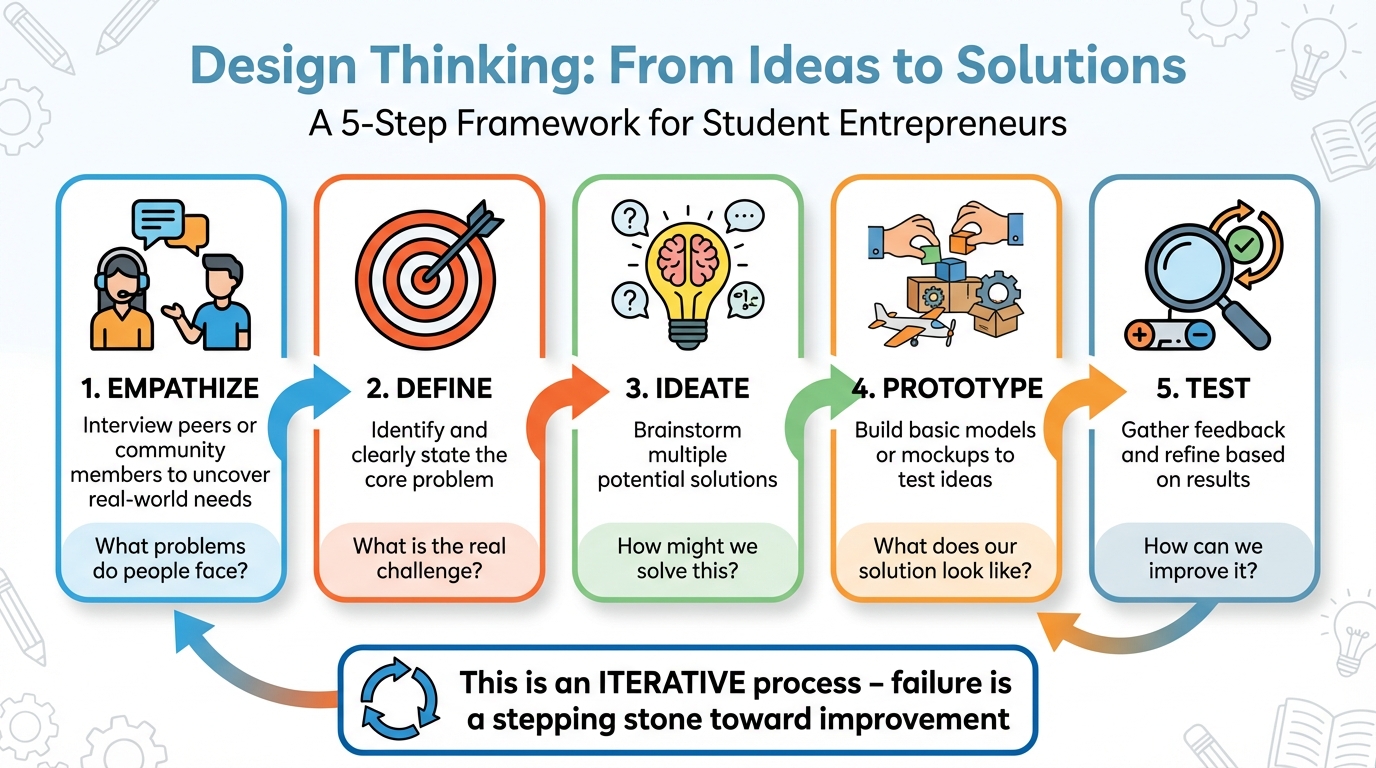
5-Step Design Thinking Process for Entrepreneurial Education
Design Thinking and Problem Solving
Design Thinking is a hands-on approach that turns creative ideas into practical solutions through five structured steps: empathize, define, ideate, prototype, and test. This method is especially effective in K–12 classrooms because it simplifies complex challenges into smaller, actionable steps that students can tackle collaboratively.
The process begins with empathy, where students interview peers or community members to uncover real-world needs. They then move to defining the core problem, brainstorming potential solutions, building basic prototypes, and refining those prototypes based on feedback. This iterative process helps students see failure not as a setback but as a stepping stone toward improvement. For example, EIX's Invention vs. Innovation lesson modules guide students through this cycle using real-world examples, helping them differentiate between creating something entirely new and improving existing ideas. Visual planning tools can also help organize and structure these creative efforts, making the process even more accessible for young learners.
Business Model Canvas and Value Proposition Canvas
While design thinking focuses on refining ideas through empathy and iteration, visual canvases like the Business Model Canvas and Value Proposition Canvas help students break down business concepts into structured, strategic elements.
The Business Model Canvas condenses business planning into a single-page visual, covering nine key areas: key partners, key activities, value propositions, customer relationships, channels, customer segments, cost structure, and revenue streams. By mapping out these elements, students can identify gaps and refine their business strategies more effectively.
The Value Proposition Canvas complements this by zooming in on two critical aspects: understanding customer needs (their jobs, pains, and gains) and evaluating how a product provides value (through pain relievers and gain creators). High school students can use these tools to analyze real businesses, from local startups to social enterprises, sharpening their strategic thinking skills - especially useful for pitch competitions. Platforms like Sutori allow students to create digital presentations of their business models, enabling peer feedback and further refinement. These tools turn abstract ideas into actionable classroom projects.
Prototyping and Lean Startup Basics
Once students have planned their ideas, Lean Startup principles help them move quickly into testing and iteration. This approach encourages rapid experimentation and learning from feedback, mirroring the fast-paced nature of real-world entrepreneurship.
The core of Lean Startup is the build, measure, learn cycle. Students create minimum viable products (MVPs) - basic prototypes designed to test key ideas - and gather feedback from peers or potential users. By focusing on quick iterations, they reduce risk and develop resilience. For example, game-based modules can help students explore uncertainty in their prototypes, teaching them to differentiate between luck and skill in business outcomes. Activities like rapid ideation sprints, where students design and test MVPs within an hour, make these concepts engaging and manageable even in shorter class periods. Collaborative tools like Padlet further enhance the process by enabling students to share ideas visually and validate them quickly, mimicking the iterative loops of real-world startups.
Digital Tools for Entrepreneurial Education
Creativity and Idea Generation Tools
Digital platforms are transforming how students brainstorm and develop ideas. Tools like Padlet act as virtual idea walls, allowing students to share business concepts, customer challenges, and feedback in real time. This fosters collaboration and equips students with skills that mirror modern entrepreneurial practices. Similarly, Sutori helps students create digital timelines and interactive presentations, blending text, images, videos, and quizzes to map out entrepreneurial journeys or develop business model canvases.
AI tools such as ChatGPT and TeachAid are also making waves in classrooms. Teachers use these platforms to craft lesson plans and generate project ideas that encourage entrepreneurial thinking. Meanwhile, students can utilize them for brainstorming customer personas, creating marketing slogans, or experimenting with value propositions. Canva takes this further by helping students design logos, taglines, brand kits, and even video clips, all essential for building a strong business identity. Additionally, YouTube provides access to real-world entrepreneur stories and serves as a platform for students to share their marketing campaigns or pitch videos.
Once ideas are generated, digital prototyping tools help students bring their concepts to life.
Prototyping and UX Tools
Interactive prototyping tools give students the ability to transform abstract ideas into functional designs, emphasizing the importance of user experience early in the process. Platforms like Adobe XD, Figma, and InVision allow students to create wireframes and clickable prototypes without requiring coding skills. A common classroom workflow involves sketching low-fidelity wireframes on paper, digitizing them, and sharing prototypes for instant feedback.
For younger students or classrooms with limited resources, Canva provides an easy-to-use alternative for creating basic prototypes, logos, and brand visuals. Sutori can also be adapted to build interactive storytelling prototypes, showcasing the evolution of a product or service. These tools enable quick iterations and encourage teamwork, replicating the fast-paced environment of startups.
Alongside prototyping, understanding financial principles is key to turning ideas into viable businesses.
Financial Literacy Tools
Financial literacy tools bring concepts like budgeting, pricing, and financial projections to life through hands-on experiences. Classroom activities such as business pitch competitions, stock market games, and simulated marketplaces teach students economic fundamentals like supply and demand, investing, and break-even analysis. Platforms like EverFi and Next Gen Personal Finance provide digital curricula with age-appropriate lessons, making these concepts accessible through interactive games and simulations.
These tools allow students to practice creating startup budgets, modeling cash flow, analyzing pricing strategies, and calculating profit margins - all within an engaging and interactive framework. By managing virtual budgets and applying these strategies in pitch competitions, students gain practical financial decision-making skills that prepare them for entrepreneurial challenges.
sbb-itb-4f1eab7
DashK12 Resources for Educators
DashK12 builds on entrepreneurial principles and digital tools to provide educators with practical, ready-to-use classroom materials.
Classroom-Ready Resources
DashK12 offers a variety of tools, including slide decks, project templates, and career and technical education (CTE) modules that cover topics like idea generation, marketing, personal branding, and business planning. These materials come complete with objectives, teacher notes, timing guidelines, and U.S.-specific examples (e.g., prices in USD and references to local small businesses). They also include formative assessments, making it easy for teachers to integrate them into current lesson plans or after-school programs with minimal preparation.
The CTE resources align with common U.S. career pathways such as Business & Marketing, Digital Media, and Hospitality. They also focus on essential workplace skills like communication, teamwork, and problem-solving, which are core elements of U.S. CTE standards. Templates guide activities ranging from simple classroom business projects for upper elementary grades to brand design projects for middle school students and micro-ventures like the $5 startup for high schoolers. These resources are designed to fit seamlessly into the entrepreneurial frameworks already discussed, creating a cohesive curriculum.
Professional Development Tools
DashK12 also supports educators through self-paced courses and e-books that cover entrepreneurship content and teaching strategies, such as project-based learning and design challenges tailored for K–12 classrooms. The e-books provide step-by-step guides for structuring venture projects, grading innovation work, and embedding entrepreneurship into core subjects. They include rubrics and sample project briefs to make implementation straightforward.
Additional tools, like job interview training modules, help teachers model professional communication, resume writing, and behavioral interviewing techniques. These skills translate directly into lessons on pitching, networking, and personal branding - key elements of fostering an entrepreneurial mindset in students.
Educators can use the self-paced courses to plan semester-long projects or refresh specific lessons with shorter modules. Professional learning communities or departments might choose a DashK12 e-book or module to focus on over a quarter, meeting briefly (e.g., 30 minutes monthly) to adapt templates, test lessons, and share student outcomes.
Beyond professional development, DashK12 also offers materials for immersive business simulations, turning theoretical concepts into practical experiences.
Business Simulation and Consulting Materials
DashK12 provides consulting resources like case briefs, client scenarios, and guided worksheets. These materials allow students to step into the role of junior consultants, tackling real-world challenges relevant to U.S. contexts, such as managing school stores or organizing local events. Students are tasked with defining client problems, analyzing basic data (e.g., sales figures or customer feedback), brainstorming solutions, and presenting recommendations - mimicking the processes used by professional consultants and entrepreneurs.
For short-term projects, teachers can use a DashK12 client scenario for a 3–5 day sprint. Students identify problems, develop solutions, and pitch their recommendations, with assessments based on creativity, feasibility, and communication skills. For longer projects (3–6 weeks), students refine their recommendations by gathering feedback through quick peer surveys, adjusting strategies like pricing or promotions, and creating basic financial projections using U.S. dollar values.
These hands-on experiences help students connect classroom learning to practical applications, preparing them for real-world challenges.
How to Use These Tools in Your Classroom
The tools and frameworks outlined here are most effective when tailored to the realities of your classroom - whether that means working around limited time or varying levels of access to technology. The best approach? Start small. Build familiarity gradually, whether through short, focused activities, longer-term projects, or weaving these ideas into existing subjects. Below, you'll find practical ways to implement these strategies in short sprints, semester-long projects, and subject-specific lessons.
Short Innovation Sprints
A 1–3 day sprint is a great way to introduce entrepreneurial thinking without overhauling your entire curriculum. These quick activities use design thinking to guide students through identifying problems, brainstorming solutions, and testing ideas in a fast-paced, low-pressure setting.
For instance, in a two-day sprint:
- Day 1: Students might interview classmates about a real problem at school, like overcrowded cafeterias or homework stress. Using sentence frames like "Students need a way to…", they can turn their findings into clear problem statements. Then, they brainstorm solutions in an 8–10 minute session, focusing on quantity over quality.
- Day 2: Teams pick one idea to develop into a simple prototype - this could be a sketch, storyboard, paper app interface, or even a LEGO® model. Afterward, they test their prototype with peers, who provide feedback using prompts like "I like… I wish… What if…". Teams refine their ideas and present them in a concise one-minute pitch.
These sprints can be adapted for different age groups:
- Upper elementary students might focus on improving recess by drawing storyboards and crafting simple paper models.
- Middle schoolers could tackle redesigning the lunch experience, using tools like Kanban boards and creating prototypes out of cardboard or Google Slides.
- High school students might try a $5 Startup-style sprint, conducting customer interviews, using a simplified Business Model Canvas, and pitching their venture - all within 2–3 days.
Assessment can be kept simple, focusing on understanding the problem, creativity, teamwork, and reflection rather than a polished final product. This approach emphasizes rapid ideation and learning through iteration, which are key entrepreneurial skills.
Semester-Long Venture Projects
For a more in-depth experience, a 6–18 week venture project allows students to explore an idea from discovery to a final pitch, refining their work through multiple stages. These projects can follow a structured process with clear milestones:
- Opportunity Discovery (2–3 weeks): Students research and define a problem within their school or community.
- Idea Generation and Selection (2 weeks): They brainstorm and choose one idea to pursue.
- Business Model and Prototyping (3–5 weeks): Teams build a Business Model Canvas and create low-cost prototypes.
- Testing and Iteration (2–3 weeks): Feedback is gathered to refine their models.
- Pitch and Reflection (1–2 weeks): Students present their pitches and reflect on the skills they've developed.
Throughout the project, simple tools like surveys, sticky notes, and whiteboards can help students organize their thoughts. Prototyping can be as basic as paper mockups or cardboard models, while business modeling can use printed templates or digital slides. Grading can focus on intermediate steps - like interview notes, canvases, and early prototypes - spreading evaluation across the project instead of concentrating on the final product.
Resources like DashK12’s slide decks and e-books can introduce key concepts like elevator pitches or business models, while their classroom activities and simulation materials provide structure for each phase. Role-play exercises, where students act as founders consulting with "experts", can also add an interactive element. Materials focused on communication skills and job interview preparation can help students craft persuasive pitches during the final weeks.
Cross-Curricular Integration
The principles of entrepreneurial thinking can go beyond standalone projects and enrich almost any subject. By using consistent tools and frameworks, these methods can be adapted to fit specific disciplines. For example:
- In business and marketing classes, students might pair the Business Model Canvas with basic revenue and cost tracking in spreadsheets, meeting standards for market analysis and budgeting.
- In STEM courses, engineering challenges can be reframed as venture problems. Students can use design thinking to identify user needs, prototype solutions, and evaluate factors like feasibility, cost, or environmental impact.
To keep things manageable, focus on one or two core tools - such as a simplified design-thinking process or an adapted canvas - while adjusting the content to fit the subject. Start with a single sprint each quarter or one semester-long project to avoid overwhelming yourself or your students. This gradual approach ensures the entrepreneurial mindset becomes a natural part of your classroom without adding unnecessary complexity.
Conclusion
Teaching students to think like entrepreneurs equips them with the creativity, problem-solving abilities, and resilience they’ll need to thrive in today’s ever-evolving job market. By incorporating tools like design thinking, the Business Model Canvas, and lean startup principles, you’re providing them with practical strategies to transform ideas into action. These approaches can make your classroom more dynamic and student-focused without requiring a complete curriculum overhaul.
Start small - perhaps with a short innovation sprint or by weaving these concepts into your existing lessons. With the help of digital tools, you can engage students in a hands-on way that feels approachable and manageable. This method encourages learning through action rather than rote memorization, helping students build skills naturally over time.
DashK12 offers ready-to-use classroom materials and professional development resources to help you bring these ideas to life. By translating real-world business strategies into practical lessons, these tools make it easier to create an environment where innovation becomes second nature.
When students test their ideas, refine them based on feedback, and gain confidence in solving meaningful problems, they develop a mindset that goes far beyond any single project. It’s this mindset that prepares them to tackle the challenges of the future.
Take the first step toward fostering entrepreneurial thinking in your classroom - whether it’s a quick activity, a long-term project, or even just one engaging lesson that sparks their curiosity. The possibilities are endless.
FAQs
What are some effective ways for teachers to incorporate entrepreneurial thinking into their lessons?
Teachers can introduce entrepreneurial thinking into their lessons by emphasizing problem-solving, interactive projects, and activities that encourage students to think like entrepreneurs. For instance, tasks such as drafting business plans, exploring case studies, or engaging in simulations can sharpen students' critical thinking and spark creativity.
To make this process smoother, educators can tap into resources like pre-designed slide decks, self-paced learning modules, or Career and Technical Education (CTE) materials. These tools help seamlessly integrate business and innovation concepts into subjects like math, science, and social studies. Plus, they save prep time while offering students engaging ways to build skills they’ll need in today’s fast-changing world.
What are the best strategies for teaching entrepreneurial skills to different age groups?
Teaching entrepreneurial skills works best when tailored to the age and development of the students. For younger kids, activities like crafting simple business plans or running pretend lemonade stands can ignite their imagination while introducing basic concepts. Meanwhile, middle and high school students thrive with project-based learning. Tackling real-world challenges and participating in mentorship programs with industry professionals can make the experience more impactful.
Using technology and digital tools suited to each age group can make lessons more engaging. Educators can benefit from resources like self-paced courses and ready-to-use classroom materials, equipping them to nurture entrepreneurial thinking in students of all ages.
What are some effective digital tools for teaching entrepreneurial skills in the classroom?
Digital tools have the power to transform entrepreneurial education, making it more interactive and impactful. Platforms offering resources like business coaching, startup management tools, marketing solutions, and virtual assistance can help students build essential entrepreneurial skills through hands-on learning and real-world applications.
For instance, educators can tap into ready-made resources such as slide decks, e-books, and self-paced courses to teach topics like innovation, business planning, and marketing strategies. Tools tailored for Career and Technical Education (CTE) further enhance the learning experience by bridging classroom lessons with practical entrepreneurial challenges students are likely to face.