Follow-Up Campaigns for Online Courses
Launching an online course is just the beginning. To keep students engaged and boost sales, follow-up campaigns are essential. These automated emails can improve course completion rates, re-engage inactive learners, and recover abandoned carts. Here's what works:
- Email Sequences: Timed emails with high open rates (up to 50%) and conversion rates (29.9% for cart recovery).
- Thank-You Emails: Personalized messages can increase open rates by 29.3% and drive conversions by 10%.
- Automated Nurture Sequences: Consistent communication keeps students engaged, with reply rates up to 30%.
- Behavioral Follow-Ups: Triggered by actions like cart abandonment or module completion, these emails achieve 152% higher click-through rates.
- Resource Campaigns: Share useful tools like checklists or guides to build trust and maintain interest.
- Feedback Surveys: Collect insights while re-engaging students, reducing dropouts and improving course completion.
Blending these strategies helps create a stronger connection with your students while driving results for your course.
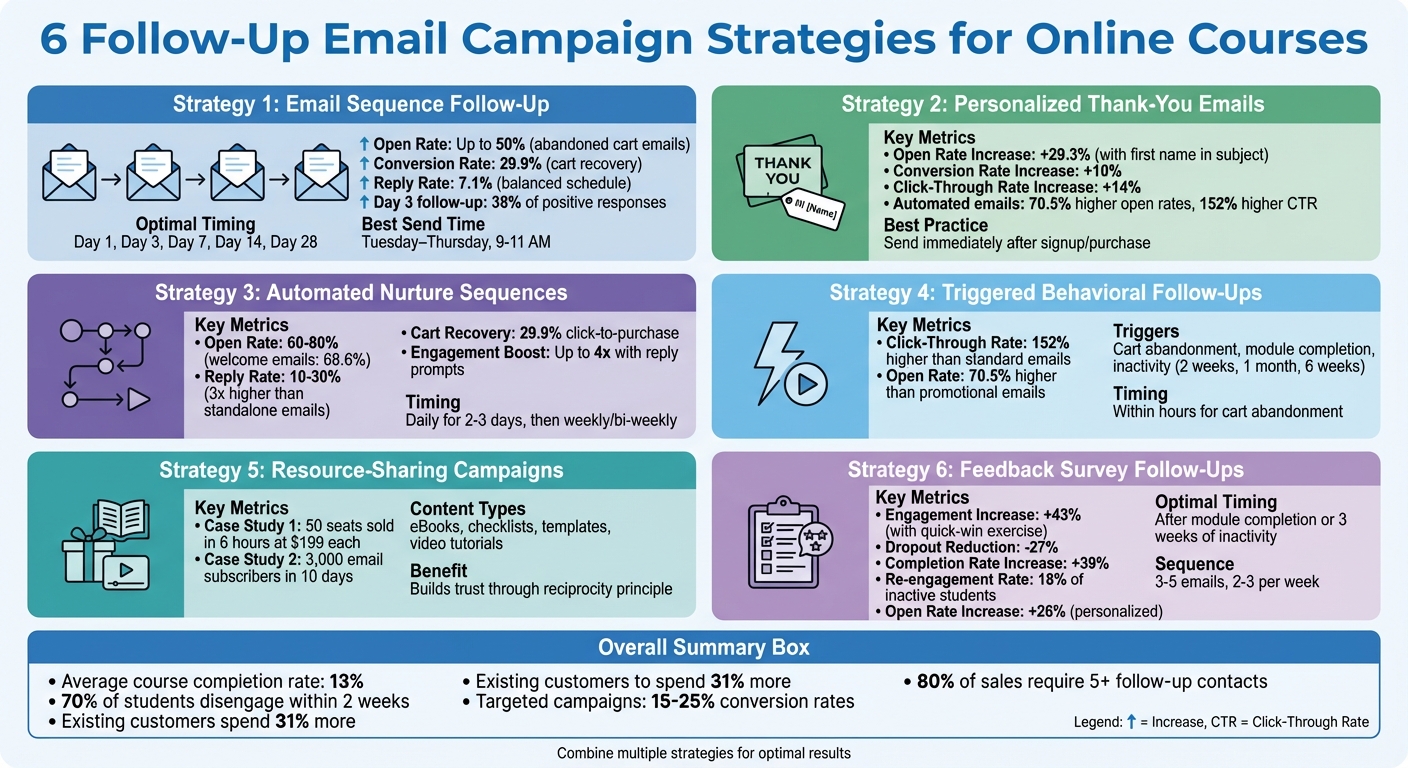
6 Follow-Up Email Campaign Strategies for Online Courses: Performance Metrics Comparison
Getting Started with Email Marketing: Full Step-by-Step Guide
sbb-itb-4f1eab7
1. Email Sequence Follow-Up
Email sequences are a series of pre-written messages that are automatically sent based on specific triggers or schedules. These emails go straight to your students' inboxes, giving you a direct way to engage with them. Let’s break down how each part of an email sequence can keep your audience connected and motivated.
Open Rates
The subject line is your first impression - and it matters. About 47% of people skip emails with boring subject lines. On the flip side, abandoned cart emails often achieve nearly a 50% open rate. Why? Because they’re timely and relevant. For course creators, this means writing subject lines that resonate with your students’ current needs, whether they’re debating a purchase or feeling stuck on a particular module.
Conversion Rates
Getting someone to open an email is just the beginning. Once they do, there’s a 29.9% chance they’ll complete their purchase if it’s an abandoned cart email. To make the most of this, send the first recovery email within hours of the cart being abandoned. A sequence of 3 to 5 emails strikes the perfect balance - enough to remind them without being overbearing.
Engagement Timing
When you send your emails can be just as important as what they say. A balanced schedule works best: aim for Day 1, Day 3, Day 7, Day 14, and Day 28. This approach delivers a 7.1% total reply rate, compared to just 4.1% for daily emails. Interestingly, the Day 3 follow-up alone accounts for 38% of all positive responses. To maximize engagement, send emails Tuesday through Thursday between 9:00 AM and 11:00 AM in your students’ time zones.
Lead Nurturing Effectiveness
Email sequences are ideal for keeping students involved in their learning journey. Drip campaigns, for example, break down complex topics into manageable steps, helping to improve course completion rates. For students who’ve gone quiet, personalized check-ins can re-engage 18% of them. Keep these nurturing emails short - under 150 words - and directly address their concerns. Adding a simple "reply to this" prompt can encourage meaningful interactions.
Scalability
Automation is what makes email sequences so powerful. Once set up, they run on their own, helping you nurture hundreds - or even thousands - of students while you focus on creating great course content. This hands-off approach allows you to grow your student base without sacrificing the personal touch that keeps them engaged and learning. It’s like having an assistant who works 24/7, ensuring no one falls through the cracks.
2. Personalized Thank-You Emails
Sending personalized thank-you emails is a great way to create meaningful connections with your students. By addressing them by name and referencing their specific action - like purchasing a course, downloading a resource, or joining your email list - you make your communication feel genuine and thoughtful. This small effort can have a big impact on how students perceive and engage with your message.
Open Rates
Adding a personal touch to your subject lines can work wonders for your email open rates. For instance, including a subscriber's first name in the subject line can lead to a 29.3% increase in open rates. That’s almost a third more people opening your emails! Even beyond first names, personalized subject lines are 22.2% more likely to be opened than generic ones. To maximize visibility, keep your subject lines under 30 characters, ensuring they display properly on mobile devices. And once your email is opened, the personalized approach often leads to better engagement and conversions.
Conversion Rates
Thank-you emails that feel personal don’t just get opened - they drive action. These emails can increase conversion rates by 10% and improve click-through rates by 14%. Automating these emails to send immediately after a student signs up or makes a purchase can make them even more effective. Automated thank-you emails achieve 70.5% higher open rates and 152% higher click-through rates compared to generic marketing emails. Timing is everything - sending that thank-you message while the student is still excited ensures you’re making the most of their interest.
Lead Nurturing Effectiveness
These emails do more than just convert - they build lasting engagement. A personalized thank-you email confirms the student’s action and gives them a clear path forward. For example, you can include a next step like accessing their first lesson, joining a community forum, or downloading a workbook. This helps maintain momentum, which is crucial given the low 13% average completion rate for online courses. By guiding students early, you set the stage for a positive and productive learning experience.
Scalability
The beauty of email automation is that it allows you to maintain a personal touch, no matter how large your student base grows. Whether you’re reaching 10 students or 10,000, automation ensures everyone receives a tailored thank-you email that feels personal. This scalability is invaluable for course creators - it lets you build strong connections without losing efficiency. Personalized thank-you emails also serve as the starting point for follow-up campaigns that keep students engaged and progressing through your course.
3. Automated Nurture Sequences
Automated nurture sequences take personalized follow-ups to the next level, offering consistent, event-driven communication that keeps students engaged throughout their learning journey.
These sequences work by delivering carefully timed emails that act like a virtual coach. Instead of one-off messages, they create multiple touchpoints to build trust and address common challenges, such as feelings of doubt or being overwhelmed. By doing so, they help prevent disengagement and guide students toward success.
Open Rates
When it comes to engagement, automated nurture sequences outperform standard promotional emails. For example, these campaigns often achieve 70.5% higher open rates compared to regular promotional emails. High-performing sequences typically see open rates ranging from 60% to 80%, with welcome emails - a crucial first impression - averaging around 68.6%. To maximize success, focus on crafting compelling subject lines and sending emails at key moments, such as right after enrollment or during critical learning milestones.
Conversion Rates
The benefits of automated sequences extend beyond open rates - they also deliver measurable results. Reply rates for these sequences are three times higher than standalone emails. Abandoned cart emails, a specific type of automated message, are particularly effective, with 29.9% of clicks leading to recovered purchases. This strategy helps guide students from initial interest to active participation, reducing the 70% two-week disengagement rate that many courses face.
Engagement Timing
Timing plays a key role in the success of nurture sequences. A good approach is to send daily emails during the first 2–3 days to capture momentum, then gradually shift to weekly or bi-weekly updates to avoid overwhelming students. For students who become inactive, a warm check-in after 7 days can help re-engage them. Adding prompts like "reply to this email" can increase engagement by up to 4x.
Lead Nurturing Effectiveness
Automated nurture sequences are more than just marketing tools - they help build meaningful connections. As Damon Falk, a business expert, explains:
"Email nurture sequences aren't marketing. They're care. They're the quiet voice that says, 'I see you. You're not failing. Keep going.'"
These sequences typically achieve reply rates of 10–30% and click-through rates of 10–20%, proving their ability to guide students through their learning journey while reducing barriers that often lead to course dropouts.
Scalability
One of the standout advantages of automated nurture sequences is their ability to scale effortlessly. Whether you're managing 50 students or 5,000, automation ensures that each learner receives timely, personalized messages based on their actions and progress. Educators who use automation are 46% more likely to report success in their marketing strategies, and triggered, personalized emails account for 75% of email revenue. By setting up these sequences once, you can maintain high levels of engagement while focusing your energy on creating outstanding course content.
4. Triggered Behavioral Follow-Ups
Triggered behavioral follow-ups take automated email sequences to the next level by reacting directly to a student’s actions. Unlike fixed schedules - like sending emails on Day 1, Day 3, and Day 7 - these follow-ups are activated by specific behaviors. For instance, an email might be triggered when a student finishes a module, visits your pricing page, abandons their cart, or hasn’t logged in for a while. This ensures your messages hit at just the right moment, making them far more relevant and impactful.
Emails sent in response to behavior - when interest is at its peak - see 152% higher click-through rates, helping you connect with students exactly when they’re most engaged. Abandoned cart emails, in particular, can significantly improve recovery rates by reaching students before they lose interest or move on to other options.
Engagement Timing
Unlike pre-scheduled campaigns, triggered follow-ups are dynamic, adjusting to the actions (or inactions) of your students. Timing is critical here. For example, the first abandoned cart email should be sent within a few hours of the cart being left behind. Waiting too long could mean losing the student entirely. For inactive users, consider a tiered approach:
- A friendly nudge after 2 weeks of inactivity.
- A special offer after 1 month to re-engage them.
- A feedback request after 6 weeks to understand their experience.
Similarly, when students hit milestones - like completing a quiz or module - send an immediate congratulations email to keep their motivation high.
Scalability
Triggered follow-ups are not just effective - they’re also scalable. As Lisa Parmley puts it:
"The magic of automation is that it empowers you to deal with significant numbers of people in a personalized, professional way."
Whether you’re working with 50 students or 5,000, the system ensures each student gets the right message at the right time. Once set up, it runs on autopilot, freeing you to focus on creating better course content instead of manually tracking student behavior or sending individual emails.
5. Resource-Sharing Campaigns
Resource-sharing campaigns take a proactive approach to keep students engaged by delivering helpful materials rather than focusing on immediate sales. These campaigns aim to provide value upfront, sharing resources like eBooks, checklists, templates, or short video tutorials that address real problems for your audience. This method builds trust and credibility through diverse content offerings. As Lizzie Davey explains:
"Email quickly becomes a valuable asset for attracting, nurturing, and retaining course students... it's a great way to offer additional value that doesn't fit into the course program (this is excellent for nurturing students and growing your authority)."
This strategy leverages the reciprocity principle - when you give something useful for free, people are more likely to engage with your paid offerings later on. Unlike reactive methods, such as abandoned cart emails, resource-sharing campaigns maintain consistent engagement, even when your audience isn't actively considering a purchase.
Lead Nurturing Effectiveness
Resource-sharing campaigns are particularly effective for nurturing leads who aren't yet ready to buy. By consistently providing valuable content, you stay relevant without coming across as overly sales-driven. As SendX points out, "newsletters are less about direct selling and more about providing value to keep your audience engaged". This approach builds trust over time, increasing the likelihood of conversions when prospects are ready to commit.
To maximize engagement, mix up your content types - include videos, infographics, quizzes, and guides to cater to different learning preferences. High-value lead magnets, like free mini-courses or industry-specific guides, can attract the right audience from the start. Once leads interact with a resource, segment them based on their interests and use automated drip sequences to deliver tailored content at scale.
Scalability
One of the biggest advantages of resource-sharing campaigns is their scalability. Automation allows you to nurture leads efficiently, regardless of the size of your audience. For example, in 2023, Gregory John of Buildcamp used his newsletter to presell a bootcamp on building no-code apps with AI. By sharing valuable resources, he managed to sell all 50 seats at $199 each within just 6 hours and generated a waitlist of 250 people within 24 hours. Similarly, Max from 100 Days of No Code launched a directory of no-code tools as a lead magnet on ProductHunt, gaining 3,000 email subscribers in just 10 days - a significant pool of potential buyers for his courses.
Automated drip sequences ensure that each lead receives the right content at the right time, whether you're managing 100 or 10,000 subscribers. This frees up your time to focus on developing better course content while nurturing leads in the background. By complementing other follow-up strategies, resource-sharing campaigns lay a solid foundation for long-term engagement and growth.
6. Feedback Survey Follow-Ups
Feedback survey follow-ups serve a dual purpose: they gather important insights and keep students engaged. Unlike campaigns that primarily share resources, these surveys open up a two-way conversation, encouraging active participation. By asking for feedback at the right moment, you not only collect useful data but also strengthen the connection students feel with your course. Just like other follow-up strategies, surveys help fine-tune your engagement process by offering actionable insights.
Timing is everything. Sending a feedback request right after a student completes a module ensures their experience is still fresh. For example, an email triggered by module completion that included a quick-win exercise increased engagement by 43%. On the other hand, for students who’ve been inactive, waiting about three weeks after their last activity can be the sweet spot for re-engagement surveys.
Engagement Timing
A well-planned feedback sequence can significantly improve response rates. A sequence of three to five emails works well, with the second email sent three to four days after the first. Keeping the frequency to two or three emails per week ensures you don’t overwhelm recipients. Take The Tech Academy’s example from July 2024: they introduced a "checkpoint system" that sent automated emails when students hadn’t logged in for five days. Instead of generic reminders, these emails included quick 5-minute refresher exercises. The result? A 27% drop in dropout rates and a 39% boost in course completion.
Building on this timing strategy, adding a personal touch to feedback requests can make an even bigger impact.
Lead Nurturing Effectiveness
As with other strategies, personalized feedback check-ins can reignite student interest while also tracking progress. A simple question like, "What did you learn?" can make a big difference - quadrupling engagement rates. Even a single warm message to inactive students has been shown to re-engage 18% of them.
Take business coach Sarah’s approach in July 2024. She noticed a sharp drop-off in participation during week four of her 12-week leadership program. To fix this, she added "catch-up weeks" every three modules and sent follow-up emails to support these intervals. Her adjustments boosted course completion rates from 34% to 71%. Additionally, personalized email campaigns that request tailored feedback outperform generic ones, achieving 26% higher open rates.
Scalability
Automated feedback surveys make scaling easy when paired with behavioral triggers. Using a CRM, you can automatically send surveys when students hit milestones, complete modules, or become inactive. This kind of automation ensures consistent engagement without requiring constant manual oversight. To increase survey completion rates, consider offering incentives like exclusive discounts or bonus resources. For subscribers who remain unresponsive after four emails, sending a final breakup email - offering to remove them from the list - can clean up your list while sometimes prompting a last-minute response.
Advantages and Disadvantages
Each follow-up strategy has its own strengths and weaknesses, and choosing the right one depends on your course goals and available resources.
Email Sequence Follow-Ups are highly effective for recovering lost sales, with nearly 29.9% of clicks converting into purchases. However, timing is everything - since 80% of sales typically require around five follow-up contacts, it’s important to avoid overwhelming recipients by spacing these emails appropriately.
Automated Nurture Sequences are excellent for maintaining long-term engagement, which is critical given that over 70% of paid course participants tend to disengage within the first two weeks. Personalization can make a big difference here, boosting open rates by 26%. But keep in mind, these sequences demand significant upfront effort to create content, and if they come across as impersonal, students might lose interest.
Personalized Thank-You Emails create meaningful connections by addressing students individually. While they shine in creating high-value interactions, scalability can become a challenge unless you have advanced automation tools in place.
Triggered Behavioral Follow-Ups take personalization to the next level by automatically responding to specific student actions with timely and relevant messages. These emails see impressive results, with 70.5% higher open rates and a 152% increase in click-through rates compared to standard marketing emails. That said, they require strong tracking systems, and without proper frequency controls, there’s a risk of overwhelming students with too many messages.
Understanding these trade-offs helps educators choose the follow-up strategies that align best with their engagement objectives and available resources.
Conclusion
Choose a follow-up approach that aligns with your goals. If boosting revenue is your main focus, strategies like abandoned cart sequences and triggered behavioral follow-ups can deliver impressive results. For instance, existing customers tend to spend 31% more, and targeted campaigns often achieve conversion rates between 15% and 25% when timed around key milestones. On the other hand, for sustaining long-term engagement, automated nurture sequences are crucial - especially since many students tend to disengage early on. Pairing these sequences with personalized, human-like check-ins can make a big difference.
When personalization is your top priority, triggered behavioral follow-ups are a powerful tool. They allow you to send timely, relevant messages based on student behavior. However, these require careful tracking and thoughtful pacing to avoid overwhelming your audience. If your focus is on gathering feedback and improving, survey follow-ups triggered after important milestones can provide valuable insights into what’s working and where adjustments are needed. Combining these methods creates a well-rounded strategy for keeping learners engaged.
Most educators find success by blending several strategies. Start with a welcome sequence to make a great first impression, use behavioral triggers to re-engage students who lose interest, and incorporate personalized outreach for your most active learners.
FAQs
Which follow-up emails should I set up first for my course?
When it comes to encouraging enrollment, a well-crafted email sequence can make all the difference. Here's a simple three-step approach to connect with potential students and guide them toward signing up for your course:
-
Step 1: Welcome Email
Start by introducing your course and making a positive first impression. Use this email to warmly greet your audience, explain what they can expect from your emails, and highlight the benefits of your course. Keep the tone friendly and inviting to set the stage for a meaningful connection. -
Step 2: Value-Driven Email
Follow up with an email that focuses on providing value. Share tips, insights, or a quick win related to your course topic to demonstrate your expertise. This email helps build trust and shows potential students that you genuinely want to help them succeed. -
Step 3: Sales-Focused Email
Finally, send an email that encourages enrollment. Highlight the unique benefits of your course, include testimonials if you have them, and create urgency with a limited-time offer or deadline. Make it easy for them to take the next step by including a clear call-to-action.
This sequence not only introduces your course but also nurtures relationships and motivates action, increasing the likelihood of enrollment.
How many follow-up emails are too many?
There’s no hard-and-fast rule for how many follow-up emails are "too many" - it really depends on your audience and the situation. That said, bombarding recipients with emails can backfire, leading to unsubscribes or even spam complaints. Instead, aim to make each email worth their time. Share useful information, offer solutions, or address their needs. Keep an eye on engagement metrics to figure out what works best for your campaign without overwhelming your audience.
What behaviors should trigger automated follow-ups?
Automated follow-ups work best when they're tied to specific actions or behaviors. For example, triggers like completing a course, reaching key progress points, periods of inactivity, or asking for more details can prompt timely messages. These follow-ups help keep learners engaged and motivated to continue their journey.