Ethical Leadership Practices for CTE Teachers
Ethical leadership in Career and Technical Education (CTE) is about making decisions that prioritize students' well-being, fairness, and professional integrity. It goes beyond following rules - it's about creating trust, accountability, and equity in the classroom. Here’s a quick breakdown of the key principles:
- Moral Purpose: Focus on improving students' lives, not just meeting targets.
- Integrity and Honesty: Be truthful, consistent, and transparent in all actions.
- Equity: Provide fair opportunities for all students, regardless of background.
- Building Trust: Earn trust through consistent actions and clear communication.
- Shared Decision-Making: Involve students and staff in decisions to encourage collaboration.
- Ethical Guidance: Lead by example and teach ethical behavior.
- Accountability: Own both successes and mistakes to build a culture of responsibility.
- Team Collaboration: Work with others to improve outcomes and reduce isolation.
- Professional Behavior: Model workplace standards and maintain boundaries.
- Continuous Growth: Stay current in your field and improve teaching methods.
These practices help create a positive environment where students and educators thrive, preparing the next generation for success in the workforce. By putting ethics at the forefront, CTE teachers can lead with purpose and inspire meaningful change.
How Is Ethical Leadership Demonstrated In Education? - The Ethical Compass
1. Demonstrate Moral Purpose
In Career and Technical Education (CTE), moral purpose goes far beyond hitting targets like enrollment numbers. It’s about a deeper, ongoing commitment to using technical education to genuinely improve students' lives. The Association for Career and Technical Education captures this idea perfectly:
"The career and technical educator believes in the worth and dignity of each individual and in the value of career and technical education in enhancing individual development".
Every choice you make - whether it’s how lab time is structured or how lessons are personalized - should focus on supporting students' well-being and helping them unlock their potential.
To lead with moral purpose, build your vision around core principles like integrity, equity, and fairness. By modeling ethical decision-making, you show students what professionalism looks like in action. This kind of leadership teaches them important lessons about workplace behavior simply through observation.
Unfortunately, research reveals that 66% of teachers report toxic school environments, often blaming unethical leadership as the root cause. As a CTE educator, you have the chance to break this cycle by creating a classroom culture rooted in ethical values, rather than just checking off administrative tasks.
Be open and transparent when making decisions about things like resource distribution or student placement. Share the reasoning behind your choices clearly and objectively. This kind of accountability not only builds trust but also reassures students and colleagues that every decision is made with their best interests in mind. By setting this example, you lay the groundwork for a classroom environment where ethical leadership and collaboration thrive.
2. Uphold Integrity and Honesty
Integrity is the cornerstone of building trust in the classroom. When students and colleagues know they can depend on you to be truthful and consistent, they’re more likely to engage openly and take responsibility for their own actions. Surveys of over 75,000 people worldwide reveal that honesty is consistently ranked among the top four traits of respected leaders.
Start by being authentic in how you present yourself. Be truthful about your qualifications, professional experience, and areas of expertise. If you don’t have an answer, admit it instead of bluffing. This simple act of honesty shows students that acknowledging limitations is a sign of professionalism, not weakness.
Make decisions based on fairness and logic, not personal benefit. The Association for Career and Technical Education highlights the importance of educators:
"recogniz[ing] and accept[ing] responsibility for individual actions, judgments and decisions".
This means avoiding conflicts of interest - like accepting gifts from vendors or leveraging your position for personal gain - and always putting students’ best interests above convenience.
Your actions must align with the principles you teach. Whether it’s ethics or safety protocols, practicing what you preach is essential. Students are quick to notice inconsistencies, and any gap between your words and actions can erode trust.
Protect confidentiality, provide unbiased evaluations, and take credit only for work that is truly yours. As Thomas Viviano puts it:
"Trust is earned through the development of the character and leadership skills of supervisors and their ability to be honest, regardless of consequences".
3. Prioritize Equity in the Classroom
Creating an equitable classroom environment means recognizing the diverse experiences, backgrounds, and needs of each student - and tailoring support accordingly. The Association for Career and Technical Education emphasizes this in its Code of Ethics, stating:
"The career and technical educator... evaluates students and colleagues without regard to race, color, creed, sex, status or any other factor unrelated to the need for career and technical education."
Take a close look at classroom data by breaking down outcomes for special populations identified in Perkins V. This approach can reveal patterns that might otherwise go unnoticed.
"Adaptive challenges linked to differences in how students experience and benefit from education, systematically advantaging some while disadvantaging others, must be recognized and addressed to change education in ways that reduce and eventually resolve systemic equity gaps."
Address financial barriers by creating programs that offer free access to industry certifications and work-based learning opportunities. These could include job shadowing, site visits, and resume-building workshops, ensuring all students have equal chances to succeed.
Incorporate Project-Based Learning with inquiry-driven prompts that encourage critical thinking and independence. Choose teaching materials that reflect the diverse identities and cultures of your students.
Take time to reflect on your own unconscious biases, ensuring your policies and practices don’t unintentionally favor certain groups of students. You might also consider starting mentorship programs and encouraging students of color to take on leadership roles, like serving as program ambassadors. These efforts can help students build social capital and professional networks before they graduate.
4. Build Trust with Students and Staff
Trust isn’t given - it’s earned through consistent actions that show care, integrity, and competence. A study of 12 Chicago schools revealed that positive, trusting relationships between staff and leadership are the driving force behind school improvement. In Career and Technical Education (CTE) programs, where students prepare for future careers, this foundation becomes even more essential. A reliable and ethical approach helps establish healthy classroom dynamics.
The Association for Career and Technical Education emphasizes that educators must uphold the highest ethical standards to gain respect and confidence. This includes maintaining strict confidentiality, only disclosing sensitive information when legally or professionally required. Breaking this trust by sharing confidential details can immediately damage relationships.
Consistency is key. When you follow through on your commitments, trust naturally grows. Setting expectations collaboratively fosters a sense of ownership and accountability. Avoid addressing group mistakes with blanket reprimands; instead, handle issues privately with empathy and clarity.
Recognition also plays a big role in building trust. Move beyond generic praise and acknowledge specific contributions. Keep track of individual efforts and express detailed gratitude through personal acknowledgment. On the flip side, when you make a mistake, own up to it quickly. Admitting errors demonstrates accountability and shows that growth often comes from learning through failure.
How you handle stress matters too. Maintaining composure during challenging moments prevents a culture of fear. Reacting with panic or anger can stifle creativity and discourage people from taking risks or sharing ideas. As Sandra Harris wisely points out:
"Trust is 'the one thing that changes everything.' In an organization with high trust, when the leader says the wrong thing... people still understand what was intended".
5. Share Decision-Making Authority
Sharing decision-making authority goes hand in hand with fostering trust and transparency. In Career and Technical Education (CTE) classrooms, this approach strengthens accountability and creates a more inclusive environment. Ethical leadership in CTE moves beyond traditional top-down management, encouraging collaboration instead. Research from Chicago schools highlights the impact of this approach - schools with strong collaborative systems are at least 10 times more likely to see significant improvements in reading and math scores. Additionally, when teachers are involved in decision-making, schools often experience higher teacher retention and better academic outcomes.
A great example of this is the International High School at LaGuardia Community College in New York City. Here, teams of four teachers oversee a cohort of 100 students over two years. These teams take charge of curriculum design, scheduling, and budgeting, allowing them to address student needs quickly without waiting for administrative input. Similarly, at Pittsfield Middle High School, students participate in site councils alongside adults and even hold the majority vote on school policy decisions. These examples illustrate how shared authority can be implemented effectively.
Eric Nadelstern captured this idea perfectly:
"If you have an authoritarian, hierarchical school structure, the teacher becomes the information dispenser in the classroom. If kids are going to collaborate in classrooms, then teachers have to collaborate in decision-making."
Practical steps to share authority include forming faculty committees for hiring decisions, rotating leadership roles to prevent silos, and involving students in governance. In CTE labs, assigning roles like "team leader" during projects can also help students develop essential leadership skills.
While empowering stakeholders is key, ethical principles should always guide the delegation of authority. Assign responsibilities based on skills and qualifications - not favoritism - and ensure confidentiality and fairness throughout the process. Create a space where everyone feels safe to contribute ideas and where accountability is shared by all.
6. Provide Ethical Guidance
Being a source of ethical guidance starts with leading by example. In Career and Technical Education (CTE) classrooms, teachers are more than instructors - they're role models for professional behavior. Students are quick to notice when actions don't align with words, and inconsistent integrity can undermine lessons about ethical conduct. As the Association for Career and Technical Education (ACTE) puts it:
"The career and technical educator strives for the highest ethical standards to merit the respect and confidence of students, colleagues and the community."
To model integrity effectively, establish clear professional boundaries. This means maintaining appropriate verbal, physical, emotional, and social limits that foster a structured and secure environment for everyone. For example, keep student information confidential unless legally required to disclose it, avoid personal relationships that could blur professional lines, and maintain separate, professional social media profiles [5, 7].
If you observe a colleague engaging in ethically questionable behavior, address the issue promptly and discreetly. The National Association of State Directors of Teacher Education and Certification (NASDTEC) emphasizes:
"The professional educator fulfills the obligation to address and attempt to resolve ethical issues by... taking proactive steps when having reason to believe that another educator may be approaching or involved in an ethically compromising situation."
This proactive mindset is also a valuable lesson to pass on to your students.
When it comes to teaching ethics to students, focus on preparing them for the professional world. Alongside your own ethical example, integrate lessons on workplace readiness and essential professional behaviors into your curriculum. It's equally important to ensure all students have equal access to opportunities and benefits, regardless of their background. Protecting students from exposure to unethical or incompetent behavior is another key responsibility [1, 7].
To foster accountability, provide respectful, policy-driven feedback and handle conflicts privately, always keeping your students’ success at the forefront [1, 5]. Sharing your expertise in CTE not only builds their professional skills but also creates a collaborative and supportive learning environment [1, 5].
sbb-itb-4f1eab7
7. Take Responsibility for Outcomes
Taking responsibility in Career and Technical Education (CTE) goes beyond just acknowledging what happens in your classroom. It means owning both the wins and the missteps. As the Association for Career and Technical Education (ACTE) puts it, "Recognizes and accepts responsibility for individual actions, judgments and decisions". By fully embracing accountability, you not only build trust with students, colleagues, and administrators but also set a professional example that encourages student success. This approach naturally leads to more open and honest classroom practices.
The importance of accountability is evident in the business world. Take the Wells Fargo scandal in 2016, for example. Leadership initially denied involvement in the creation of millions of unauthorized accounts, which led to a 50% drop in profits during the next quarter. This case underscores how a lack of accountability can erode trust and have far-reaching consequences.
In the classroom, being transparent about your decisions and teaching methods reinforces trust. If something doesn’t work - like a lab activity that falls short or an assessment that confuses students - acknowledge it openly. Reflect on what went wrong, what challenges arose, and how you can improve. This kind of reflection not only helps you grow as an educator but also demonstrates to students that accountability is key to progress.
Create an environment where it’s safe to make mistakes and learn from them. When you take responsibility for your actions, students notice and often follow suit. The National Association of State Directors of Teacher Education and Certification (NASDTEC) highlights this principle: "The professional educator demonstrates responsibility to oneself and the profession by... taking responsibility and credit only for work actually performed or produced, and acknowledging the work and contributions made by others". Share credit with your team, recognize others’ contributions, and let data guide your decisions.
Thomas Viviano from the Journal of Career and Technical Education sums it up well: "When a leader trusts no one, no one trusts him... When all is finished, the people say, 'We did it ourselves.'" Balancing accountability with empowerment not only prepares students for the professional world but also fosters the trust needed for ethical leadership.
8. Encourage Team Collaboration
Teamwork plays a crucial role in fostering accountability and shared responsibility, aligning seamlessly with ethical practices. It not only supports professional growth but also enhances student learning outcomes. Wendy Custable, Director of Applied Arts at Adlai E. Stevenson High School, highlights this point:
"Teachers working within a collaborative team is the best form of job-embedded professional development - even for CTE teachers".
For many Career and Technical Education (CTE) educators, working alone in their specialized field can lead to feelings of isolation. Collaboration counters this by building collective efficacy, which has been shown to boost both student motivation and achievement.
To make collaboration effective, teams should be structured around meaningful connections. For example:
- Vertical teams: These connect courses like Food Prep, Culinary 1, and Culinary 2, creating a seamless progression for students.
- Interdisciplinary teams: These bring together educators from fields like Agriculture, Business, and Technology Education to focus on shared skills, such as budgeting or project management.
- Virtual teams: Ideal for niche subjects, these connect specialized instructors - like automotive service educators - across a region.
The success of collaboration depends on structure. Assign clear roles within the team, such as facilitator, note-taker, timekeeper, and resource coordinator. Establish norms and use structured protocols, like round-robin discussions, to focus on expected student skills. While career-specific standards may differ, transferable skills - such as communication, critical thinking, and teamwork - are universally important. Additionally, integrating core academic skills, such as applying math to calculate labor rates or using writing skills for marketing plans, strengthens the learning experience.
This structured, collaborative approach also embodies ethical leadership by encouraging ownership and innovation. As Thomas Viviano aptly puts it:
"A manager controls people and initiatives but a leader inspires and encourages a collaborative approach".
9. Model Professional Behavior
As a CTE teacher, you set the tone for professionalism in the workplace. Your students are constantly observing how you handle challenges, interact with colleagues, and maintain boundaries. These observations shape their understanding of workplace standards and influence their future behavior. The ACTE Code of Ethics highlights this responsibility:
"The career and technical educator strives for the highest ethical standards to merit the respect and confidence of students, colleagues and the community."
Your professional conduct becomes the foundation for accountability and integrity in your classroom, creating a standard for students to emulate.
Professionalism begins with honesty and precision. Always represent your qualifications accurately, take ownership of your decisions, and ensure your actions are guided by fairness rather than personal interests. Protect the confidentiality of both students and colleagues unless legal obligations require disclosure. Establishing clear boundaries within your school community reinforces trust and fosters a collaborative, open environment.
How you respond to pressure matters. Maintaining composure, addressing challenges openly, and focusing on solutions that benefit students demonstrate professionalism under stress. These moments teach students the importance of handling adversity with grace and determination.
Your online presence is just as important as your in-person behavior. Treat your digital interactions as an extension of your professionalism. Keep personal and professional profiles separate, and resolve conflicts with colleagues privately and respectfully, adhering to established policies.
Research involving over 75,000 individuals from business and industry highlights honesty, forward-thinking, inspiration, and competence as the most admired leadership traits. These qualities resonate strongly with Generation Z, which is expected to make up 25% of the workforce by 2025. This generation values integrity and is less likely to compromise on these standards.
Lastly, prioritize your own well-being to lead effectively. Patience during setbacks, reflective practices like exercise or meditation, and the courage to challenge harmful policies are essential. By taking care of yourself and continuing to grow professionally - both in your trade and teaching methods - you ensure that you remain a strong leader and role model for your students.
10. Support Ongoing Professional Growth
Building on the ideas of accountability and collaboration, continuous professional growth is a cornerstone of ethical leadership in Career and Technical Education (CTE). Ethical leaders commit to lifelong learning - not just for themselves but for their colleagues as well. The ACTE Code of Ethics underscores this commitment:
"The career and technical educator... strives throughout one's career to master, maintain and improve professional competence through study, work, travel and exploration".
In practice, this means staying up to date with both your trade expertise and teaching methods. As industries evolve, so must your skills and knowledge.
Creating an environment that nurtures professional growth requires a shift in mindset - from managing to leading. Thomas Viviano, in the Journal of Career and Technical Education, highlights the importance of this shift:
"Trust and love take the place of power and fear in order for employees to buy into educational reform and it's important for them to know that they are in the forefront of change and are key agents of change".
When educators feel secure enough to take creative risks and share new ideas without fear of backlash, they become active participants in driving progress and innovation.
Supporting professional growth doesn’t just enhance teaching skills - it also strengthens ethical decision-making in the classroom. There are practical ways to make this happen. For instance, forming professional development committees allows teachers to take the lead in designing their own training sessions. Joining organizations like ACTE connects educators to evolving standards and broader trends in CTE. Additionally, self-evaluation tools, such as the ACTE Quality CTE Program of Study Framework, provide measurable ways to improve; pilot tests have shown that higher rubric scores are linked to better technical skill attainment.
Staying informed about industry trends is another key element. For example, healthcare roles like home health care workers are projected to grow by 70%, while construction trades such as glaziers are expected to see a 42% increase. Regularly reviewing data from sources like the Bureau of Labor Statistics and O*NET ensures that your curriculum aligns with high-demand fields. Reflecting on these insights - individually or with colleagues - can enhance both personal effectiveness and collective impact.
For professionals transitioning into teaching, structured support is essential. DashK12 offers an online course, "The Ultimate Guild to Teaching CTE", designed to equip new educators with the skills and confidence needed to succeed in K–12 settings. Through courses, mentoring, and workshops, DashK12 helps educators refine their expertise and build a strong foundation for teaching.
Using DashK12 for CTE Success

Transitioning from the industry to a teaching role in Career and Technical Education (CTE) can be a tough shift. While industry experience is valuable, it doesn’t automatically translate into effective teaching. This is where ethical leadership and structured support become essential. DashK12 steps in to bridge this gap with resources tailored to help new educators succeed. One standout resource is DashK12's online course, "The Ultimate Guide to Teaching CTE," which equips you with critical teaching tools.
The course focuses on foundational skills that are crucial during your first years in the classroom. These include classroom management, lesson planning, and applying ethical standards. DashK12’s approach aligns with the ACTE Code of Ethics, helping you learn how to present your qualifications honestly, safeguard student confidentiality, and make decisions based on sound reasoning. Mastering these skills is key to fostering ethical leadership in your teaching practice.
DashK12 also connects you with experienced mentors who guide you through the transition. This mentorship helps you create a classroom environment built on trust and accountability. With 66% of teachers reporting toxic school cultures, starting off with a positive and supportive classroom culture can make a huge difference.
Beyond mentorship, DashK12 offers tools to track student outcomes and certifications. These resources emphasize accountability, a cornerstone of ethical leadership. They also help you implement the 13 standards of accomplished practices for CTE teachers, focusing on areas like diversity, effective classroom management, and democratic values. Over time, you’ll shift from a directive leadership style to one that empowers students to actively participate in decision-making.
For school districts looking to retain new CTE teachers, DashK12 provides workshops and ongoing support. These programs address the challenge many industry professionals face: entering the classroom with technical expertise but limited teaching preparation. By offering this comprehensive support, DashK12 reinforces the accountability and ethical leadership that are essential for thriving in CTE.
Comparison Table
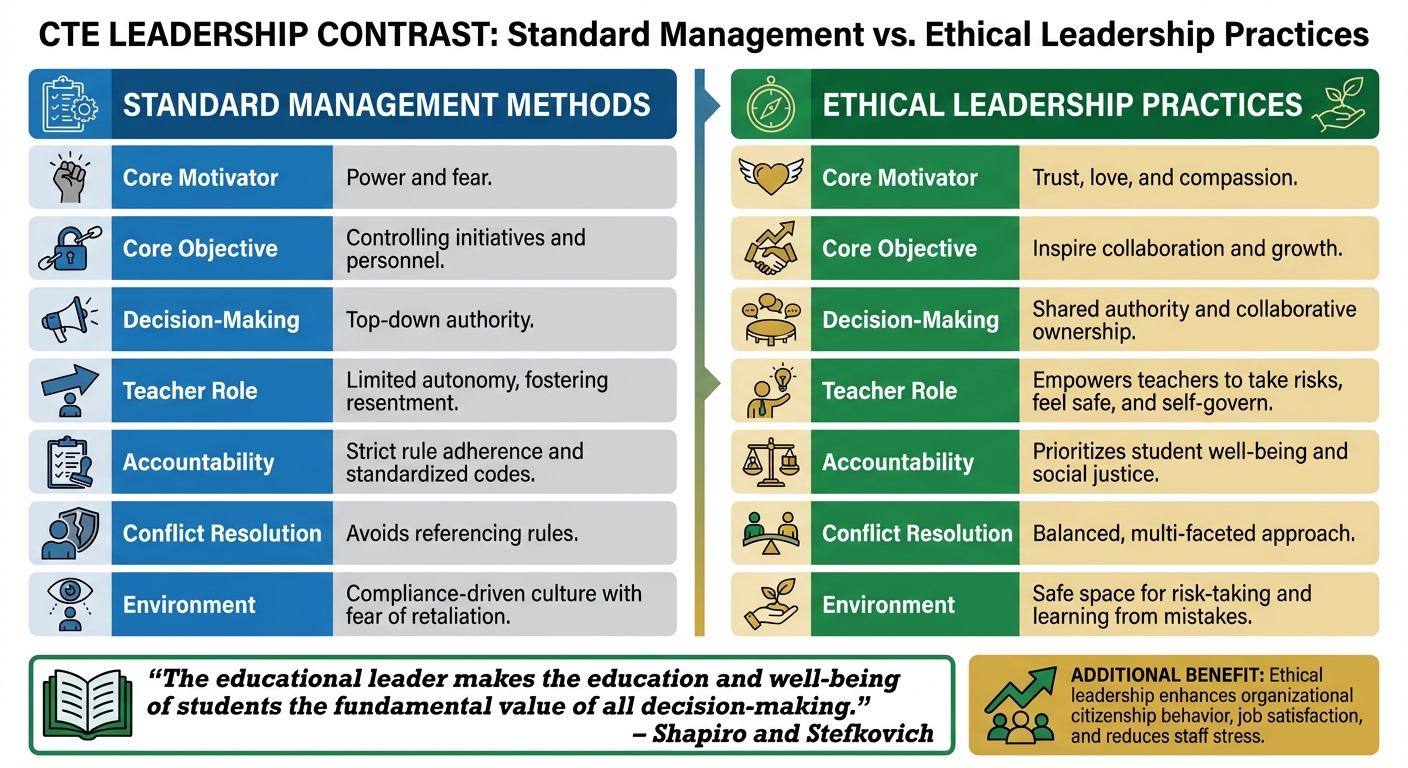
Standard Management vs Ethical Leadership in CTE Education
To better understand the differences between standard management methods and ethical leadership practices, take a look at the table below:
| Feature | Standard Management Methods | Ethical Leadership Practices |
|---|---|---|
| Core Motivator | Relies on power and fear | Builds on trust, love, and compassion |
| Core Objective | Focused on controlling initiatives and personnel | Aims to inspire collaboration and growth |
| Decision-Making | Operates through top-down authority | Encourages shared authority and collaborative ownership |
| Teacher Role | Limited autonomy, often fostering resentment | Empowers teachers to take risks, feel safe, and self-govern |
| Accountability | Enforces strict rule adherence and standardized codes | Prioritizes student well-being and social justice |
| Conflict Resolution | Avoids referencing rules for resolving conflicts | Takes a balanced, multi-faceted approach to conflict resolution |
| Environment | Creates a compliance-driven culture with fear of retaliation | Establishes a safe space for risk-taking and learning from mistakes |
Shapiro and Stefkovich highlight the essence of ethical leadership with this statement:
The educational leader makes the education and well-being of students the fundamental value of all decision-making.
Additionally, research shows that ethical leadership enhances organizational citizenship behavior and job satisfaction while helping reduce stress among staff. This distinction demonstrates how ethical leadership can directly contribute to accountability and student success in CTE classrooms.
Conclusion
Ethical leadership plays a crucial role in career and technical education (CTE). It fosters accountability and professionalism, directly shaping the next generation of skilled professionals. Your dedication to ethical practices not only impacts student success but also ensures they are prepared for the demands of the modern workplace.
Studies highlight that ethical leadership leads to better teacher retention, improved student performance, and enhanced workforce readiness. These factors are especially important as Generation Z embarks on career paths influenced by your guidance.
Take time to evaluate your actions and ensure they align with ethical standards. Consider using an ethical checklist to identify areas where you can improve, acknowledge mistakes when they occur, and address unethical behavior when you see it. As Malavika Sundararajan and Binod Sundararajan, Professors of Management, emphasize:
If educators are serious about training ethical leaders, they must act as role models not only in their classrooms, but in their everyday interactions on campus.
For those looking for structured guidance, DashK12 offers valuable resources. Their online course, "The Ultimate Guild to Teaching CTE", is tailored to help industry professionals thrive in K-12 education. Additionally, DashK12 provides mentoring and workshops to support your journey as an ethical leader in education.
FAQs
What are some practical ways CTE teachers can demonstrate ethical leadership in the classroom?
CTE teachers play a critical role in shaping the ethical framework of their classrooms and beyond. They can lead by example by consistently demonstrating integrity and professionalism in their everyday actions. This means respecting confidentiality, treating everyone fairly, and making decisions rooted in sound judgment. Following professional codes of ethics not only strengthens their credibility but also sets a clear standard for students and colleagues to follow.
Creating an ethical classroom environment is another key responsibility. Teachers can encourage open conversations about values, fairness, and accountability, helping students navigate complex ethical dilemmas. By promoting critical thinking and practicing self-reflection, CTE teachers empower students to develop their own moral compass. These efforts foster trust, mutual respect, and a supportive learning atmosphere for all.
How can CTE programs promote equity and inclusivity?
Creating equity and inclusivity in Career and Technical Education (CTE) begins with identifying and addressing barriers that might limit access for certain students. Schools can take a closer look at their policies and practices to ensure they don’t unintentionally disadvantage students based on factors like race, socioeconomic background, gender, or ability. Including students, families, and community members in these discussions is a key step toward fostering a more welcoming and supportive environment.
Educators play a crucial role, too. By using culturally responsive teaching methods and tailoring lessons to accommodate different learning styles, they can make classrooms more accessible for everyone. Offering targeted resources - such as scholarships, transportation assistance, or outreach programs - can help ease logistical challenges faced by underserved students. On top of that, training teachers on topics like implicit bias and disability awareness ensures they’re better equipped to support a diverse range of learners.
These efforts can transform CTE programs into spaces where every student feels valued and empowered to thrive.
Why is shared decision-making essential for ethical leadership in CTE education?
Shared decision-making plays a crucial role in ethical leadership by promoting collaboration, openness, and shared responsibility within the school community. When teachers, staff, families, and students are included in important decisions, it helps build trust, enhances the overall school atmosphere, and contributes to stronger academic results.
This approach also reflects democratic principles, emphasizing respect, inclusion, and shared accountability - core aspects of ethical leadership. By involving everyone, it not only deepens relationships but also fosters an environment where individuals feel appreciated and encouraged to actively participate.