Emotional Intelligence Through Mindfulness: A Guide
Mindfulness can help you improve emotional intelligence (EI), which is the ability to recognize, understand, and manage emotions in yourself and others. This skill is increasingly valued in workplaces and education, as it directly impacts leadership, relationships, and stress management.
Here’s how mindfulness strengthens EI:
- Self-Awareness: Recognize your emotions by noticing physical signals like a racing heart or tense shoulders.
- Self-Regulation: Use techniques like breath awareness to pause and respond thoughtfully instead of reacting impulsively.
- Empathy: Practices like Loving-Kindness Meditation enhance your ability to understand and connect with others' feelings.
- Social Skills: Mindful listening improves communication and builds stronger relationships.
Even short mindfulness practices - such as the STOP technique or gratitude journaling - can reduce stress, improve focus, and help you manage emotional triggers. Research shows these methods can lead to measurable improvements in emotional control and mental well-being. Start small by incorporating mindfulness into daily routines like breathing exercises, reflective journaling, and mindful listening.
Mindfulness isn’t just about managing emotions - it’s about creating space to respond intentionally and build stronger connections with others.
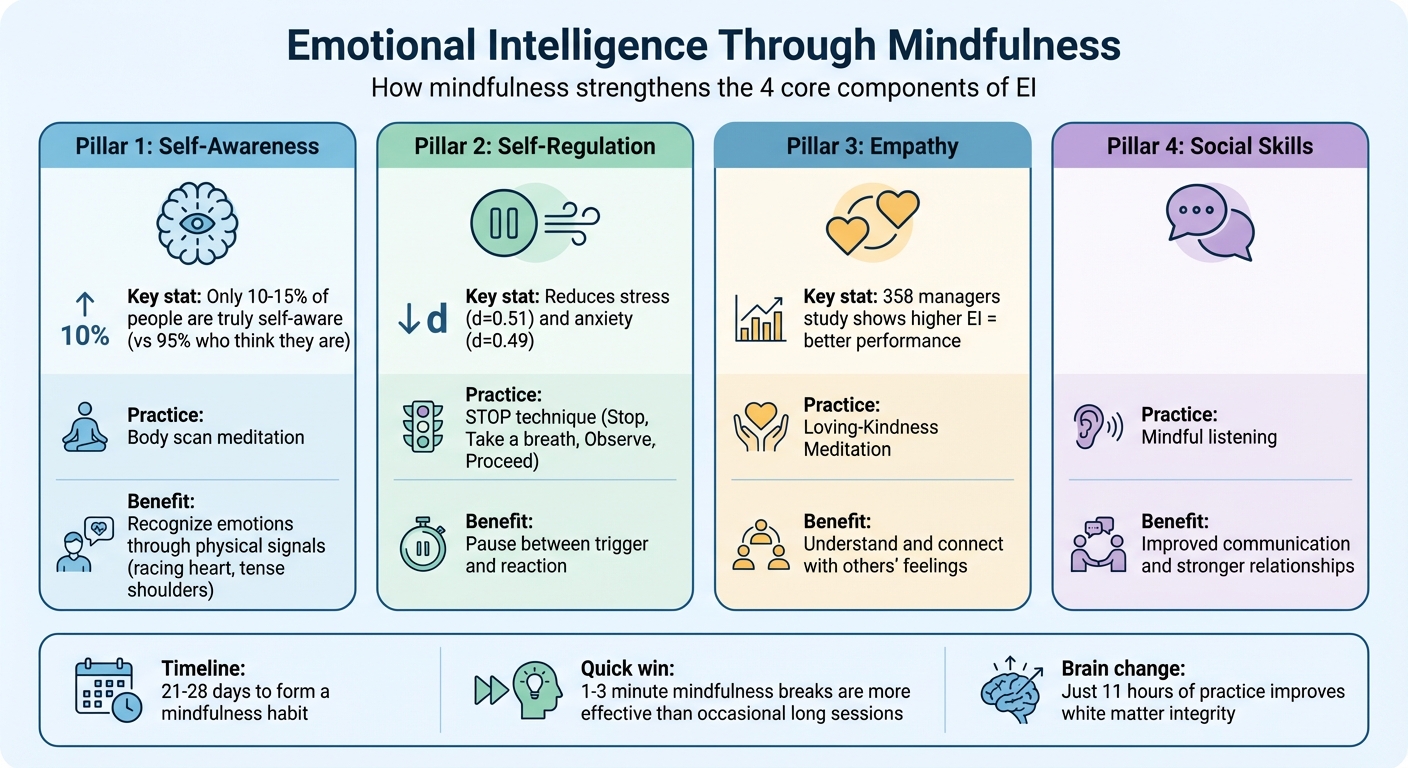
4 Pillars of Emotional Intelligence Through Mindfulness Practice
Emotional Intelligence Meditation
Building Self-Awareness Through Mindfulness
Self-awareness is a cornerstone of emotional intelligence, but most people think they're better at it than they actually are. Research shows that while 95% of people believe they're self-aware, only 10–15% truly meet the criteria for it. This gap highlights why practicing mindfulness is so important.
Mindfulness helps build self-awareness by teaching you to observe your inner experiences without reacting right away. This creates what researchers call "psychological distance" - the ability to see emotions as temporary events ("I am feeling anger") rather than permanent parts of your identity ("I am angry"). This small shift gives you the space to choose how you respond.
Mindfulness also sharpens your ability to notice bodily signals in real-time. Instead of vaguely feeling "stressed", you might become aware of a quickening heartbeat, tense shoulders, or shallow breathing. These physical signs often show up before you're consciously aware of your emotions, acting like an early warning system to help you avoid rash reactions.
Observing Your Thoughts and Emotions Without Judgment
Judging your emotions can make things worse. For example, feeling guilty about being angry or anxious about feeling anxious creates a "vicious cycle" that compounds the original emotion.
"Mindfulness means paying attention in a particular way; On purpose, in the present moment, and nonjudgmentally." – Jon Kabat-Zinn
To break this cycle, try mental labeling. When you notice a thought, label it as "thinking" or get more specific with terms like "planning", "worrying", or "remembering". This technique helps you step back from your thoughts without suppressing them.
Another helpful practice is locating emotions in your body. When you're upset, pause and identify where the feeling shows up physically. Does it feel tight, warm, or heavy? For instance, you might notice tightness in your chest, heat in your face, or a knot in your stomach. Grounding yourself in these sensations reminds you that emotions are temporary and don't define you.
The "Name it to Tame it" method builds on this by encouraging precise language for your feelings. Instead of saying "bad" or "stressed", use tools like an Emotion Wheel to pinpoint specific emotions like "frustrated", "overwhelmed", or "disappointed". This clarity helps your brain process emotions more effectively.
Heightened awareness like this naturally leads to recognizing patterns and triggers that influence your emotional responses.
Recognizing Your Emotional Triggers
Once you’ve developed non-judgmental observation skills, you can start identifying what triggers strong emotional reactions. For example, educators might face triggers like challenging students, unexpected interruptions, or feeling unprepared. The goal is to notice these triggers early, before they lead to reactive behavior.
Tracking physical sensations can be an early warning system. Your body often signals emotions before your mind catches up. You might feel your jaw clench when a student talks back, sweat on your palms during a tense conversation, or faster breathing when you're overwhelmed.
The RAIN method offers a structured way to handle triggers as they arise: Recognize the emotion, Allow it to exist without judgment, Investigate it with curiosity, and Nurture yourself through the experience. For instance, if a student’s comment sparks frustration, you can recognize the anger, allow it to be present, notice where it shows up in your body, and nurture yourself by taking a few deep breaths.
Reflective journaling is another useful tool. After a high-stress moment, jot down the trigger, the physical sensations you noticed, and any urges you had - like snapping back or withdrawing. Over time, journaling can reveal patterns in your reactions, helping you prepare for future challenges.
Understanding your Window of Tolerance is also key. This is the mental and emotional space where you can think clearly without becoming overwhelmed. When you're in hyper-arousal (feeling panicked or wired) or hypo-arousal (feeling numb or foggy), it's harder to process emotions effectively. Margaret Cullen, M.A., M.F.T., introduced the Mindfulness-Based Emotional Balance (MBEB) program in February 2020 to help high-stress professionals like neurosurgeons and military members manage emotions in real time. Participants reported better sleep, fewer headaches, and improved job satisfaction. Recognizing when you're outside your Window of Tolerance - and using grounding techniques like holding an ice cube, deep breathing, or engaging your senses - can help you regain balance and respond thoughtfully instead of impulsively.
| Skill | What It Does | Classroom Benefit |
|---|---|---|
| Equanimity | Helps you experience emotions without being swept away | Reduces the impact of student insults or workplace conflict |
| Concentration | Keeps your focus on what's important | Enables you to address one student's question despite distractions |
| Sensory Clarity | Heightens awareness of physical signals | Allows you to notice stress signals before reacting |
Improving Self-Regulation with Mindfulness Techniques
Building on the earlier discussion of self-awareness, self-regulation takes emotional management to the next level. While recognizing your emotions and triggers is crucial, the ability to manage them in real-time is what truly makes the difference. Self-regulation involves managing your behaviors, thoughts, emotions, and impulses effectively.
Mindfulness plays a key role here, offering a moment of reflection between a trigger and your reaction. For instance, instead of snapping at a student who challenges you or feeling defensive when a colleague criticizes your work, mindfulness helps you pause and respond thoughtfully. Research supports this: a meta-analysis of mindfulness-based interventions found notable reductions in stress (effect size d = 0.51) and anxiety (d = 0.49).
Unlike suppressing emotions, mindfulness encourages you to acknowledge and experience them without judgment. This approach promotes emotional recovery, whereas suppression often buries distress, allowing it to linger and potentially worsen over time. Suppression doesn't eliminate the emotional experience; instead, it can lead to increased rumination, anxiety, and even stress-related health issues.
Using Breath Awareness to Control Emotions
When stress hits, your breath can be your quickest tool for calming down. By focusing on the sensations of breathing - like the cool air entering your nostrils or the rise and fall of your chest - you activate your parasympathetic nervous system, which helps counteract the "fight or flight" response.
Breath awareness helps you step back from overwhelming emotions. Instead of being swept away by anger or anxiety, you can observe them as temporary experiences rather than letting them define you. This process, often called "decentering", interrupts the cycle of overthinking.
"Emotions live in the body, not the mind, so notice your physical sensations." – University of Rochester
As you practice, pay attention to where emotions show up in your body - maybe as tightness in your chest, heat in your face, or tension in your shoulders. If your mind starts to wander, gently guide your focus back to your breath.
For beginners, breath awareness works as a top-down regulator, where the prefrontal cortex helps manage the emotional responses of the amygdala. A practical tip: when an emotion surfaces during breathing exercises, name it - like "anxiety" or "frustration." This simple act of labeling can shift your brain from reacting to processing.
With breath awareness as a foundational tool, let’s look at a structured approach to handling stress in the moment.
The STOP Technique for Managing Stress
The STOP technique is a straightforward mindfulness method designed to help you pause and regulate your emotions before reacting impulsively. Here's how it works:
- Stop: Pause whatever you're doing.
- Take a breath: Focus on the physical act of breathing in and out.
- Observe: Tune into your sensations (e.g., a racing heart, tense muscles) and name the emotion you're feeling (e.g., "this is frustration").
- Proceed: Choose an intentional action that aligns with your goals.
This four-step process creates a buffer between a stressful trigger and your response, giving you the chance to act deliberately rather than reactively. For example, if a student makes a disrespectful comment, instead of immediately responding in frustration, you can stop, breathe, observe your feelings, and then reply in a calm, thoughtful manner.
The STOP technique works best when you're within your "Window of Tolerance" - a mental state where you can process emotions without feeling overwhelmed. If you're in hyperarousal (e.g., heart racing, feeling panicked) or hypoarousal (e.g., feeling numb or foggy), grounding strategies like splashing cold water on your face or taking a short walk can help bring you back to a place where you can use STOP effectively.
What makes STOP so practical is its simplicity. You don’t need any special tools or a quiet space to use it. Whether you're in a classroom, a meeting, or at home, this technique can help you regain control whenever emotions start to take over.
sbb-itb-4f1eab7
Developing Empathy and Social Skills
Self-regulation helps you manage your own emotions, but empathy takes it a step further by connecting you to others' feelings. For educators, this is especially important when working with students from diverse backgrounds.
Empathy doesn’t mean you have to agree with everyone or solve every issue. It’s about seeing the world from your students’ perspectives and understanding their concerns. When students feel that their emotions are acknowledged, they’re more likely to engage meaningfully.
By addressing your own emotions first, you can avoid reacting negatively - like snapping or withdrawing - when faced with challenging interactions. Our natural tendency to focus on the negative can distort our reactions, but mindfulness encourages a more open and nonjudgmental approach.
If you want to deepen your empathetic connection, mindfulness techniques can be a great place to start.
Practicing Loving-Kindness Meditation for Empathy
Loving-Kindness Meditation, also known as Metta Meditation, is a practice designed to build compassion. It involves repeating kind phrases like “may you be happy” and “may you be healthy,” starting with yourself and gradually extending to others - friends, neutral individuals, and even those you find challenging. Unlike breath-focused mindfulness, which centers on your own emotional regulation, this practice strengthens feelings of compassion, joy, and balance.
Start by directing these phrases toward yourself. Then, shift your focus to someone you care about, followed by a neutral person, and finally someone who may test your patience - like a disruptive student. Studies show that loving-kindness meditation can enhance social connections, boost positive emotions, and even alleviate PTSD symptoms.
"By leading your students in a mindfulness exercise, you can help them strengthen your empathy muscle." – Calm Classroom
For teachers, this practice not only helps develop genuine compassion for students but also sets an example of empathetic behavior. When students feel emotionally supported, their stress levels decrease, and their resilience improves.
While loving-kindness meditation builds internal compassion, mindful listening takes that empathy and applies it to real classroom interactions.
Using Mindful Listening in the Classroom
Mindful listening requires your full attention. It’s about setting aside distractions and focusing completely on the person speaking. Research from the ReSource Project, one of the largest mindfulness studies, highlights how relational mindfulness practices can improve social connections and reduce feelings of isolation.
To practice mindful listening in the classroom, lean in, make appropriate eye contact, and use nonverbal cues to show you’re engaged. Reflective listening can also be powerful. For example, if a student says they’re struggling with a group project, you might respond with, “It sounds like you’re feeling left out.” This approach helps students identify and name their emotions.
Encourage students to dive deeper by asking open-ended questions like, “What’s making you feel that way?” or “How do you think you’d like to address this situation?” These types of questions show curiosity without judgment, giving students the space to process their emotions.
"Emotional support isn't necessarily about solving the problem, but creating a space where someone feels safe, understood, and less alone." – Calm Editorial Team
You can also foster listening skills among students with simple activities. For example:
- Use Thunder and Lightning Rounds, where students give quick, one-word responses to a prompt.
- Pair students up for a listening exercise: one speaks for two minutes while the other listens silently.
Both methods highlight the importance of every student’s voice, even without immediate feedback.
When you model empathy - whether through calm tone, open body language, or thoughtful responses - you set the tone for a supportive classroom environment. Even during disagreements, your behavior can lower the emotional intensity in the room. In fact, research involving over 358 managers found that those with stronger emotional intelligence tend to perform better, emphasizing the value of authentic connections with both students and colleagues.
These approaches help establish a classroom culture where empathy and engagement thrive.
Daily Mindfulness Routines for Emotional Intelligence Growth
Emotional intelligence can grow by weaving short, intentional mindfulness moments into your daily life. These small, mindful pauses create a ripple effect, fostering emotional growth over time. Think of them as little acts of emotional upkeep that build resilience and awareness.
The secret lies in consistency. Research suggests it takes 21 to 28 days of repeated practice to form a new habit. Short, frequent mindfulness breaks - lasting just 1 to 3 minutes - are often more effective for regulating emotions than occasional longer sessions. Done daily, these practices can make a big difference.
Starting Your Day with Mindfulness
Mornings can feel rushed, especially with stress hormones naturally peaking after waking. A brief mindfulness routine can help set a calmer, more focused tone for your day. Start by taking five slow, mindful breaths before even getting out of bed. Pay attention to the sensation of air moving in and out - this simple act can shift your body from stress mode to a state of awareness.
Once you're up, dedicate 10 minutes to seated breath awareness - whether at your desk, in your car, or in a quiet spot at home. Instead of trying to clear your mind completely, simply notice when your thoughts wander and gently bring your focus back to your breath.
Another morning practice to consider is gratitude journaling. Rather than listing vague or general things you're thankful for, focus on specific details tied to physical sensations or emotions. For example, instead of writing, "I'm grateful for my students", try something like, "I felt a warm sense of pride when Maria finally grasped fractions and her face lit up." This level of specificity trains your brain to notice and appreciate positive moments throughout the day.
Taking Mindfulness Breaks During the Day
Incorporating mindfulness into your day doesn't require big chunks of time. Set a phone timer to ring every hour as a reminder to pause for one minute of focused breathing. At lunchtime, practice mindful eating by paying attention to the textures, flavors, and sensations of your meal.
You can also use everyday sounds - like a phone ringing, birds chirping, or even a car horn - as cues to bring your attention back to the present moment. If stress creeps in, try square breathing: inhale for four counts, hold for four, exhale for four, and hold for four again. Repeat this cycle three times to help calm your nervous system.
"Mindfulness is not about living life in slow motion. It's about enhancing focus and awareness both in work and in life." – Rasmus Hougaard, Founder, The Potential Project
These small mindful moments can help you stay grounded and prepare for a peaceful evening.
Ending Your Day with Reflection
As your day winds down, mindfulness can help you process emotions and prevent intrusive thoughts from lingering. Since our brains naturally focus on negative experiences, intentional reflection can help counter this bias.
Start your transition home with a mindful commute. Whether you're driving, walking, or taking public transit, spend at least 10 minutes in silence - no phone, no radio - allowing yourself to mentally shift from work to personal time. This simple pause can help prevent work stress from spilling into your evening.
Once you're home, try a body scan before bed to release tension. Slowly focus on each part of your body, from your toes to your head, and breathe into areas that feel tight, like your jaw, neck, or shoulders.
For processing difficult emotions, the RAIN technique can be a game-changer:
- Recognize the emotion.
- Allow it to exist without judgment.
- Investigate how it feels in your body.
- Nurture yourself with self-compassion.
For instance, after a tense meeting, you might identify feelings of frustration, accept them without self-criticism, notice tightness in your chest, and remind yourself that challenging conversations are part of personal growth.
"When we practice mindfulness, we're practicing the art of creating space for ourselves - space to think, space to breathe, space between ourselves and our reactions." – Mindful Staff
End your day with gratitude journaling, focusing on specific moments that brought you joy or connection. This trains your mind to notice the good, strengthening your emotional awareness over time.
Conclusion
Developing emotional intelligence through mindfulness isn't a one-time effort - it’s about taking consistent, manageable steps that gradually reshape how we process emotions. Studies have shown that mindfulness can lead to measurable improvements in stress (d = 0.51), anxiety (d = 0.49), and depression (d = 0.37). Remarkably, even five days of integrative mindfulness training can activate the anterior cingulate cortex, a key brain region for emotional regulation.
The real shift happens when mindfulness becomes second nature. At first, beginners rely on deliberate, effortful "top-down" control. But with regular practice, the brain transitions to more automatic "bottom-up" processing. Research highlights that after just 11 hours of mindfulness training, the integrity of white matter in the corona radiata - a neural pathway linked to emotional regulation - shows significant improvement. These changes in the brain demonstrate the powerful, measurable effects of mindfulness.
"Emotional intelligence is not simply an inborn ability, something you do or don't have. If you put your mind and heart to the task, you can learn the necessary skills to improve your emotional intelligence." – Harvard Health Publishing
To build emotional intelligence, focus on mindfulness techniques that fit seamlessly into your daily routine. Whether it’s practicing breath awareness, loving-kindness meditation, or single-tasking with full attention, these habits help reinforce self-awareness and emotional balance. Mindfulness also strengthens the four essential pillars of emotional intelligence: self-awareness, self-management, social awareness, and relationship management.
With continued practice, mindfulness becomes woven into the fabric of everyday life. Start where you are, and know that every mindful moment contributes to rewiring your brain. Beyond improving emotional regulation, these practices can deepen your relationships, ease chronic stress, and enhance overall well-being. Emotional intelligence is a skill - one you can nurture, one mindful breath at a time.
FAQs
How does practicing mindfulness help improve emotional intelligence?
Mindfulness plays a crucial role in boosting emotional intelligence by strengthening self-awareness and emotional regulation - two fundamental aspects of emotional intelligence. By practicing mindfulness regularly, you train yourself to observe emotions without judgment, which helps you better recognize and understand them.
Studies have found that mindfulness influences key brain regions, such as the prefrontal cortex and insular cortex, both of which are heavily involved in emotion management. This can lead to improved emotional control, fewer impulsive reactions, and a stronger sense of empathy. Staying present with your emotions also fosters emotional clarity, which supports resilience and helps you respond to challenges in a more balanced way - skills that are essential for developing emotional intelligence.
What are some easy mindfulness practices to boost emotional intelligence?
Mindfulness practices can play a powerful role in improving emotional intelligence (EI) by sharpening self-awareness and enhancing emotional control. A simple starting point is mindful breathing - just focus on each inhale and exhale to bring calmness to your mind and body. Another helpful approach is guided imagery, where you picture serene, comforting scenes to ease stress and boost concentration. You can also practice being fully present by tuning into your senses, thoughts, and feelings as they happen.
Even brief daily sessions of these exercises can help you better recognize and understand your emotions, bounce back from stress, and handle challenges with greater clarity and composure. Over time, these habits can strengthen your ability to manage emotions and build deeper connections with others.
How can mindfulness help reduce workplace stress and improve relationships?
Mindfulness can be an effective way to handle workplace stress and build stronger connections with colleagues. By engaging in mindfulness practices, people can develop emotional intelligence (EI) - skills like self-awareness, empathy, and emotional regulation - that are crucial for thriving in high-pressure environments and fostering better communication.
Studies suggest that mindfulness helps reduce stress by enabling individuals to face challenges with greater clarity and composure. It also enhances emotional awareness, making it easier to recognize and manage not only your own emotions but also those of others. This can strengthen workplace relationships, improve teamwork, and make resolving conflicts more productive.
Simple mindfulness practices, such as pausing for deep breaths or reflecting on things you're grateful for, can boost emotional well-being and contribute to a more cooperative and uplifting work atmosphere.