Break-Even Analysis for Tutoring Businesses
When does your tutoring business start making money? Break-even analysis helps you figure out exactly when your revenue covers your expenses. This is critical for setting goals, pricing services, and managing costs effectively. Here’s the key takeaway:
- Break-even formula: Fixed Costs ÷ (Revenue per Student – Variable Costs per Student)
- Example: A business with $33,875 in monthly fixed costs, charging $250 per student with $50 in variable costs, needs 170 students to break even.
- Key factors: Fixed costs (e.g., rent, salaries), variable costs (e.g., tutor wages), and pricing determine how quickly you reach profitability.
Know Your Tutoring Business Numbers - Revenue, Gross Profit, Expenses, Net Profit
sbb-itb-4f1eab7
What is Break-Even Analysis?
When it comes to navigating the financial hurdles of running a tutoring business, break-even analysis is a crucial tool. It helps you pinpoint the exact moment when your revenue matches your expenses - essentially, the point where you stop losing money and start making profits. For tutoring services, this analysis can reveal how many billable hours or student enrollments you need to cover your costs.
Think of it as setting a clear revenue target. For instance, if your fixed monthly costs - like rent, insurance, and software subscriptions - add up to $8,000 and your contribution margin is 50%, you’ll need $16,000 in monthly revenue to break even. This formula eliminates guesswork, giving you a concrete goal to work toward.
It also allows you to experiment with pricing and service models. For example, increasing your hourly rate from $60 to $63 could shave 2–3 weeks off your break-even timeline. Or, switching from one-on-one tutoring to small group sessions could significantly boost your earnings. Instead of $70 per hour for an individual session, you might earn $180 per hour by teaching a group of four students - drastically speeding up your path to profitability.
Key Components of Break-Even Analysis
Three main factors shape your break-even point: fixed costs, variable costs, and revenue. Let's break them down:
- Fixed Costs: These are expenses that stay the same no matter how many students you teach. For instance, a tutoring center might have fixed costs like $2,500 for rent, $150 for utilities, and $300 for scheduling software.
- Variable Costs: These fluctuate based on student enrollment. Tutor wages typically account for 40–55% of revenue. For example, if you pay your tutors $30 per hour while charging students $70, your variable cost per session is $30. Add minor costs like printed materials or payment processing fees (around 2.9% plus $0.30 per transaction), and you get your total variable cost.
- Revenue: This is what you charge students, whether through hourly rates, prepaid packages, or subscriptions. In the U.S., hourly tutoring rates range from $60 to $120, while monthly memberships might cost $250 for elementary reading, $300 for middle school math, or $450 for SAT prep. Your contribution margin - the difference between what you charge and your session costs - goes toward covering fixed expenses.
Here’s a quick look at how these components interact:
| Component | Tutoring Business Examples | Impact on Break-Even |
|---|---|---|
| Fixed Costs | Rent, utilities, admin salaries, insurance, software | These set the baseline revenue you need to cover. |
| Variable Costs | Tutor wages, materials, payment processing fees | These scale with enrollment and affect your margins. |
| Revenue | Hourly rates, package discounts, subscription fees | Higher rates or better efficiency lower break-even. |
Why Educators Should Use Break-Even Analysis
Understanding your break-even point is essential for reducing financial uncertainty. It shows you exactly how many sessions or enrollments are needed to cover your costs, helping you set realistic goals. For lean tutoring models, breaking even might happen in a month. On the other hand, businesses with higher fixed costs could take up to three years to reach profitability. This clarity also helps you decide whether to start small - perhaps working from home - or invest in a commercial space.
Break-even analysis is also a powerful tool for refining your pricing strategy and identifying inefficiencies. As Amy Ashford, a specialist in tutoring software, explains:
"Profitability isn't about working harder; it's about fixing leaks in utilization, admin costs, payments, and churn".
For instance, if your tutors are only being utilized 60% of the time, compared to a benchmark of 75–85%, you’re likely overpaying for idle capacity. The numbers don’t lie - they’ll show you where to direct your efforts for the biggest impact.
Identifying Costs for a Tutoring Business
Before figuring out your break-even point, you need to get a clear picture of your expenses. Knowing your costs is key to understanding how quickly your revenue can cover them and help your tutoring business turn a profit. Expenses for tutoring businesses fall into two main categories: fixed costs, which stay the same no matter how many students you have, and variable costs, which change depending on student enrollment.
Fixed Costs: Expenses That Don’t Fluctuate
Fixed costs are predictable and consistent. One of the biggest fixed expenses is commercial rent, which averages about $4,500 per month for a tutoring center. Rent can range from $1,500 in smaller markets to as high as $12,000 in prime urban locations.
You'll also need to budget for utilities like electricity, water, and high-speed internet. These typically cost around $800 per month, though they can vary between $400 and $1,500 depending on the size of your facility. Another major fixed cost is staff salaries. For example, a Center Director usually earns about $75,000 annually, while Lead Tutors typically make between $40,000 and $45,000 per year.
Other fixed expenses include insurance for property damage and liability, which generally costs between $600 and $2,500 per year. Additionally, you'll have administrative expenses like business licenses, legal fees, and maintaining your website.
When you add up wages and operating expenses, a specialized tutoring center's fixed costs can reach about $33,875 per month. This figure represents the minimum revenue you'll need to keep your business afloat.
Variable Costs: Expenses That Depend on Enrollment
Variable costs increase as you enroll more students. The largest of these is tutor compensation, which typically makes up about 40% of your total revenue. Tutors generally earn between $20 and $60 per hour, depending on their qualifications, so more tutoring sessions mean higher payroll costs.
Other variable costs include curriculum materials and student supplies like books and printed worksheets. These usually account for about 2% to 4% of your monthly revenue. You'll also need software licenses for tools like interactive learning platforms and diagnostic assessments, which can take up about 15% of your revenue during the first year.
Additional expenses might include payment processing fees that grow with transaction volume, background checks for new tutors (around $150 per person), and digital marketing campaigns costing between $500 and $2,000 monthly.
As your enrollment grows, finding ways to manage these rising costs becomes essential. For instance, offering group workshops instead of one-on-one sessions can help lower the cost per student by spreading tutor wages across more learners. You can also negotiate discounts with curriculum vendors as you scale up, trimming your variable expenses.
Next, we’ll dive into how these cost figures play into calculating your break-even point.
Calculating the Break-Even Point
Break-Even Analysis Calculator for Tutoring Businesses
Once you’ve outlined your costs, the next step is figuring out how many students you’ll need to cover those expenses. This is known as the break-even point - where your total revenue matches your total costs. At this stage, you’re not making a profit, but you’re no longer operating at a loss either. Knowing this number gives you a clear enrollment target to aim for as you launch or expand your tutoring business. Let’s break down the formula that makes this calculation possible.
The Break-Even Formula
Here’s the formula:
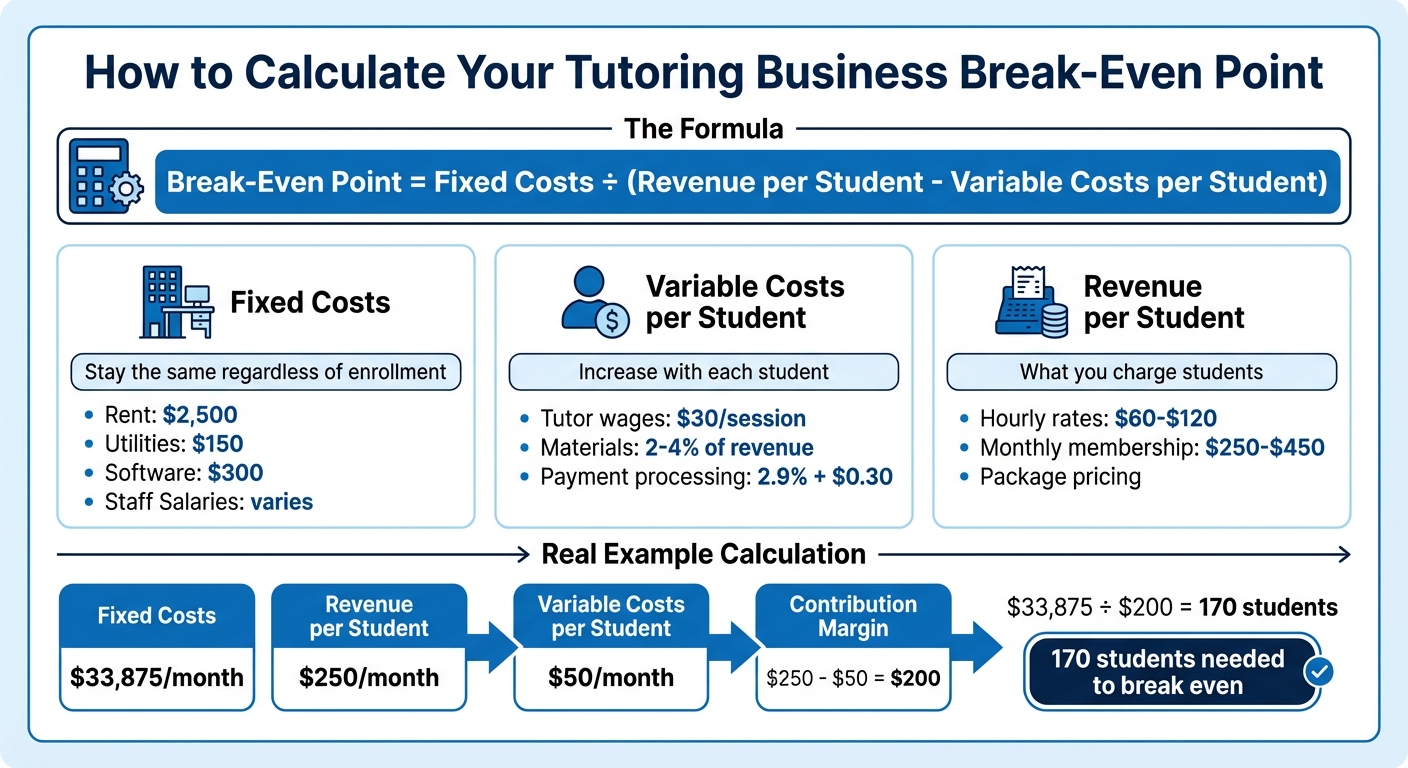
Fixed Costs ÷ (Revenue per Student – Variable Costs per Student).
- Fixed costs include monthly expenses that stay consistent, like rent, utilities, insurance, and base salaries.
- Revenue per student is what you charge - whether it’s a monthly membership fee or an hourly rate.
- Variable costs per student are expenses that grow with enrollment, such as tutor wages and materials.
The difference between revenue per student and variable costs per student is called the contribution margin. When the total contribution margin equals your fixed costs, you’ve hit the break-even point.
Example: Break-Even Calculation for a Tutoring Business
Let’s look at an example. Imagine a tutoring center with fixed costs of $33,875 per month, covering rent, utilities, staff salaries, and administrative expenses. You charge $250 per student per month, and your variable costs are $50 per student per month. Here’s how the math works:
$33,875 ÷ ($250 - $50) = $33,875 ÷ $200 ≈ 169.375
Since you can’t enroll a fraction of a student, you’ll round up to 170 students. At this point, your monthly revenue ($42,500) will cover both fixed costs ($33,875) and variable costs ($8,500). Any students beyond 170 will start generating profit.
This calculation gives you a clear enrollment goal and helps you assess whether your pricing structure supports sustainable growth. If reaching 170 students isn’t feasible due to your market or facility size, it may be time to rethink your pricing or find ways to cut costs. This kind of analysis is essential for making informed decisions about pricing and expense management. It’s a practical tool that helps educators align their financial goals with realistic strategies.
Using Tools to Simplify Break-Even Analysis
Crunching numbers manually for break-even analysis can feel like a chore, especially if you're juggling multiple pricing scenarios or tracking monthly updates. Thankfully, tools like spreadsheets can take the hassle out of the process. They can automate calculations and create visual charts that clearly show where your revenue meets your costs. For tutoring centers managing complex schedules and multiple tutors, specialized platforms can provide real-time data on things like occupancy and no-shows. This data can then be exported to a spreadsheet, where you can fine-tune your financial projections.
Setting Up Your Break-Even Analysis Template
When creating your spreadsheet, it’s helpful to organize it into three main sections: inputs (like pricing, variable costs, and fixed costs), calculations (such as contribution margin and total costs), and outputs (break-even units and revenue). Using Excel’s named ranges feature can make your formulas easier to follow. For instance, you could label cells as "Fixed_Costs" or "Price_Per_Student" to keep things clear and reduce mistakes. Adding data validation to input cells ensures only positive values or specific ranges are accepted, which helps maintain accuracy.
Want to test different scenarios? Excel’s Goal Seek tool (found under Data > What-If Analysis) is a lifesaver. For example, you can quickly see how increasing rates would affect the number of students needed to break even. Keeping your sales forecasts, fixed costs, and variable costs on separate tabs or sections also helps prevent accidental formula disruptions when you update your data.
Key Metrics to Monitor
Finding your break-even point is just one piece of the puzzle. Keeping an eye on key performance metrics can give you a clearer picture of your business’s health. For tutoring centers, student enrollment drives total revenue, while average revenue per student (ARPU) shows how much each student contributes toward covering fixed costs. If your break-even analysis reveals a gap between your current enrollment and what’s needed, it might be time to rethink your pricing or cut back on expenses.
Another critical metric is churn rate. A high churn rate means you’ll need to work harder to maintain enrollment. Similarly, tracking occupancy rates is crucial. Aiming for an occupancy rate above 75% is often a sign of strong profitability. Low occupancy, on the other hand, can lead to paying for tutor hours that aren’t generating revenue.
Using a simple dashboard - whether in Excel or through dedicated tutoring software - can help you stay on top of these metrics. Dashboards make it easier to spot potential issues early, giving you the chance to adjust your strategy before problems grow. With these tools and insights, you’ll be better prepared to manage costs and refine pricing as you move forward in the next section.
Adjusting Your Tutoring Business Based on Break-Even Results
Once you've calculated your break-even point, it's time to fine-tune your pricing and manage costs to push your business into profitability. For instance, if your analysis shows you need 200 students to break even but can realistically handle only 150, adjustments are necessary - whether that means revisiting your pricing, cutting expenses, or both.
Adjusting Your Pricing
Tweaking your pricing strategy can make a big difference in reaching profitability faster. As one industry expert puts it:
"You sell results and expertise, not just an hour of your time".
Instead of sticking to hourly billing, consider offering prepaid packages or monthly subscriptions. For example, a 10-session package or a $300/month membership can improve cash flow and reduce the hassle of invoicing after every session. You might also try peak pricing, charging higher rates for in-demand times like weekday afternoons (4–7 PM), while offering discounts for slower periods like midday or Saturdays. If you specialize in high-demand areas such as SAT/ACT prep or advanced STEM subjects, you could potentially charge 50–75% more, with rates often reaching $100–$150+ per hour.
Another effective approach is requiring a minimum monthly commitment - such as four or eight sessions - instead of offering pay-per-session options. This change can boost your average revenue per client by 15–25% while creating a steadier cash flow. When increasing prices, give existing clients 30–60 days' notice and consider "grandfathering" them at their current rate for a limited time to maintain loyalty. Additionally, implementing small annual price increases of 3–5% helps account for inflation and reflects your growing expertise.
If adjusting your pricing isn't enough to meet your goals, cutting costs can provide another path to improved profitability.
Reducing Costs to Improve Margins
Tightening up expenses while maintaining quality is a direct way to improve your margins. Start by increasing tutor utilization - raising it from 60% to 80% can significantly boost profits without needing to add new clients. To achieve this, schedule tutors in longer, consecutive blocks (three to four hours) instead of scattering one-hour sessions throughout the day.
Shifting some lessons to small group formats (three to five students) can also maximize revenue per teaching hour - sometimes increasing it by over 150% - while offering families a more affordable option. For physical space, explore ways to lower costs by negotiating lease terms with step-up rent or tenant improvement credits. Alternatively, adopting a hybrid model with some online sessions can help cut facility expenses.
Automation can also save time and money. Automating scheduling, billing, and reminders can reduce administrative work from over 20 hours a week to under eight, potentially saving $12,000–$18,000 annually. Additionally, regularly audit software licenses to ensure you're only paying for active student seats. Negotiating bulk rates for curriculum materials or switching to digital-only resources can further trim costs.
"Profitability isn't about working harder; it's about fixing leaks in utilization, admin costs, payments, and churn." – Amy Ashford, Tutoring Software Specialist
For more tips and tools to refine your business model, check out DashK12 (https://dashk12.com).
Conclusion
Break-even analysis is a critical tool for making smarter decisions about pricing, staffing, and growth strategies. By pinpointing the exact point where your revenue covers all costs, you can sidestep financial pitfalls and focus on building a strong, sustainable tutoring business.
Key metrics to keep in mind include maintaining tutor utilization between 75–85%, keeping payroll costs at 40–50% of revenue, and ensuring rent stays within 8–15% of income. Even small adjustments can have a big impact. For example, increasing tutor utilization from 60% to 80% can potentially double net profits without needing additional enrollments. Likewise, improving student retention by just 10% can significantly boost lifetime value and reduce the pressure on your marketing efforts.
Financial monitoring isn’t a one-time task - it’s an ongoing process. As costs and enrollment numbers fluctuate, update your break-even analysis weekly or monthly. Pay close attention to metrics like Revenue per Tutor-Hour and utilization rates to quickly identify and address inefficiencies. If you’re considering expanding to a second location, ensure your current center achieves at least a 20% net margin for two consecutive years before scaling.
In the U.S., the average tutoring business generates around $337,000 annually in gross revenue. Well-optimized operations can recover their initial investment in as little as eight months, proving that careful financial planning truly pays off.
For additional resources and tools to help grow your tutoring business, check out DashK12. With a disciplined approach to break-even analysis and smart financial strategies, you can transform your teaching skills into a thriving business venture.
FAQs
What should I include in variable costs per student?
Variable costs per student refer to expenses that fluctuate depending on the number of students or sessions. These typically include:
- Teaching materials: Items like handouts, workbooks, or digital resources.
- Session supplies: Materials such as stationery or manipulatives used during each session.
- Payment processing fees: Charges incurred for each transaction.
To get a clear picture of your variable costs, break them down on a per-student basis. This will help you manage your budget more effectively.
How do I convert hourly tutoring into a per-student break-even number?
To figure out your per-student break-even point, start by calculating your total hourly costs. This includes things like teacher wages, operational expenses, and any fixed costs. Once you have that number, divide it by your hourly rate per student.
Here’s an example: Let’s say your hourly costs come to $50, and you charge $25 per student. In this case, you’d need at least 2 students per hour to break even. This calculation helps ensure your pricing covers your expenses effectively.
How often should I update my break-even analysis?
You should revisit and update your break-even analysis on a regular basis - ideally every month or whenever there are notable changes in your costs or revenue. Keeping it current allows for more precise financial planning and helps you make informed decisions to steer your tutoring business in the right direction.