How to Align Event Branding with Business Goals
Aligning event branding with your business goals ensures every aspect of your event reinforces your company's objectives and delivers measurable outcomes. Here's how to do it:
- Set Clear Goals: Define specific, measurable objectives like increasing revenue by 15% or securing 10 new sponsors.
- Understand Your Audience: Segment attendees (e.g., prospects, customers, sponsors) and tailor branding to their needs.
- Create Consistent Branding: Use your brand's logo, colors, and messaging across all event materials to build trust and recognition.
- Focus on Purpose: Match your event's purpose (e.g., lead generation, customer retention) with your business priorities.
- Design Meaningful Experiences: Reflect brand values (e.g., inclusivity, sustainability) through event design and interactions.
- Measure ROI: Track KPIs like lead generation, sponsorship revenue, and attendee satisfaction to evaluate success.
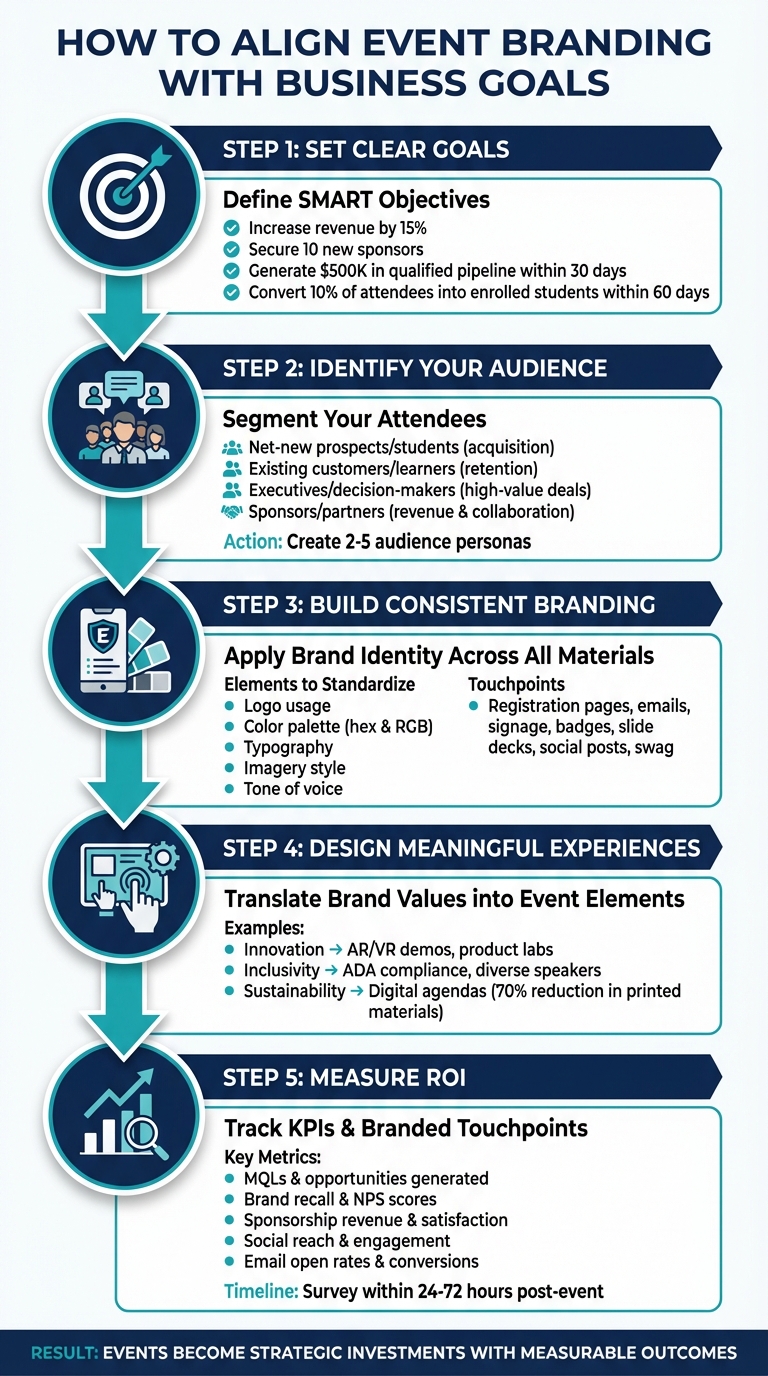
5-Step Framework for Aligning Event Branding with Business Goals
How to build an event-led growth strategy that drives results
Set Clear Business and Event Goals
Before diving into branding, take a step back and define what you want your event to achieve. Are you aiming to boost revenue by 15%, increase enrollments by 20%, or bring in 10 new sponsors? Pinpoint your business priorities first, then ask yourself: which of these goals can this event help you accomplish?
Set Measurable Business Objectives
Vague goals like "increase awareness" or "grow sponsorships" are a decent starting point, but they won’t help you measure success or guide your branding efforts. Instead, turn them into SMART objectives - specific, measurable, achievable, relevant, and time-bound. For instance, instead of saying "increase sponsorships", aim for something like: "Secure 8 sponsors at $5,000 each by May 1."
Similarly, if your focus is revenue, you might set a target like: "Generate $500,000 in qualified pipeline within 30 days of the event." For enrollment-focused goals, you could aim to "convert 10% of attendees into enrolled students within 60 days." Look at past event data or marketing benchmarks to set realistic numbers. If last year’s event brought in 200 registrations, aim for 250 this year. If your cost per lead averages $150, calculate how many leads your event needs to justify the budget.
DashK12 offers small business services that can help you achieve measurable results in just 90 days. Their tools make it easier to set percentage-based targets, like improving your business skillset by 20%, that align perfectly with your event goals. Whatever your objectives, document them clearly and get buy-in from key stakeholders before diving into the creative process.
Match Event Purpose with Business Goals
Every event has a unique purpose, and your branding should reflect that. A product launch or demo day is all about generating leads, driving sales, or encouraging product adoption. On the other hand, a community event - like a user meetup or a parent engagement night - focuses on retention and engagement, with goals such as achieving a Net Promoter Score of 60 or collecting 50 new opt-ins for ongoing communication. Educational events, such as workshops or professional development sessions, prioritize knowledge sharing and credibility, with targets like course enrollments, certification completions, or content downloads.
Define your event’s purpose in one sentence to guide your branding decisions. For example: "Generate qualified leads for our new product line", "Strengthen loyalty among top customers", or "Increase enrollment in our fall programs." Use this purpose as a filter for every creative choice. If your event is focused on enrollment growth, your branding should emphasize trust, clarity, and outcomes. If sponsorship revenue is the goal, your visuals and messaging must convey professionalism, audience quality, and reach. When your event’s branding aligns with your company’s goals, both attendees and sponsors will walk away with a clear understanding of your brand’s mission.
Identify Your Target Audience
Even the best business goals won’t hit the mark if your branding doesn’t connect with the right people - or tries to appeal to everyone at once. Start by segmenting your audience based on their relationship to your brand and the outcomes you want to achieve. Common segments include:
- Net-new prospects or students: Focus on acquisition or enrollment.
- Existing customers or learners: Target retention, upselling, or advocacy.
- Executives or decision-makers: Aim for high-value deals or strategic partnerships.
- Sponsors or partners: Drive revenue and build long-term collaborations.
For education and CTE events, you might also include educators, parents, and counselors. Each group has unique needs and goals. For instance, a high school counselor might look for reliable, classroom-ready resources, while a sponsor might prioritize visibility and lead generation.
Use tools like your CRM and past event data to create 2–5 audience personas. Then customize your branding for each group while keeping a consistent core message. For prospects, focus on outcomes with messaging like: "Land your first job-ready credential before graduation", paired with inspiring visuals. For parents and educators, build trust with statements like: "Proven CTE pathways that boost graduation and placement rates", supported by testimonials and data. For sponsors, emphasize ROI and reach with messages like: "Engage 500+ local families and educators in one evening", along with a clear breakdown of sponsorship benefits.
With well-defined objectives and a clear understanding of your audience, you’ll be ready to shape your branding strategy to meet your event’s goals.
Build Branding Strategies that Support Business Goals
Once you've nailed down your goals and audience, it's time to fine-tune your branding elements so they actively align with your business objectives. The key is to turn those goals and audience insights into branding that not only resonates but also drives tangible results.
Apply Brand Identity to Event Materials
Start with your corporate brand guidelines - these are your non-negotiables. They define your logo, color palette, typography, imagery style, and tone of voice, and they’re the foundation of your brand’s recognition and trust. From there, develop an event sub-brand that complements your main brand. This could include a unique event logo, a catchy tagline, and one or two accent colors that blend seamlessly with your existing palette.
Next, create a cohesive design system for the event. This means developing templates for everything: registration pages, email campaigns, venue signage, name badges, slide decks, social posts, and even swag. Consistency is key - if your website uses bold navy sans-serif headlines, carry that same style across all event materials.
To keep everything on-brand, establish a single approval process for reviewing all assets before they go live. Store your approved logos, color codes (in hex and RGB), fonts, and templates in a shared drive or digital asset management system. This ensures everyone on your team is working from the same playbook. Whether it’s your website, livestream overlays, or post-event recordings, consistent branding builds trust and recognition among attendees.
Write a Core Event Message
Every event needs a clear, concise promise that ties back to your business objectives and speaks directly to your audience’s needs. Start with a one-sentence positioning statement that outlines who the event is for, what problem it addresses, and the outcome it delivers. For instance: "A one-day summit for K–12 CTE leaders who want to align classroom experiences with workforce realities and improve student career outcomes."
From this positioning statement, craft a tagline that stays consistent across all channels. If your goal is pipeline growth, your tagline might be: "Turn your events into a measurable growth engine." If you’re focused on enrollment, you could say: "Land your first job-ready credential before graduation." Use language that reflects how your audience speaks. For example, C-suite leaders might connect with terms like "ROI" or "strategic growth", while educators and small-business owners might prefer phrases like "practical tools" or "ready-to-use resources."
Build 3–5 supporting message pillars around your core promise. These could include themes like innovation, customer success, measurable ROI, or community. Back up each pillar with proof points - such as past event data ("Attendees increased product adoption by 18%"), customer case studies, or partner logos. Then, map your breakout sessions, workshops, and demos to these pillars. This ensures all content reinforces the same narrative, making it easier for attendees to see the value and take action - whether that’s registering, engaging, or following up after the event.
Design Experiences that Show Brand Values
Your branding isn’t just about visuals - it’s also about what attendees experience and feel. Identify 2–3 core brand values, like innovation, inclusivity, or sustainability, and translate them into tangible event elements.
For innovation, consider creating interactive spaces like product labs, AR/VR demos, or live data dashboards where attendees can test prototypes. For inclusivity, make sure your event is ADA-compliant with clear wayfinding, quiet rooms, captioned sessions, and a diverse speaker lineup. For sustainability, opt for digital agendas instead of printed programs, use reusable signage, source materials locally, and share metrics like "We reduced printed materials by 70% this year."
Tailor these branded experiences to support your business goals. If you’re aiming for lead generation or product adoption, set up "Solution Zones" with demo stations, pre-scheduled consults, QR codes for capturing contact details, and hands-on "How-To Labs" where attendees can complete tasks with guided support. For brand authority, focus on mainstage storytelling with high-profile speakers and research-backed keynotes that align with your visual identity. To encourage community building, create themed networking areas like a "Builder Bar" or "Educator Exchange", complete with conversation prompts that reflect your mission and tone.
sbb-itb-4f1eab7
Measure Event Branding ROI
To show that your brand experience delivered results, tie your branded touchpoints to key business outcomes like revenue, pipeline growth, brand awareness, and sponsor satisfaction.
Set Key Performance Indicators (KPIs)
Begin by turning your business goals into clear, measurable KPIs. For example, if revenue growth is the goal, track metrics like MQLs, opportunities, and revenue influenced by the event (measured in U.S. dollars). If market expansion is your focus, monitor new accounts from target industries, attendance in priority regions, and new partner or sponsor sign-ups. For brand awareness, use metrics such as unaided brand recall, brand favorability, net promoter score (NPS), social reach, and media mentions.
For events driven by sponsorships, keep an eye on sponsorship revenue, the quality and quantity of sponsor leads, sponsor satisfaction scores, and renewal rates. Before the event kicks off, ensure all teams - events, marketing, sales, and customer success - agree on the definitions and reporting methods for each KPI. Document these in a shared plan or checklist to keep everyone aligned on the measures of success.
Track Branded Touchpoints
Your brand interacts with your audience at multiple points throughout the event lifecycle, and each one is a chance to make an impression. During the pre-event phase, track metrics like email performance (open rates, click-through rates, and registrations), event website analytics (unique visitors, time on page, and registration conversions), and social engagement.
While the event is live, measure session attendance, time spent at keynotes, engagement with branded activations (like photo booths or AR demos), and app usage. Collect live social data, including hashtag activity, user-generated content, sentiment analysis, and livestream stats like peak concurrent viewers and average watch time.
Post-event, focus on metrics like on-demand content views, website traffic, and follow-up campaign results (email replies, meeting acceptances, and funnel progression). By integrating your event platform with your CRM and marketing automation tools, you can consolidate this data into one reporting system. After gathering these insights, review post-event feedback to confirm how effectively your branding resonated.
Review Post-Event Results
Once the event wraps up, revisit your original KPIs and goals while analyzing attendee feedback to see how well they align with your business objectives. Within 24 to 72 hours, send out attendee surveys to evaluate their perception of your brand before and after the event. Use these surveys to check how well the messaging and visuals matched your overall branding and to gauge their likelihood of recommending or purchasing from your brand. Break down the feedback by audience type - prospects, customers, partners, and sponsors - to pinpoint where your branding had the greatest effect.
Compare the event's actual performance against your KPIs: Did you hit your targets for pipeline growth, revenue, brand lift, and sponsor goals? Identify which branded components - like keynotes, activations, content themes, or design elements - drove the most engagement and positive feedback.
Use CRM reporting to link event participation to revenue and conduct an internal review with stakeholders to assess what worked, what fell flat, and what experiments to tweak. Creating a simple event branding scorecard that combines quantitative metrics (e.g., brand recall, NPS, social reach) with qualitative feedback can help you benchmark results across events and refine your strategy over time.
If you're collaborating with a partner like DashK12 - which provides marketing services, slide decks, and photography - you can standardize your branded assets and messaging. This consistency makes it easier to measure engagement shifts and attribute them to improved branding efforts.
Tools for Event Branding Alignment
Use an Event Branding Checklist
A well-thought-out checklist can keep your event branding aligned with your business goals from start to finish. Begin by focusing on strategy - confirm your objectives (e.g., generating 150 qualified leads or boosting partner district applications by 20%), identify your target audience, and define clear success metrics before diving into design. Then, address your brand's foundation. Ensure the event name, tagline, and core message reflect your organization’s mission and ongoing campaigns. Use a messaging guide to outline tone, key talking points, and other essential elements.
Next, tackle visual identity. Document your color palette, logo usage rules, and accessibility requirements, including contrast ratios and font sizes. Decide whether the event falls under a sub-brand or your master brand. For tracking and follow-up, include items like campaign tagging, UTM parameters, lead capture workflows, and branded post-event communications to tie ROI directly to your goals.
Assign an event marketing lead to oversee and update the checklist, and have team leads (design, content, registration, social, sales, or academic program managers) sign off on their sections to ensure accountability. Schedule checkpoint reviews at critical milestones - concept lock, creative lock, two weeks before the event, and 24–48 hours before launch. These reviews help catch any off-brand visuals or conflicting messages before they reach your audience.
A detailed checklist ensures everyone stays on the same page and makes collaboration smoother across teams.
Coordinate Across Teams
Achieving strong alignment requires clear roles and consistent communication. Define responsibilities early: marketing should oversee brand standards and messaging, administration should handle approvals and budgets, and educators can focus on creating targeted content. Summarize your goals, audience, key messages, and visual guidelines in a concise event branding brief, and share it with internal teams and vendors before content development begins.
Hold regular cross-functional meetings - weekly 30-minute check-ins work well - to address branding decisions, ensure message consistency, gather audience feedback, and manage any last-minute changes. Use shared dashboards and calendars to keep everyone aligned on KPIs, deadlines, and timelines. Set up an approval process where all public-facing materials (emails, decks, signage, one-pagers) go through a central brand owner or committee to maintain consistency. For the final week and event day, assign a brand decision-maker to handle urgent questions or last-minute adjustments in real time.
This structured coordination helps maintain a unified brand experience throughout the event.
Use DashK12 Resources
If you’re looking for tools to simplify event branding, DashK12 offers tailored resources for educational organizations like school districts, CTE programs, and colleges. Their consulting services can help refine your event goals - whether it’s boosting CTE program enrollment, enhancing district–industry partnerships, or increasing family engagement - and translate those goals into actionable messaging and branding strategies. Their marketing services ensure cohesive campaigns across email, social media, landing pages, and print, driving audiences toward enrollment, appointments, or partnership inquiries.
DashK12 also provides pre-designed slide decks for educators, offering templates that align with your institution’s branding. These decks feature consistent visual elements - like color schemes, typography, and layouts - and include standardized talking points to help presenters stay on message. For organizations without in-house design capabilities, DashK12 delivers exclusive photography and polished visuals that reflect your institution’s identity, community values, and recruitment goals.
Conclusion
When you align event branding with your business goals, events shift from being just gatherings to becoming strategic investments with measurable outcomes. Start by identifying clear business objectives - like hitting specific targets - and ensure every branding element reflects those goals. From registration pages to follow-up emails, maintaining consistent visuals, messaging, and experiences builds recognition and trust. This consistency makes it easier for attendees to remember your brand and respond to your calls to action.
Select KPIs that directly tie into your objectives, whether that's marketing-driven revenue, qualified leads, Net Promoter Score, or social media engagement. Monitor branded touchpoints during the event to identify which messages and experiences resonate most. Use these insights to fine-tune your strategy for future events. This process not only improves your approach but also strengthens collaboration within your team. Over time, each event becomes a stepping stone for greater value and success.
As discussed earlier, unified teamwork is key to delivering a cohesive brand message. When marketing, sales, and event teams use shared tools like dashboards and checklists, they stay aligned with core business priorities. Resources like event branding checklists, collaboration platforms, and specialized support - such as DashK12's consulting services and branded materials - can help maintain consistency without increasing workload. This collaborative effort ensures every team member contributes to a seamless and impactful event.
To maximize impact, focus on a single, clear message and a simple visual system. Prioritize high-visibility touchpoints, like your event website, main stage, and follow-up communications. Using the frameworks discussed, start planning your next event by defining your top three business goals, choosing the KPIs to measure them, and crafting a one-sentence core message that ties everything together. This clarity will guide your decisions and amplify your event's impact, boosting both short-term ROI and long-term brand value.
FAQs
How can I make sure my event branding supports my business goals?
To ensure your event branding works hand-in-hand with your business goals, begin by setting clear objectives that tie directly to your overall strategy. Your messaging, visuals, and tone should consistently reflect your brand identity while connecting with your target audience.
Keep an eye on essential metrics such as engagement levels, brand awareness, and ROI to gauge how well your efforts are performing. If needed, tweak your approach to stay on course, making sure your branding continues to align with your objectives and deliver measurable results. These steps can help your events make a real impact on your business.
How can I measure the ROI of event branding effectively?
To get a clear picture of how successful your event branding is, you need to focus on metrics that tie directly to your business goals. Start by looking at attendee engagement - this could mean tracking how many people participated in sessions or activities. Keep an eye on social media mentions too, as they can give you a sense of the buzz your event is generating online.
Don’t stop there. Dive into website traffic spikes during the event, count the leads generated, and pay close attention to feedback from post-event surveys. These can reveal how your audience's perception of your brand may have shifted.
By connecting these data points to your bigger-picture goals, you’ll get a better grasp of how your event branding is performing and where you might want to make adjustments.
How can I adapt event branding to connect with different audience groups?
When shaping event branding for various audience groups, it's crucial to fine-tune your messaging, visuals, and themes to resonate with their specific preferences and expectations. Start by segmenting your audience and leveraging targeted marketing channels to communicate effectively with each group. Adding elements that reflect relevant regional, industry-specific, or cultural details can make your branding feel more relatable and personal.
By aligning your branding with what your audience values and cares about, you can create a stronger connection. This approach not only boosts engagement but also reinforces brand recognition and drives better ROI.