Adapting CTE for AI and Automation Careers
The future of work is changing fast, and Career and Technical Education (CTE) programs must evolve to prepare students for jobs shaped by AI and automation. Here’s the challenge:
- 80% of U.S. workers will see at least 10% of their tasks impacted by automation, with 19% facing changes to half or more of their responsibilities.
- Many CTE programs are outdated, with 27% of educators reporting no formal policies on using generative AI tools.
- Technical skills now become obsolete in less than five years, while 58% of in-demand skills are nontechnical, like critical thinking and problem-solving.
CTE programs need updates to teach students how to work with AI effectively - not just use it as a tool. Fields like agriculture, HVAC, and welding are already integrating AI-powered technologies, from drones to predictive analytics. But outdated materials, unprepared instructors, and inconsistent policies are holding back progress.
Solutions include integrating AI into existing courses, offering teacher training, and building industry partnerships for hands-on learning. Schools like Bentonville Public Schools and Mounds View are leading the way by embedding AI into career pathways and professional development programs. By focusing on both technical and nontechnical skills, students can graduate ready for an AI-driven workforce.
The takeaway? Schools must act now to align CTE programs with workforce needs, ensuring students gain the skills to thrive in industries reshaped by automation.
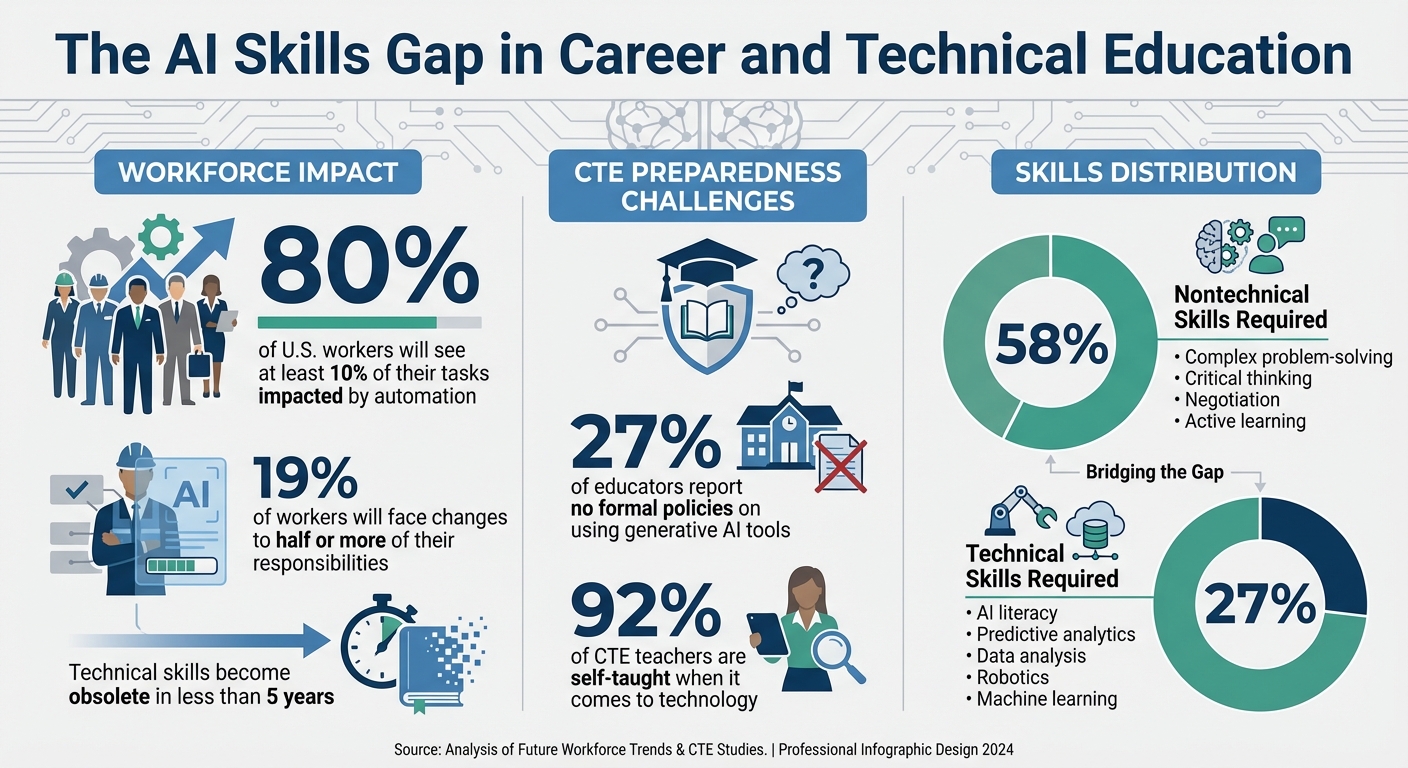
AI Impact on Workforce and CTE Skills Gap Statistics
The Skills Gap in AI and Automation Careers
Required Skills for AI and Automation Careers
Careers in AI and automation require a unique blend of abilities: 27% technical skills and 58% nontechnical skills, such as critical thinking, complex problem-solving, negotiation, and active learning.
On the technical side, hands-on experience is key. For instance, students must develop proficiency in AI literacy, predictive analytics, and data analysis. In agriculture, this could mean working with AI-powered sensors and drones. In HVAC systems, it involves applying predictive analytics to monitor energy efficiency and prevent equipment breakdowns.
How Current CTE Programs Miss the Mark
Despite the clear need for both technical and nontechnical skills, many Career and Technical Education (CTE) programs fail to adequately prepare students for the realities of an AI-driven workforce. These programs often emphasize outdated technical training while neglecting the critical thinking and adaptability essential for modern roles. With around 80% of U.S. workers expected to see at least 10% of their tasks influenced by large language models, the lack of comprehensive AI training in CTE programs is a glaring issue.
This gap in nontechnical skill development further exacerbates the problem. Graduates frequently leave these programs unprepared for roles that demand a mix of analytical and interpersonal expertise.
Another challenge lies in the way AI is taught - when it is included at all. Many programs fall into what some call the "Googlification" approach, treating AI as nothing more than an advanced search tool. This approach fails to teach students how to critically evaluate AI outputs or understand the algorithms behind them. Without these skills, students are ill-equipped for careers where AI is deeply embedded in day-to-day tasks, from manufacturing floors to hospital systems and agricultural operations.
The table below highlights the distribution of skills required for AI and automation careers:
| Skill Category | Share of Demand | Key Examples |
|---|---|---|
| Nontechnical Skills | 58% | Complex problem-solving, critical thinking, negotiation, active learning |
| Technical Skills | 27% | AI literacy, predictive analytics, data analysis, robotics, machine learning |
sbb-itb-4f1eab7
Solutions for Updating CTE for AI and Automation
Adding AI to CTE Pathways
Preparing students for careers shaped by AI means integrating AI into existing programs, not treating it as an isolated subject. Michael Connet, Associate Deputy Executive Director at the Association for Career and Technical Education, highlights the importance of this approach:
"In a very overt way, don't just make it a side part of the conversation... Make sure it's woven throughout".
Bentonville Public Schools took this to heart when they launched their "Ignite" program in November 2025. This initiative brings AI literacy to all 10 high school career pathways, ranging from health sciences to digital media. Specifically designed for juniors and seniors, the program equips them with the tools needed to apply AI directly in their future workplaces.
The way AI is applied varies by field. In agriculture, students use drones with AI-driven sensors to monitor soil and optimize crop yields. HVAC programs incorporate predictive analytics for energy efficiency monitoring. Even culinary arts students explore AI for food and nutrition analysis based on available ingredients. The goal is clear: help students see AI as a practical tool within their chosen career, not just as a general concept.
For this integration to succeed, educators need the right support, particularly through focused professional development.
Training Teachers Through Professional Development
Teachers play a crucial role in making AI education effective, but many are learning on the fly - 92% of CTE teachers are self-taught when it comes to technology. Professional development needs to go beyond surface-level AI applications like search tools. Instead, it should focus on advanced concepts such as predictive analytics, specialized simulations, and ethical considerations.
Mounds View Public Schools in Minnesota set an example in November 2025. Business educator Diane Waite teamed up with a General Mills executive to create an "Introduction to AI" series. This program, embedded across her classes, teaches students about ethical AI use, advanced prompt engineering (like tone adjustment and data narrowing), and the limits of AI training data. J.J. Ayers, Ed.D., CTE Coordinator at Little Elm Independent School District, underscores the need for such support:
"CTE teachers are experts in their fields, but they often need coaching related to classroom management, student engagement, pedagogy, and curriculum development. This is where AI comes in".
Effective training should include hands-on experience with tools teachers will actually use in their classrooms. The NEA AI Education Hub offers valuable resources like webinars, micro-credentials, and courses that cover everything from AI basics to equity and ethics. Given that technical skills often become outdated within five years, professional development must be continuous. Schools should aim to refresh introductory CTE course content every one to two years to stay current.
Partnering with industry can further enhance teacher training, ensuring it remains aligned with the latest workforce demands.
Creating Industry Partnerships for Hands-On Learning
Industry advisory boards are key to keeping CTE programs relevant. These boards, made up of professionals and community members, help identify in-demand AI skills and collaborate on creating instructional content. Alumni networks can also play a role, especially when former students who’ve climbed the career ladder share their expertise.
Lowndes County Schools in Georgia offers a great example of how partnerships can work. In November 2025, work-based learning coordinator Jason Van Nus used SchoolAI to run mock interviews tailored to specific fields like welding and engineering. Automating this process freed up time for him to recruit more industry partners for job fairs.
These collaborations are particularly valuable for rural districts. AI and remote learning platforms now allow schools in places like Idaho to develop specialized CTE programs that address national workforce needs, rather than being confined to local opportunities. By working closely with industry, schools can ensure students graduate with practical skills that employers are actively seeking, rather than just theoretical knowledge.
Steps for Updating Your Curriculum
Reviewing Courses for AI Integration Opportunities
Start by auditing your existing courses to pinpoint areas where AI can be introduced in ways that align with industry needs. Instead of creating entirely new classes, focus on integrating AI into tasks that students are likely to encounter in the workplace. This keeps the curriculum practical and relevant.
Look for specific integration opportunities in each course. For instance, in health sciences, you might highlight how diagnostic AI tools or patient data analysis are already being used in hospitals. In agriculture programs, explore how precision farming technologies or crop monitoring systems can be incorporated. The National Education Association underscores this priority:
"At the heart of all our recommendations is the principle that humans must always be the center of the teaching and learning experience and play a significant role in every consequential education and employment decision".
Involve a diverse group of students, caregivers, and educators in this process to ensure fairness and accessibility for all. Also, keep in mind the environmental impact of AI. A single generative AI query uses energy at 4 to 5 times the level of a typical search engine request. With these considerations in mind, you can introduce AI lessons that enhance the curriculum without disrupting its core structure.
Adding AI Modules and Lessons
Once you've identified where AI fits, start by introducing modular lessons. This allows you to experiment with what works and refine your approach without overwhelming students or overhauling entire programs.
A recent example showed how AI concepts were seamlessly integrated into traditional agricultural Career and Technical Education (CTE) tracks without replacing essential content.
Use project-based learning to make these lessons hands-on and relevant. For example, students could apply AI tools to solve real-world problems in their fields of study. The National Center on Education and the Economy puts it like this:
"The question is no longer 'Should we give students access to AI?', but rather, 'How should students work with AI?'".
Set clear learning objectives for each module. The goal should be to develop "AI fluency", empowering students to decide how and when to use AI tools effectively. This goes beyond basic literacy, encouraging students to engage with AI critically and creatively.
Measuring Success Through Simulations
Swap out traditional tests for practical projects that require students to apply AI in meaningful ways. These assessments, such as presentations or work-based projects, provide a better sense of whether students can use AI effectively in their prospective careers.
For example, in November 2025, the Bentonville School District in Arkansas evaluated students in its Ignite program through hands-on projects across 10 career pathways. Led by educators like Wendy Broughton in health sciences, the program assessed skills through real-world learning experiences in areas ranging from digital media to technology.
Teach students to verify AI outputs rigorously. This is a critical skill in any AI-driven role. Students should learn to identify inaccuracies in AI-generated results and apply sound judgment to correct them. This "human-in-the-loop" approach ensures they remain active problem-solvers, not just passive users of technology.
Track progress using short-term (18–20 months) and long-term strategic frameworks. Regularly evaluate whether the AI skills being taught align with what businesses expect from entry-level employees. As technology evolves, adjust the curriculum to meet these changing demands. This ongoing feedback loop strengthens industry partnerships and keeps your programs relevant.
Conclusion
Key Takeaways
AI has become a critical component in career and technical education (CTE), touching every field - from welding to healthcare to agriculture. To stay ahead, focus on three main priorities: integrate AI into all CTE programs, offer ongoing AI training for educators, and collaborate with industry advisory boards to ensure your curriculum reflects workplace realities and ethical practices.
As automation reshapes industries, human-centric skills are gaining importance. Abilities like communication, teamwork, and solving complex problems - skills that are challenging to automate - account for nearly 58% of those needed in jobs impacted by AI. Updating your curriculum should emphasize these strengths while teaching students to critically evaluate AI outputs, fostering a "trust but verify" mindset.
Next Steps for Educators and Administrators
Educators and administrators can take immediate steps to modernize their curricula. Start small: audit one course this month to identify opportunities to naturally integrate AI tools. Update a single lesson by including an industry-specific scenario or problem-solving activity that incorporates AI. Use input from your industry advisory boards to pinpoint local workforce trends influenced by AI, and adapt your curriculum accordingly.
For administrators, providing accessible resources is key. Offer ready-to-use curricula with clear video tutorials and step-by-step instructions. Platforms like DashK12 (https://dashk12.com) can support this transition by offering tools for both teachers and students, making AI integration more manageable. With projections showing that roughly 80% of the U.S. workforce could see at least 10% of their tasks influenced by large language models, the time to act is now. Equip your students with the AI skills they’ll need to thrive in tomorrow’s job market.
Industry 4.0, AI and the Future of K-12 Technical Education - Mike Beighley, Superintendent of Wh...
FAQs
How can CTE programs prepare students for careers in AI and automation?
To help students gear up for careers in AI and automation, Career and Technical Education (CTE) programs should weave AI skills and concepts into their current courses. This could mean teaching students how to work with AI tools, grasp automation workflows, and interpret data - abilities that are becoming essential in many industries.
Programs can take it a step further by integrating real-world applications, like using AI for predictive maintenance, managing smart technologies, or streamlining project management tasks. Collaborating with industry experts ensures that the curriculum mirrors the skills most sought after in today’s workforce, particularly in automation and data analysis. On top of that, AI-powered tools can make learning more dynamic by offering personalized lessons, simulating workplace environments, and delivering customized feedback.
By blending up-to-date course material, hands-on learning opportunities, and partnerships with industry leaders, CTE programs can prepare students to thrive in a rapidly changing job market.
What are the key nontechnical skills needed for careers in AI and automation?
Nontechnical skills are essential for thriving in AI and automation careers. Abilities like critical thinking, problem-solving, communication, and social perceptiveness stand out as highly sought-after. These skills enable individuals to navigate technological advancements, work seamlessly with AI systems, and address challenges that technical expertise alone might not resolve.
Equally important are active learning and interpersonal abilities such as negotiation. In a job market that evolves rapidly, these skills help professionals remain adaptable. Since technical knowledge can quickly become outdated, a commitment to continuous learning ensures individuals can grow alongside advancing technologies. Prioritizing these skills in education and training equips workers to excel and drive innovation in AI-powered workplaces.
Why is ongoing teacher training important for preparing students for AI and automation careers?
Ongoing professional development for teachers is crucial in helping them equip students for careers in AI and automation. As technology continues to advance at lightning speed, educators must keep up with the latest tools, trends, and industry needs to seamlessly incorporate AI into Career and Technical Education (CTE) programs.
This training also enables teachers to tackle the ethical and practical challenges of AI, fostering critical thinking and promoting a deeper understanding of responsible AI use among students. By staying informed, educators can ensure that CTE programs stay aligned with industry demands, preparing students with the skills they’ll need to thrive in tomorrow’s AI-driven job market.